


Distributors face growing challenges in meeting custom order demands, from managing complex supplier relationships to handling intricate pricing and tight deadlines. Manual processes often fall short, leading to delays, inefficiencies, and missed opportunities. Here’s how automation solves these issues:
- Faster RFQ Processes: Automation reduces RFQ cycle times by 30–50%, helping you respond to requests faster than competitors.
- Eliminates Manual Tasks: Automated systems handle data entry, follow-ups, and supplier communication, freeing up your team for higher-value work.
- Centralized Data for Better Decisions: By consolidating supplier and order data, automation minimizes errors and ensures visibility into risks like lead times and single-source dependencies.
- Integrated Systems: Automation connects CRM, ERP, and sourcing tools, streamlining workflows and cutting procurement cycle times by up to 30%.
- Advanced Tools Like QSTRAT: Platforms like QSTRAT simplify supplier management, quoting, and approval workflows, saving time and improving accuracy.
Automation isn’t just about speed – it transforms sourcing into a more efficient, data-driven process. By implementing systems like QSTRAT, distributors can handle complex demands, improve supplier collaboration, and drive better business outcomes.
Finding Sourcing Bottlenecks and Scalability Problems
Scaling your sourcing operations requires identifying and addressing the bottlenecks that slow down efficiency and growth. Often, distributors run into familiar hurdles: supplier management spirals into disarray, quoting processes drag on, and crucial data remains scattered across various systems. These challenges leave you with a tough choice – either hire more staff or risk losing valuable business opportunities.
Manual Supplier Management Bottlenecks
When supplier data is spread across emails, spreadsheets, and outdated systems, teams end up wasting over 20% of their time on manual processes. This scattered approach can lead to poor decisions, like defaulting to underperforming vendors simply because their information is easier to access. Another major issue arises when experienced staff retire, taking their unwritten knowledge with them. Training new hires on outdated systems becomes a lengthy process, making it harder to scale operations effectively. With 76% of supply chain leaders citing workforce shortages, relying on institutional knowledge alone is a risky strategy.
Quoting and Workflow Delays
Delays in Request for Quote (RFQ) processes are another common bottleneck. Manually handling contractor documents and creating quotes can take hours – or even days – causing backlogs to pile up as new orders keep coming in. Comparing spreadsheets eats up time and complicates Bill of Materials (BOM) version control. On top of that, multi-step approval workflows, often tied to complex spending rules like conditional thresholds, can further drag out decision-making.
Missing Data for Better Decisions
Incomplete BOMs, such as missing part numbers or package details, lead to repeated back-and-forth clarifications with suppliers. Without centralized data, risks like single-source dependencies, long lead times, or end-of-life alerts often go unnoticed until production grinds to a halt.
"When risk is hidden, you start approvals too late. That is how a sourcing delay becomes a production stop." – CalcuQuote
Additionally, many distributors focus solely on securing the lowest unit price because calculating total landed costs – factoring in freight, duties, MOQ impact, and expedite fees – becomes too complicated without a centralized system. This lack of visibility can result in missed opportunities for better negotiations and smarter decision-making. Pinpointing these bottlenecks is the first step toward automating and optimizing your sourcing processes.
sbb-itb-827f251
Using Automation to Improve Sourcing Processes
Once you’ve identified where sourcing inefficiencies lie, automation steps in as the key to resolving those pain points. Modern cloud platforms simplify supplier selection and quote generation by combining them into one seamless system, capable of handling thousands of RFQs daily. With these tools, your team can shift from constantly putting out fires to making strategic decisions that drive profitability. This streamlined approach sets the stage for smoother quoting and approval workflows.
Automating Supplier Sourcing and Segmentation
Automation takes the guesswork out of supplier management by organizing and systematizing supplier data, replacing tedious manual searches. Instead of combing through emails or spreadsheets to find the right vendor, automated systems match suppliers to specific part categories or provide prevalidated supplier lists for RFQs. Over time, this data-driven segmentation creates a robust database of sourcing events, enabling you to evaluate supplier performance and focus on high-value partnerships worth cultivating.
Even onboarding becomes a breeze. Automated platforms collect and verify supplier data upfront, ensuring everything is in order before integrating with ERP systems, which eliminates delays. A great example of this is Samsung, which in 2024 reported cutting 85% of their time spent on sourcing by moving from manual spreadsheets to an automated system. Their new platform not only simplified intricate processes but also acted as a "second pair of eyes", uncovering opportunities in strategic sourcing events.
Once supplier sourcing is running smoothly, the next challenge is speeding up quoting and approvals.
Faster Quoting and Approval Workflows
Automation transforms the RFQ process by removing manual steps, significantly shortening cycle times. It factors in complex cost variables – like customs and logistics – directly into quotes, eliminating the need for spreadsheet acrobatics.
Built-in approval workflows handle everything from RFQ creation to final customer transmission. You can set up custom pricing logic based on factors like customer type, product category, or sales velocity, and the system automatically routes quotes through the appropriate approval channels. This eliminates delays caused by conditional spending thresholds or multi-step approvals. Once the deal is finalized, automation seamlessly transfers quote data to your execution system, removing the need for manual order entry and reducing the risk of errors.
Connecting Automation Tools with CRM, ERP, and Sourcing Systems
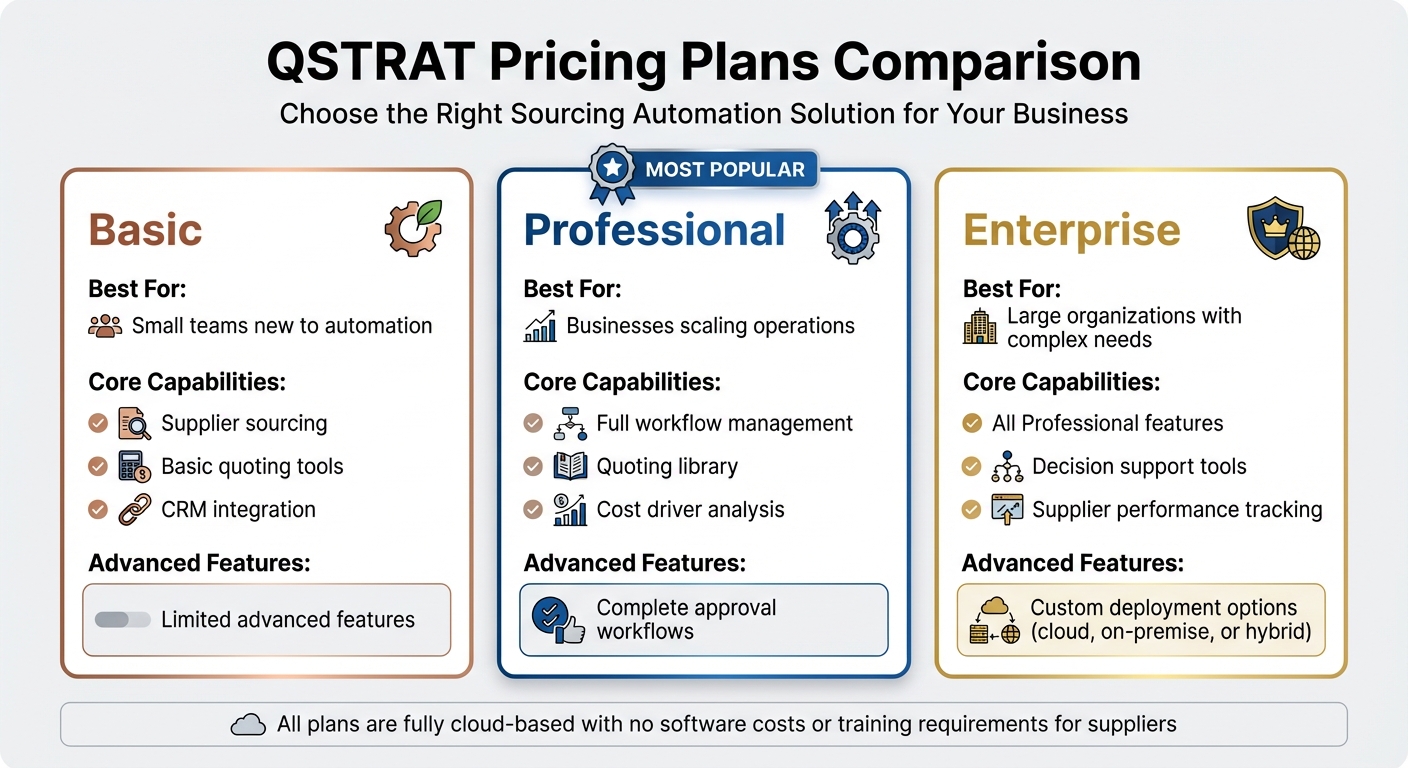
QSTRAT Pricing Plans Comparison for Distribution Automation
Once you’ve streamlined internal processes, the next step is integrating your systems for a smoother, faster workflow. Automation truly shines when it connects your CRM, ERP, and sourcing systems. Why? Because it creates a unified process where customer requests from your CRM seamlessly flow into sourcing systems, and finalized business data automatically updates in your ERP. This eliminates redundant data entry, reduces errors, and gives teams a clear, shared view of spending activity across departments.
The stats are convincing. Around 56% of the source-to-pay process can be automated, and companies that integrate their systems can cut procurement cycle times by up to 30%. For businesses spending $2 billion annually, sourcing automation could add as much as $70 million in savings. It’s no wonder that 53% of supply chain leaders see digital transformation as a critical advantage.
Using QSTRAT for Scalable Sourcing Solutions
QSTRAT is a cloud-based platform designed to connect the dots between separate systems, bringing CRM, ERP, costing, and sourcing into one cohesive solution. Tailored for manufacturers and distributors in key industries, QSTRAT simplifies the challenge of integrating existing infrastructure.
The platform’s architecture allows for smooth ERP and MRP integration. For example, customer requests can flow directly from your CRM to initiate quotes, and once deals are awarded, QSTRAT transfers the order data to your execution system. It also ensures new supplier data – like ESG compliance and onboarding details – is validated before being synced with your ERP, maintaining data accuracy from the start.
QSTRAT’s global presence is impressive, processing thousands of RFQs daily and managing over $5 billion in RFQs across 22 countries. By automating requisitions, notifications, and vendor communication, the platform speeds up RFQ cycles by 30–50%, all while eliminating the need for suppliers to manage separate logins.
These capabilities enable real-time tracking and give teams continuous visibility into their sourcing operations.
Key Features for Better Performance
QSTRAT tackles common sourcing roadblocks with a range of features. Its centralized quoting library stores customer, product, and vendor data in one place. This makes it easy to locate and reuse RFQs from previous events. Automated workflows further streamline the process by routing quotes based on custom pricing rules. For added accountability, the platform includes built-in audit trails that meet SOX compliance standards.
Another standout feature is QSTRAT’s two-way communication system. Vendors can respond to automated emails with validated submissions, removing the hassle of logging into a portal. Decision support tools provide real-time access to supplier responses, enabling quick comparisons and awarding decisions. The ability to integrate PDFs ensures supplier responses are unified and automatically updated in the system.
Companies like Carl Zeiss use QSTRAT to gather over 50 data points from suppliers during New Product Development and Engineering Change processes. This data feeds into follow-up activities like trial runs and full production. BAE Systems, on the other hand, uses QSTRAT to compare costs across suppliers, including labor, raw materials, and transportation. As BAE Systems shared:
"QSTRAT Sourcing is much more than a great tool to compare price, labor, raw material, packaging, and transportation among our suppliers. It’s helping BAE become a better manufacturer by using QSTRAT Sourcing as a learning tool for suppliers."
These tools not only reduce manual effort but also support a scalable and efficient sourcing strategy.
QSTRAT Pricing Plans Comparison
QSTRAT offers three deployment tiers to match different business needs. All plans are fully cloud-based, with no software costs or training requirements for suppliers.
| Plan | Best For | Core Capabilities | Advanced Features |
|---|---|---|---|
| Basic | Small teams new to automation | Supplier sourcing, basic quoting tools, CRM integration | Limited advanced features |
| Professional | Businesses scaling operations | Full workflow management, quoting library, cost driver analysis | Complete approval workflows |
| Enterprise | Large organizations with complex needs | All Professional features plus decision support tools, supplier performance tracking | Custom deployment options (cloud, on-premise, or hybrid) |
For businesses with specific needs, QSTRAT also provides flexible deployment options, including cloud-based, on-premise, or hybrid solutions.
Tracking Performance with Data Dashboards
Once your systems are connected, the real benefit lies in tracking your sourcing operations effectively. Dashboards bring together data from ERP, CRM, and sourcing tools into a single, easy-to-read view. This makes it much easier to spot bottlenecks and identify underperforming suppliers right away. For instance, if your dashboard shows that a high percentage of shipments from a specific supplier arrive without proper documentation, you’ll know exactly where to focus your attention. This consolidated view naturally transitions into detailed, real-time performance tracking.
But it’s not just about collecting data – it’s about turning that data into something useful. Actionable analytics take raw numbers and translate them into clear, actionable insights you can use immediately.
"Actionable Analytics refers to the process of analyzing data and transforming it into insights and recommendations that can be readily acted upon".
In January 2024, Hector Lopez, Corporate Senior Manager of Supply Chain at MAI Companies (which includes GLA, GSA, and IA), introduced a customized procurement dashboard using Phocas Analytics. By tracking specific metrics like overdue PO lines, non-conformance rates, and the average time to confirm purchase orders, the procurement team sharpened their supply chain operations and improved decision-making. These gains laid the groundwork for more proactive performance management.
Real-Time Metrics for Continuous Improvement
With streamlined sourcing and automated workflows in place, real-time dashboards become a key tool for ongoing improvement. Instead of finding out about issues weeks later, you can detect patterns as they emerge and address them immediately. For example, tracking lead time variance – by comparing actual delivery times against ERP-stored expectations – can help pinpoint planning gaps. Similarly, monitoring invoice accuracy can significantly cut down on manual reconciliation tasks.
The best dashboards balance metrics across compliance, efficiency, quality, and risk. For compliance, track contract adherence and ESG health scores to ensure suppliers meet regulatory and ethical standards. Efficiency metrics like RFQ cycle times and on-time delivery rates are also critical, with automation capable of reducing RFQ cycles by 30–50%. Quality-related metrics, such as defect rates and incoming inspection acceptance rates, help maintain stable upstream processes. On the risk side, modern dashboards include tools like supply continuity scores and disruption risk indicators, which can flag potential vulnerabilities before they escalate into major problems.
Conclusion: Growing Your Business with Automation
Automation isn’t just about saving money – it’s about setting up your business for long-term success. Automating sourcing processes allows your team to concentrate on strategic priorities rather than getting bogged down with manual tasks like data entry or chasing suppliers. The results are clear: distributors using purchase order automation are helping their buyers reclaim at least 50% of their time every week. This shift is more than operational; it’s a step toward gaining a competitive edge.
The advantages of automation go beyond time efficiency. With only 15% of Chief Procurement Officers having visibility beyond Tier 1 suppliers, automation offers the multitier transparency that most distributors lack. By integrating real-time ERP updates, AI-powered analytics, and automated tracking of supplier performance, businesses in demanding sectors like aerospace and medical devices can move from simply keeping up to staying ahead.
Tools like QSTRAT take these benefits even further. By streamlining supplier sourcing with automated quoting and performance management, QSTRAT offers a unified, scalable solution. It works seamlessly with your existing CRM and ERP systems, enabling the real-time data flow necessary for quick, informed decisions. For distributors managing increasingly customized demands, this approach means shorter RFQ cycles, improved supplier collaboration, and the flexibility to adapt as markets change.
FAQs
Where should I automate first in sourcing?
The supplier quoting process is a great place to kick off sourcing automation. Automating this step can drastically accelerate quote generation, minimize mistakes, and streamline communication with suppliers. In fact, automation can make quotes up to 10 times faster and reduce approval times by 95%. It’s a key move to meet growing demand while boosting overall efficiency.
How do I connect CRM and ERP to sourcing?
Integrating CRM and ERP systems with sourcing processes can transform supply chain operations into a streamlined, automated system. Tools like QSTRAT play a key role by connecting CRM, ERP, costing, quoting, and sourcing into a single, unified platform. This kind of integration simplifies communication, reduces manual tasks, and supports better decision-making.
Some of the core steps involved include:
- Synchronizing supplier data: Ensures accurate, up-to-date information across all systems.
- Automating workflows: Speeds up repetitive tasks and minimizes human error.
- Using analytics: Helps track supplier performance and identify ways to cut costs effectively.
By combining these elements, businesses can save time, improve efficiency, and make smarter sourcing decisions.
What should I track on sourcing dashboards?
Tracking the right metrics is essential for evaluating sourcing efficiency and performance. Pay close attention to supplier performance, which includes factors like quality, delivery reliability, and responsiveness. Additionally, monitor bid status and sourcing cycle times to make more informed decisions.
Incorporate real-time data, such as RFQ (Request for Quote) processing times, quote success rates, and cost-related elements like logistics. These metrics provide valuable insights that can help you pinpoint top-performing suppliers, refine your processes, and improve your sourcing strategies. Leveraging automation and data-driven approaches can make scaling your sourcing models much more efficient.
Related Blog Posts
You may also like

Top 7 Tools For Supplier Relationship Management
Compare seven SRM platforms by features, integrations, and scalability to find the right supplier management solution.

Supplier Certification: Why It Matters for Compliance
Supplier certification is a strategic safeguard that prevents regulatory breaches, supply disruptions, and reputational damage.