

How Customizable Quoting Templates Improve RFQ Processes
- March 19, 2026
- 13 Mins Read
- 1008 Views

Customizable quoting templates transform RFQ workflows by saving time, improving accuracy, and reducing errors. Traditional manual processes often take up to 48 hours, with accuracy capped at 85%. In contrast, these templates cut response times to just 5 minutes and boost accuracy to 98%.
Key benefits include:
- Faster turnaround: From 48 hours to 5 minutes.
- Higher accuracy: Errors drop from 15% to 2%.
- Better supplier responses: Standardized formats simplify comparisons.
- Increased quote value: Companies see an 11-12% boost in deal sizes.
These templates use features like automated pricing rules, reusable sections, and clear evaluation criteria to streamline sourcing. Digital tools like QSTRAT further enhance efficiency by automating workflows, centralizing data, and providing analytics.
Switching to customizable templates not only improves speed and accuracy but also simplifies the RFQ process, helping procurement teams make smarter decisions.
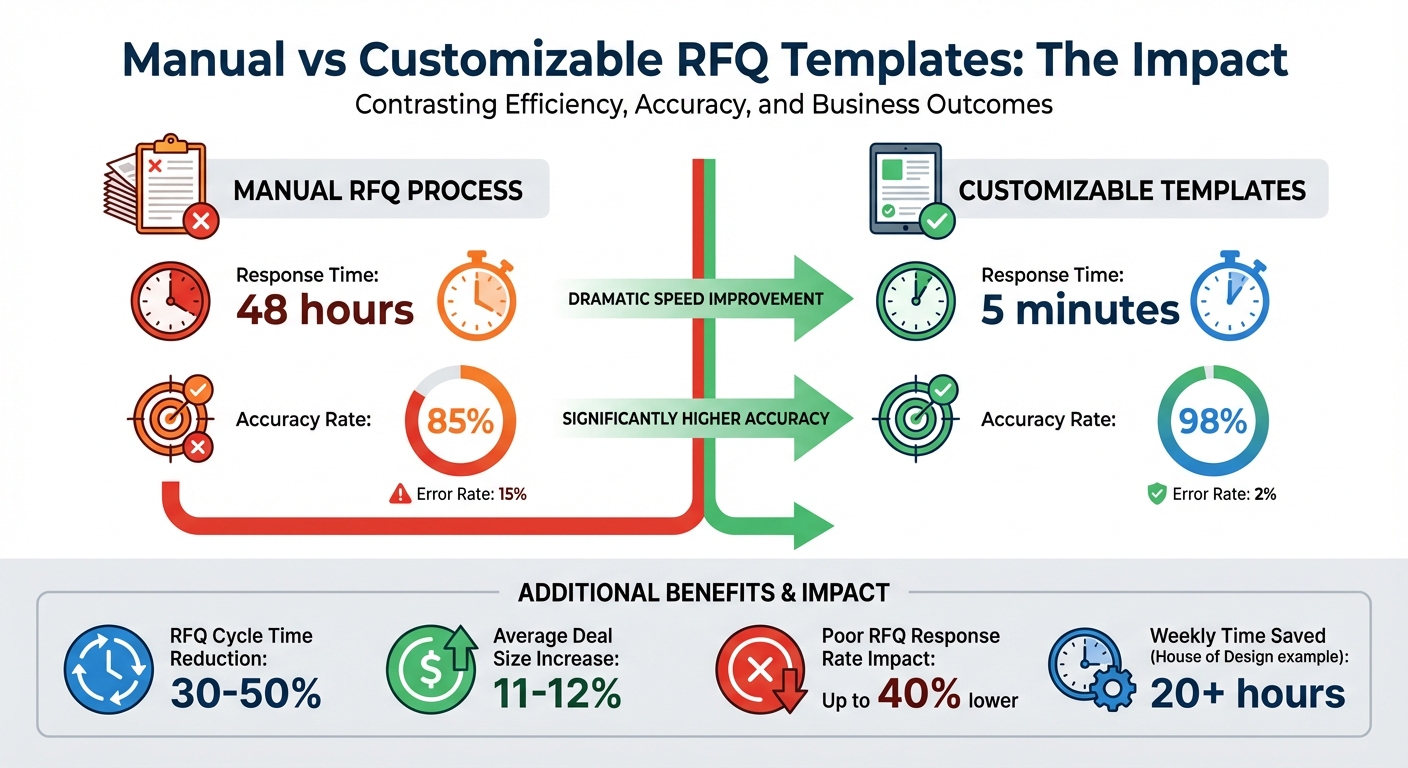
Manual vs Customizable RFQ Templates: Speed, Accuracy & Impact Comparison
What Are Customizable Quoting Templates?
A customizable quoting template is a flexible framework designed to streamline the process of requesting pricing and terms. Unlike rigid, generic documents that often include irrelevant fields, these templates are tailored to fit the specific needs of different industries and projects. For instance, a procurement team could seamlessly switch from requesting quotes for office supplies to IT support services. This versatility lays the groundwork for creating detailed RFQ (Request for Quotation) templates, discussed further below.
The standout feature of these templates is their ability to combine flexibility with precision. Traditional templates often rely on fixed fields, which can lead to vague requirements and unexpected costs. Customizable templates, on the other hand, allow buyers to clearly define their exact needs upfront. This reduces confusion and ensures proposals are tailored to the project. Many of these templates include formula-driven pricing tables that automatically calculate total costs based on inputs like unit price, quantity, and shipping. This makes it much easier to compare proposals from different vendors side by side.
Take the example of House of Design. In December 2024, they adopted customizable request forms and automated workflows, which cut administrative tasks by over 20 hours each week and doubled their job capacity. COO Ryan Okelberry shared:
"Today, with our requests and tasks in Wrike, we have the data to make decisions quicker and more confidently".
Key Elements of an RFQ Template
A strong RFQ template includes several essential components. At its core are detailed specifications that outline measurable requirements, such as materials (e.g., 316 stainless steel), dimensions, tolerances, and surface finishes. These specifications should reference recognized standards like ASTM or ISO to avoid vague descriptions.
Other critical elements include:
- Quantities and volume tiers: These cover initial order amounts, yearly estimates, and any discounts based on higher volumes.
- Standardized pricing format: Vendors are required to present unit prices, extended totals, and any additional fees in a consistent table for easy comparisons.
- Delivery requirements: This includes Incoterms (e.g., FOB Destination), lead times, delivery locations, and packaging specifications.
- Terms and conditions: These outline payment terms (e.g., Net 30), warranties, return policies, and quote validity periods.
- Submission instructions: Clear deadlines, accepted formats, and contact details for inquiries are provided.
Modern templates may also include evaluation criteria, such as weighted scorecards. For example, technical requirements might account for 20% of the score, while financial stability contributes another 20%, enabling objective, data-driven decisions.
Why Customization Matters in RFQ Processes
Customizing RFQ templates does more than just simplify data collection – it eliminates inefficiencies caused by irrelevant or unclear information. By incorporating precise technical requirements, measurable details, and industry-standard references, these templates help buyers avoid comparing "apples to oranges" when reviewing quotes. This level of precision is crucial, as about 80% of companies use RFQs to compare costs and find the best value.
The risks of ambiguity can be costly. In one manufacturing example, a vague RFQ for steel brackets resulted in quotes ranging from $1,500 to $5,000 – a 300% difference – because vendors interpreted the requirements differently. When the buyer issued a more detailed RFQ, the quotes narrowed to between $2,400 and $2,850, making the decision much clearer. Ian Jennings, Founder of Harbour View Mortgages, explained the advantage:
"Providing such specificity ensured that we received tailored and relevant proposals".
Tailored templates also help mitigate risks by addressing compliance requirements upfront. For example, they can include fire safety standards for commercial buildings or environmental assessments for infrastructure projects. This ensures that legal and safety standards are met from the beginning, reducing the chances of costly rework or compliance issues down the line.
sbb-itb-827f251
Building Modular and Flexible RFQ Templates
Customizable templates do more than just speed up and improve the accuracy of your RFQ process – they also bring a modular design approach that can tackle a variety of sourcing challenges. Tools like QSTRAT make it easy to create modular RFQ templates by standardizing key sections while leaving room for project-specific tweaks. Plus, QSTRAT simplifies the entire RFQ process with automated workflows and flexible template designs.
Creating Reusable Template Sections
Think of your RFQ template as a collection of building blocks – each section is modular and tailored to specific sourcing needs.
Some sections, like Introduction, Requirements Overview, Specifications, Quantities, Delivery Requirements, Pricing, and Terms, should stay consistent across projects. Meanwhile, optional sections – such as those covering payment terms, warranty details, SLAs, or compliance requirements – can be added as needed for individual projects.
For pricing, use a standardized table format to make vendor comparisons straightforward and reliable.
Once these reusable sections are in place, the goal becomes finding the right balance between maintaining consistency and allowing room for necessary customizations.
Maintaining Consistency While Allowing Flexibility
The tricky part of modular templates is ensuring they remain consistent while still being adaptable to unique project demands. To protect your company’s interests and maintain brand integrity, lock down critical sections like company information, legal disclaimers, and standard terms and conditions. At the same time, allow flexibility in areas such as project milestones, material specifications, and delivery timelines.
Centralizing RFQ communication is key to avoiding confusion. Share all clarifications with every vendor to ensure a level playing field. When customizing template sections, work closely with technical teams and end-users to clearly separate "must-haves" from "nice-to-haves." This prevents scope creep and keeps the RFQ focused on essentials.
If changes arise after the RFQ is issued, always document them through a formal addendum. This keeps the process transparent and maintains a clear audit trail.
Refining Templates Through Feedback and Testing
RFQ templates should adapt based on feedback from both suppliers and internal teams. If multiple vendors repeatedly ask the same clarifying question, it’s a clear sign that a section might need rewording or additional details. By tracking these patterns, you can identify and address ambiguities before they disrupt future sourcing efforts. Regular updates ensure your templates stay clear, relevant, and effective throughout the RFQ process.
Using Supplier Feedback to Improve Templates
One effective way to gather supplier feedback is by establishing a formal Q&A period before the submission deadline. This allows suppliers to raise questions early, helping you address potential misunderstandings. Ian Jennings, Founder of Harbour View Mortgages, highlights the importance of this step:
"To avoid misunderstandings, I always include a Q&A period in our RFQ process. During a procurement for a new loan origination system, this step helped clarify doubts and led to more accurate and suitable proposals".
To maintain fairness, share all supplier questions and your responses with every vendor. Clear communication is essential, which is why it’s helpful to designate a single point of contact for all RFQ-related communications. This reduces the risk of mixed messages and creates a consistent trail of feedback for future analysis.
Metrics such as response rates and quote quality scores can also provide valuable insights. For instance, if poorly structured RFQs lead to up to 40% lower response rates, it’s a signal to reassess your template. Marcus Nelson of Xos Trucks emphasizes the value of acting on feedback:
"Customer service has been top-notch… proactively listening to our feedback and working quickly to implement our ideas and suggestions into the platform".
Tracking and Solving Common Problems
Recurring issues in RFQs should be documented and addressed systematically. For example, in January 2026, SpecLens encountered a situation where a vague RFQ for 50 steel brackets resulted in quotes ranging from $1,500 to $5,000. The wide range was due to unclear specifications regarding material grades and lead times. By revising the RFQ to specify material, tolerances, and finish, they significantly narrowed the quote range. This example underscores how ambiguity in templates can lead to inconsistent responses.
Another common challenge is ensuring pricing formats are easy to use. Suppliers should be able to provide quotes that allow for straightforward comparisons. Before sending out templates, proofread for inconsistencies – such as mismatched tolerances or conflicting material requirements – that suppliers frequently identify as problematic.
Here’s a quick look at key metrics to track:
| Metric to Track | Purpose |
|---|---|
| Response Rate | Identifies if the RFQ is too complex or if the timeline is too short |
| Quote Quality Score | Measures whether specifications were clear enough for accurate bidding |
| Clarification Frequency | Highlights sections that suppliers consistently find unclear |
| Submission Errors | Flags confusing pricing formats or unclear submission instructions |
Using Digital Tools to Standardize and Automate RFQ Processes
Switching from spreadsheets and email chains to cloud-based sourcing platforms can drastically shorten RFQ cycle times – by as much as 30–50%. These digital tools eliminate tedious tasks like copying specifications, managing supplier responses across multiple emails, and hunting down missing details. Instead of starting from scratch for every RFQ, procurement teams can quickly locate similar past requests, duplicate them, and tweak the details to suit new requirements. This not only saves time but also minimizes the risk of errors. Plus, this shift sets the stage for centralized management and advanced automation, which are explored further below.
Advantages of Digital Template Management
Cloud-based platforms act as a centralized hub, tracking every update to an RFQ template. Each change is logged with timestamps and user identifiers, creating a complete audit trail that aligns with SOX compliance standards. When sourcing data from ERP systems, spreadsheets, or earlier projects, these tools can automatically pull in the necessary information, send notifications, route approvals, and even issue follow-up reminders to suppliers – all without manual effort. These capabilities significantly reduce human error while improving compliance, reinforcing earlier points about increased speed and precision.
Take Carl Zeiss‘s strategic sourcing team, for example. They use QSTRAT Sourcing to gather over 50 distinct data points from suppliers during the bidding process. The platform processes this information to aid decisions on trial runs, sample runs, and production volumes.
One standout feature is how these platforms handle supplier responses. Vendors aren’t required to navigate complicated portals or learn new software. Instead, tools like QSTRAT use PDF eForms that suppliers can complete using standard software like Adobe Reader. The system then automatically integrates their responses, maintaining data accuracy while keeping the process user-friendly. QSTRAT has successfully processed over $5 billion in RFQs across 22 countries using this method.
Tracking Template Performance with Analytics
Beyond automation, digital tools provide powerful analytics to refine RFQ processes. These platforms track supplier interactions with RFQ templates, including document downloads, submission statuses, and communication histories. This data highlights potential bottlenecks – such as sections that frequently confuse suppliers – allowing teams to make targeted improvements. Advanced systems even use AI to flag out-of-range quotes, helping procurement teams quickly catch pricing anomalies.
For instance, BAE Systems leverages digital sourcing tools to compare costs across labor, raw materials, packaging, and transportation. QSTRAT Sourcing provides BAE with comprehensive data for these comparisons while also serving as an educational resource for suppliers. Over time, the collected data helps organizations analyze win/loss ratios and pinpoint which template formats or pricing strategies yield the best outcomes. This data-driven approach not only optimizes quoting strategies but also uncovers inefficiencies and informs smarter decisions for future RFQs. These insights demonstrate how customizable templates and digital tools work together to enhance accuracy and efficiency in sourcing.
Conclusion
Customizable quoting templates are changing the game for RFQ workflows, making processes faster and more efficient. By bringing together standardization and flexibility, these templates cut errors dramatically – from 15% down to just 2% – and reduce turnaround times from 48 hours to under 5 minutes. They also speed up RFQ cycles by 30–50%.
But it’s not just about speed. These templates bring accuracy rates up to 98%, a significant improvement over the 85% seen with manual methods. This level of precision helps protect profit margins by incorporating approval checkpoints and ensures compliance through standardized legal language embedded directly into the templates. These measurable improvements highlight how digital tools can further refine and enhance RFQ processes.
Platforms like QSTRAT build on these advancements by centralizing template management, automating data entry from ERP systems, and offering analytics to monitor performance. As John Dickey, Managing Director of QSTRAT, puts it:
"Our goal has always been to deliver innovative solutions that simplify complex tasks. With this major update, we are taking ease of use and efficiency to the next level, empowering users to achieve even more with our platform".
The results are clear – organizations using structured templates report an 11–12% increase in average deal size while maintaining thorough audit trails for compliance. For procurement teams still relying on spreadsheets, moving to customizable templates and cloud-based tools offers a practical way to achieve faster quotes, fewer mistakes, and smarter sourcing decisions.
FAQs
What should I lock vs. customize in an RFQ template?
When designing an RFQ template, it’s smart to lock in elements that stay the same, like your company details, standard terms and conditions, and overall formatting. This keeps things consistent and minimizes the chance of mistakes. At the same time, leave room to customize sections for project-specific details – things like product descriptions, quantities, delivery timelines, and pricing requirements. Striking this balance helps maintain a professional and clear approach while offering the flexibility needed for different projects. It also simplifies the process of comparing supplier responses.
How do I prevent suppliers from misinterpreting my RFQ?
To make sure your RFQ (Request for Quotation) is understood correctly, it’s important to provide clear and detailed instructions. Using a standardized template can help maintain consistency and avoid confusion. Be specific about the scope, specifications, and expectations of your project to ensure everyone is on the same page.
Customizable templates tailored to your specific needs can also reduce the chances of miscommunication. Additionally, setting clear communication standards helps suppliers grasp your requirements, leading to fewer errors and more accurate responses.
How can I measure whether my RFQ templates are improving results?
You can gauge how well your RFQ templates are working by tracking a few important metrics. Look at the number and quality of vendor responses, check how clear your questions are during the response period, and monitor overall response times. These metrics give you a clear picture of whether your RFQ process is running smoothly and improving over time.
Related Blog Posts
You may also like

Top 7 Tools For Supplier Relationship Management
Compare seven SRM platforms by features, integrations, and scalability to find the right supplier management solution.

Supplier Certification: Why It Matters for Compliance
Supplier certification is a strategic safeguard that prevents regulatory breaches, supply disruptions, and reputational damage.