

Managing supplier relationships effectively is critical for businesses aiming to reduce risks, improve performance, and drive collaboration. Supplier Relationship Management (SRM) tools centralize data, automate processes, and offer real-time insights, helping businesses streamline operations and make data-driven decisions. Here’s a quick overview of the top SRM tools:
- QSTRAT: Focuses on supplier performance tracking, seamless CRM/ERP integration, and automating sourcing and quoting processes.
- TLM (Total Lean Management): Designed for compliance-heavy industries, offering tools for audits, inspections, and detailed performance scorecards.
- Ivalua: Provides a unified platform for onboarding, risk tracking, and performance management, with strong AI-driven insights.
- SAP Ariba: Part of the SAP Business Network, it excels in supplier lifecycle management, integration with ERP systems, and automated sourcing.
- Coupa: Known for procurement, finance, and supply chain optimization, with AI-driven tools and spend analysis.
- GEP SMART: AI-powered platform for procurement, offering supplier scorecards, risk alerts, and seamless ERP integration.
- Precoro: A budget-friendly option for automating procurement processes, with tools for tracking supplier performance and compliance.
Each tool caters to different business sizes and needs, from small teams to global enterprises, ensuring efficiency and visibility in supplier management.
Quick Comparison:
| Tool | Key Features | Best For | Integration Options |
|---|---|---|---|
| QSTRAT | Performance tracking, RFQ automation | Manufacturers, distributors | CRM/ERP systems like MFG/PRO |
| TLM | Compliance tools, scorecards | Regulated industries | Built-in CRM, ERP support |
| Ivalua | AI insights, risk tracking | Large enterprises | APIs, ERP/CRM integration |
| SAP Ariba | Supplier lifecycle management | Enterprises with SAP/ERP | SAP S/4HANA, ECC, others |
| Coupa | Spend analysis, guided buying | All business sizes | SAP, Oracle, NetSuite |
| GEP SMART | AI-driven procurement, risk alerts | Midsize to large enterprises | ERP/supply chain systems |
| Precoro | Budget-friendly, compliance tracking | Small to midsize businesses | NetSuite, QuickBooks, Xero |
Choose the right SRM tool by aligning features with your business needs, testing demos, and involving key stakeholders in the decision-making process.
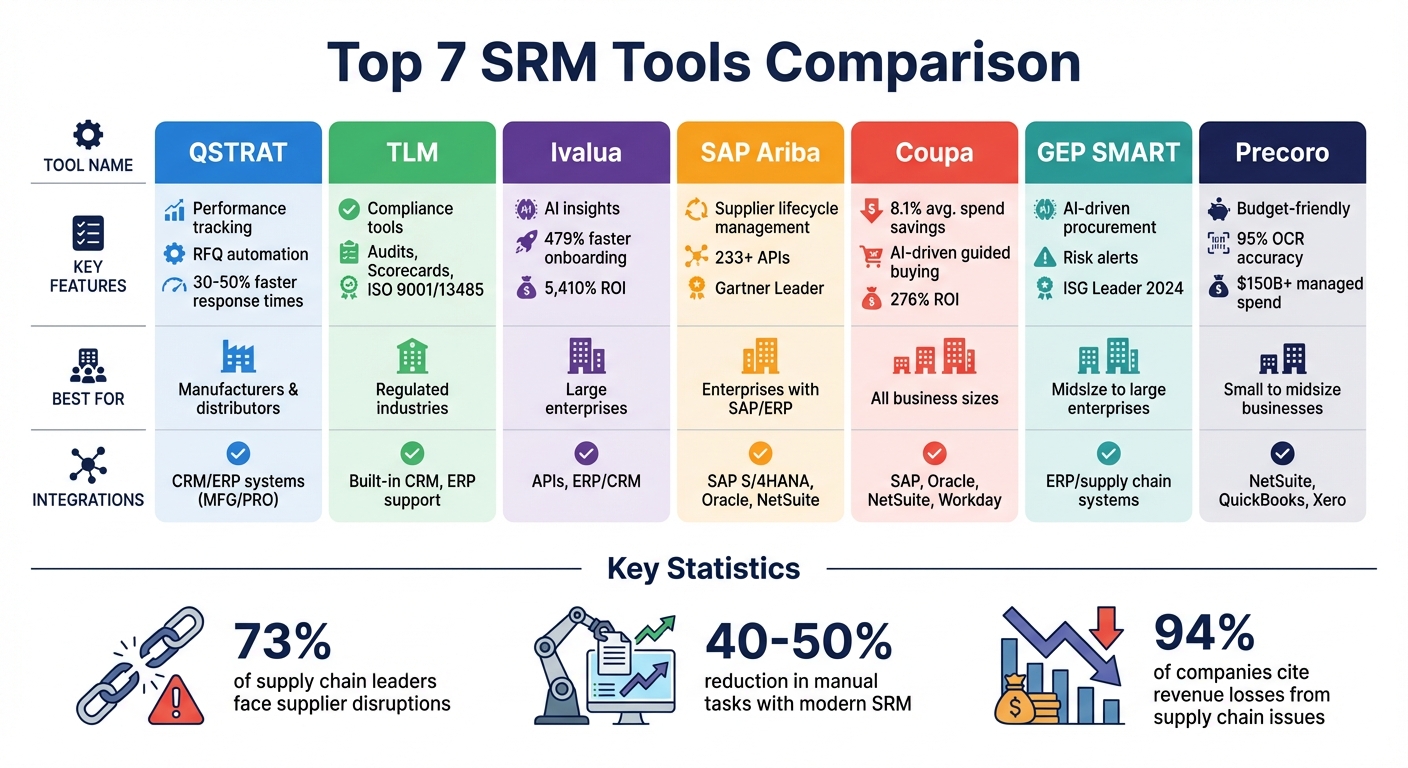
Top 7 SRM Tools Comparison: Features, Best Use Cases, and Integration Options
Supplier Relationship Management Tools | Exclusive Lesson
sbb-itb-827f251
1. QSTRAT
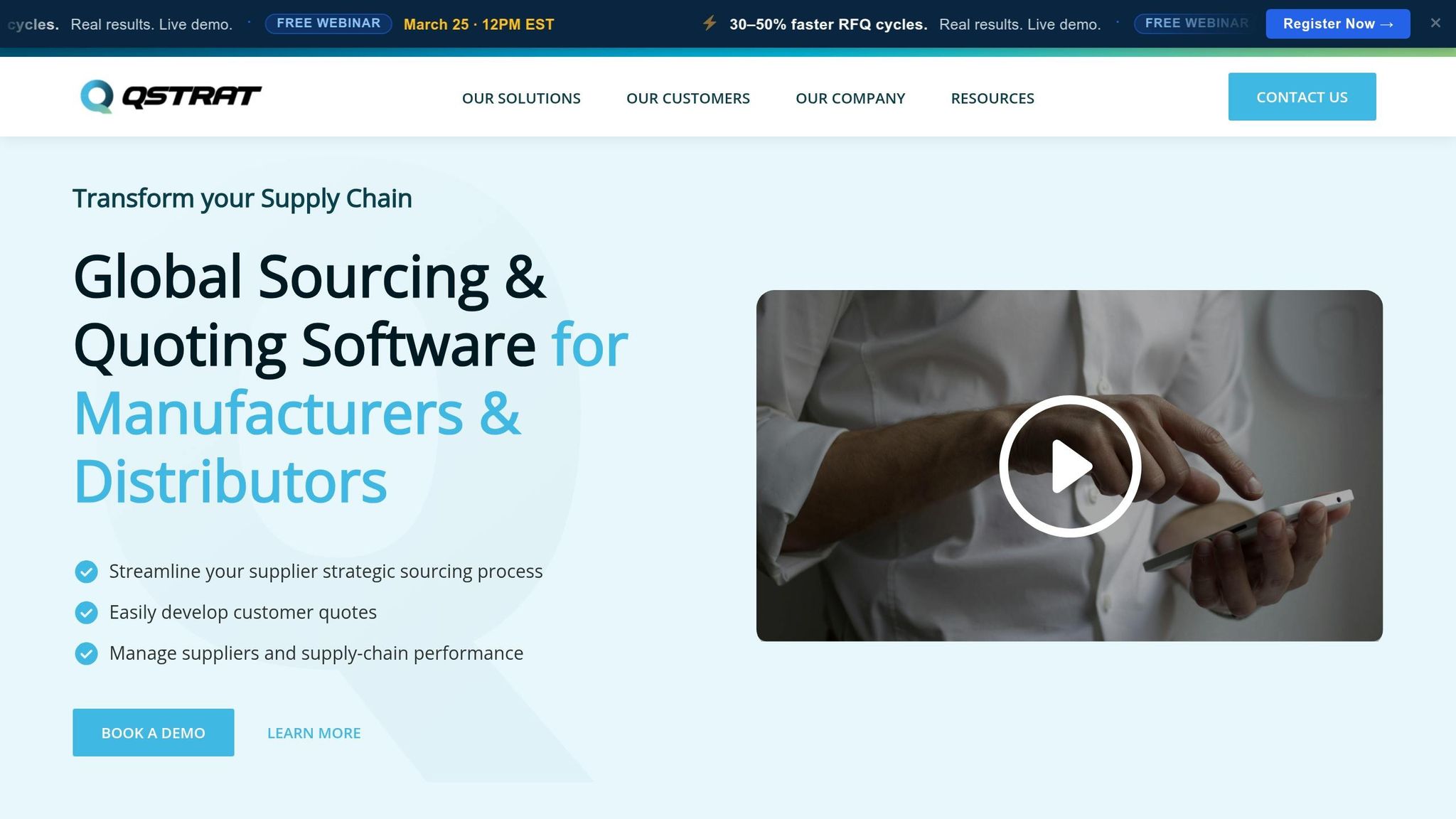
QSTRAT is a cloud-based solution designed for manufacturers and distributors in industries like aerospace, medical devices, automotive, industrial, and high tech. It brings together supplier sourcing, quoting, and performance management into one streamlined platform, eliminating the need for spreadsheets, emails, and disconnected tools. Here’s a closer look at its key features, from supplier performance tracking to automation.
Supplier Performance Management
QSTRAT takes supplier tracking to a new level by offering automated ranking, simplified onboarding, and integrated ESG (Environmental, Social, and Governance) tools. This allows businesses to assess suppliers not just on cost but also on quality, compliance, and sustainability – all from a single dashboard. BAE Systems shared their perspective on how the platform has enhanced their operations:
"For BAE, QSTRAT Sourcing is much more than a great tool to compare price, labor, raw material, packaging, and transportation among our suppliers. It’s helping BAE become a better manufacturer by using QSTRAT Sourcing as a learning tool for suppliers. Through this process we are driving our quality initiatives forward."
Integration with CRM/ERP Systems
QSTRAT integrates seamlessly with existing systems like MFG/PRO and Cyberquery, enabling businesses to track projected versus actual costs with precision. This integration ensures that data flows smoothly across platforms, enhancing accuracy and efficiency. BAE Systems highlighted the benefits of this connectivity:
"By leveraging QSTRAT’s suite of products with our existing MFG/PRO and Cyberquery solutions we can now accurately quote, track successes and measure our accuracy of our projected costs versus our true costs when entered into our MFG/PRO system."
Automation of Sourcing and Quoting Processes
QSTRAT simplifies the RFQ (Request for Quotation) cycle, cutting response times by 30–50%. It allows users to import sourcing data from spreadsheets or costing modules, automatically assigning vendors to e-RFQs based on specific categories. The platform’s AI tools flag unusual quotes for review, catching pricing inconsistencies early. Additionally, automated emails with validated submissions enable smooth two-way communication, eliminating the need for manual data entry.
Scalability for Different Business Sizes
QSTRAT is built to adapt to businesses of various sizes, whether you’re a mid-sized distributor or a large-scale manufacturer. The platform can be up and running in as little as five days. It collects and analyzes over 50 data elements from suppliers during the bidding process, supporting everything from trial runs to full production. For instance, Carl Zeiss‘s Strategic Sourcing team uses QSTRAT to manage New Product Development and Engineering Change processes, leveraging detailed supplier data to streamline their supply chain activities.
2. TLM
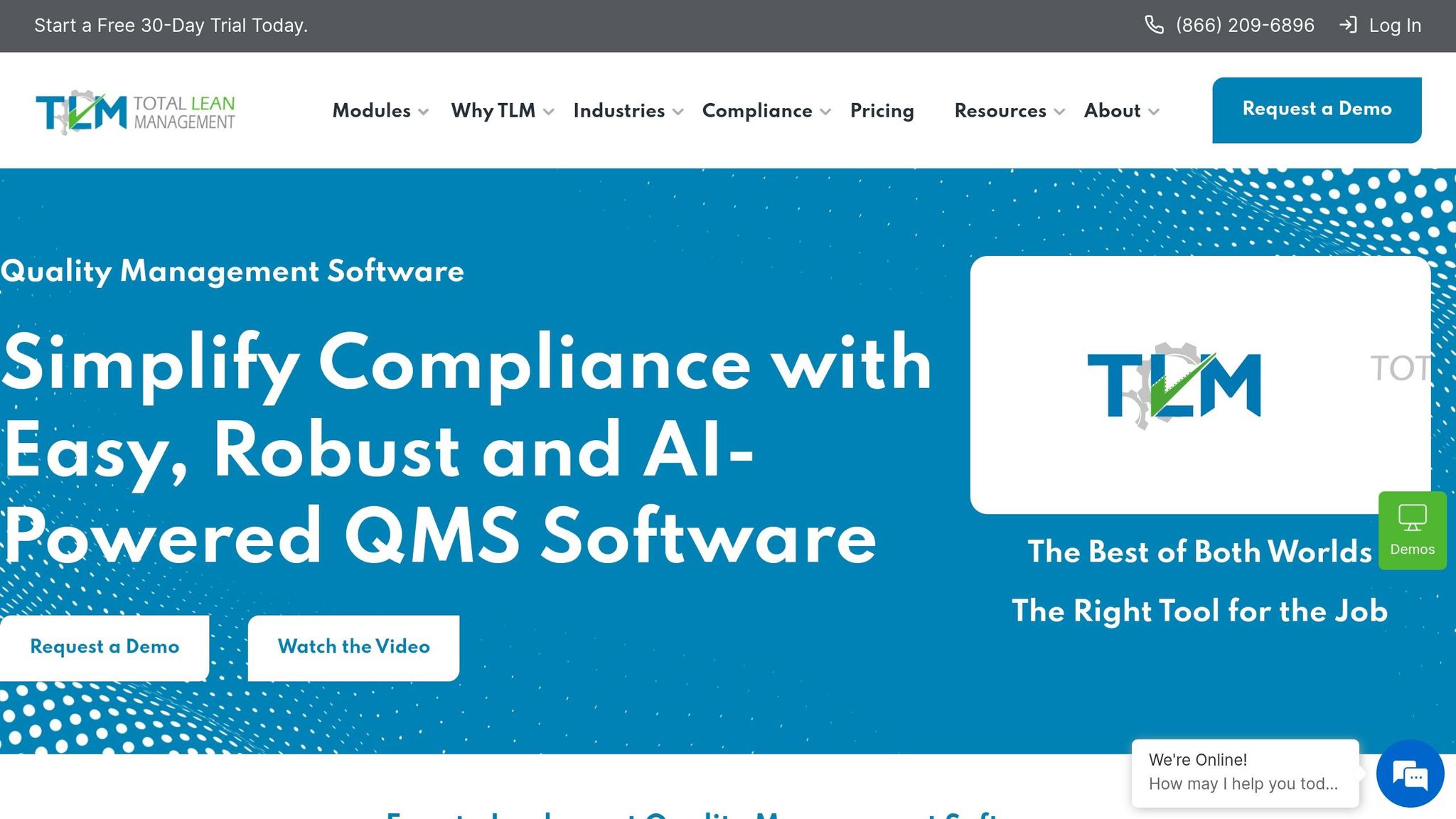
TLM (Total Lean Management) is designed to help manufacturers meet standards like ISO 9001 and ISO 13485. By integrating supplier approval, audits, inspections, purchasing, and corrective actions into one streamlined system, it minimizes the risk of defective materials making their way to the production floor. This compliance-focused setup is especially useful for industries with strict regulatory requirements.
Supplier Performance Management
TLM uses customizable scorecards and detailed inspection statistics to monitor supplier performance. Its proprietary Fusion Technology connects suppliers with specific parts, control plans, and risk records. This system automatically triggers inspections and sends alerts about upcoming reviews or expiring approvals. With 94% of companies citing revenue losses due to supply chain issues and only 6% achieving full visibility, TLM addresses these challenges by centralizing critical data.
Integration with CRM/ERP Systems
The platform includes a built-in CRM that syncs with procurement and ERP systems. This integration consolidates supplier information, aids in creating cost estimates, and manages quantity discounts efficiently.
Scalability for Different Business Sizes
TLM supports flexible deployment options, whether through the cloud, local servers, or desktop installation, and offers a 30-day free trial. A secure supplier portal allows vendors to access up-to-date specifications and CAPA responses, while electronic signatures simplify the approval process for regulatory audits. These features make TLM a strong choice for manufacturers aiming to enhance compliance and streamline operations.
3. Ivalua
Ivalua combines supplier onboarding, risk tracking, performance metrics, and master data into a single platform. This unified approach provides a comprehensive view of supplier data. By utilizing automated scorecards and standardized KPIs, the platform tracks supplier performance across various business units, making it easier to identify trends and address potential issues early.
Supplier Performance Management
Ivalua leverages AI to create improvement plans and corrective actions based on clear performance metrics. Real-time alerts ensure that supplier issues are addressed quickly. Steven Velte, Honeywell‘s Senior Director of Procurement Transformation, adopted Ivalua as the company’s centralized system for vendor master management. This streamlined approvals, audits, and data de-duplication, providing accurate records and global spending insights across Honeywell‘s diverse ERP systems. Through a branded supplier portal, businesses can share performance data directly with their vendors, aligning them with specific goals and innovation strategies. This approach integrates seamlessly with other systems, enhancing overall performance management.
Integration with CRM/ERP Systems
Ivalua also excels in integrating with ERP and CRM systems using standard APIs and configurable connectors. This ensures real-time synchronization of master data and workflows, reducing manual data entry and errors. Companies using Ivalua have seen impressive results, including a 479% decrease in supplier onboarding time and a 20% to 180% reduction in operating costs. The platform’s integration dashboard centralizes supplier records, maintaining consistent data across all connected systems.
Scalability for Different Business Sizes
Designed with a cloud-native, single-instance architecture, Ivalua supports global operations with its multi-region and multi-currency capabilities. Its no-code/low-code environment allows businesses to customize workflows without extensive development efforts. Arindam Sengupta, Dole’s Global VP of Strategic Sourcing & Procurement, reported a 10x ROI in a very short period after implementing Ivalua’s source-to-contract solution. The platform delivers an overall 5,410% ROI within the first three years, with a payback period of less than 8 months. Recognized as a Leader in the 2026 Gartner Magic Quadrant™ for Source-to-Pay Suites, Ivalua is trusted by over 500 leading companies across various industries.
4. SAP Ariba
SAP Ariba operates within the SAP Business Network, giving users instant access to a vast pool of pre-verified vendors. This network significantly speeds up onboarding processes. Recognized as a Leader in the 2026 Gartner Magic Quadrant for Source-to-Pay Suites, SAP Ariba was noted for its "Completeness of Vision". Its extensive network provides rich insights into supplier performance.
Supplier Performance Management
SAP Ariba delivers a comprehensive view of supplier value throughout their lifecycle – from onboarding and qualification to ongoing performance monitoring. This enables businesses to make informed, data-driven decisions and assess risks effectively. The platform’s matrix-based filtering allows sorting suppliers by category, region, and business unit. A great example is Smith+Nephew, which standardized its source-to-contract processes using SAP Ariba, gaining global visibility and achieving compliance to support its sustainability goals. Additionally, real-time alerts help identify potential supply chain vulnerabilities as they arise.
Integration with CRM/ERP Systems
For companies already using SAP S/4HANA or ECC, SAP Ariba offers seamless integration, ensuring accurate data management and reduced maintenance effort. Through the SAP Ariba Cloud Integration Gateway, the platform supports over 233 APIs and more than 200 standard integration points. This integration unifies master data and supplier records, providing real-time visibility into spending while automating document exchanges. Coca-Cola Consolidated benefited from this approach, enhancing user experience and enforcing spend compliance by streamlining supplier interactions. Moreover, SAP Ariba also works with non-SAP systems like Oracle and NetSuite, offering custom professional services for integration. With these capabilities, the platform automates essential sourcing processes, making operations more efficient.
Automation of Sourcing and Quoting Processes
SAP Ariba simplifies sourcing through its Quote Automation tool, which links a buyer’s ERP system to the SAP Business Network to automate RFQ generation and supplier identification. The platform’s AI-driven "Joule Agents" further enhance efficiency by providing recommendations, sending bid reminders, and summarizing bids to highlight risks and opportunities. Additionally, its multilevel weighted scoring and automated comparison reports allow for collaborative supplier evaluation. SAP Ariba also supports various auction formats – such as reverse, forward, Dutch, index, and Japanese auctions – and its Business Network Discovery feature automatically connects sourcing events with qualified suppliers.
Scalability for Different Business Sizes
While SAP Ariba is often seen as the go-to solution for large global enterprises with complex needs, it also provides tiered packages tailored for mid-market businesses and larger organizations. For instance, Churchill Downs leveraged SAP Ariba to unify its procurement operations in the cloud, achieving greater efficiency, scalability, and control as it prepared for future growth. With its cloud-based SaaS model, SAP Ariba supports global trading, offering multi-language and multi-currency capabilities. However, businesses should plan structured adoption programs to effectively manage the platform’s complexity.
5. Coupa
Coupa is a cloud-based platform designed to streamline procurement, finance, and supply chain operations for businesses of all sizes. It supports multi-currency, multi-language, and multi-entity deployments across more than 50 countries. On average, Coupa customers save 8.1% on total spend, showcasing its impact across various industries.
Supplier Performance Management
Coupa offers real-time insights into supplier performance, including delivery accuracy, quality scores, and compliance status. Automated supplier scorecards provide timely feedback before and after work completion. Its SpendGuard™ feature uses AI to detect errors, suspicious activity, and potential fraud. For instance, Casey’s reduced its single-source suppliers by 60% over three years, achieving over $200 million in savings. Similarly, the American Red Cross improved supplier diversity by 35% and freed up $15 million for internal transformation projects.
Integration with CRM/ERP Systems
Coupa integrates seamlessly with leading ERP and financial systems like SAP, Oracle, NetSuite, Workday, and Microsoft Dynamics. The platform’s App Marketplace serves as a hub for certified, pre-built apps that expand its functionality, while open APIs allow for flexible data sharing with existing systems. Its unified procure-to-pay workflow ensures that negotiated discounts and contract terms are applied automatically, with real-time budget tracking and "budget meters" to guide approvals. As Robert Christmas, Financial Director at AstraZeneca, explained:
"In our selection process, it became very clear around usability studies that Coupa had an enhanced user experience compared to other platforms."
Top-performing companies using advanced procurement tools achieve a 97% first-time invoice match rate, and the requisition-to-order cycle time can be as short as 3.8 business hours.
Automation of Sourcing and Quoting Processes
Coupa simplifies compliance with policies through AI-driven "guided buying", directing users to contract-approved goods and preferred suppliers. It automates the entire intake-to-order process, from purchase requisitions to three-way invoice matching. The platform’s AI is powered by trillions of dollars in spend data from a global network of over 10 million buyers and suppliers. The Coupa Advantage Marketplace also highlights sustainable alternatives and pre-negotiated rates to curb rogue spending. According to a 2024 Forrester study, a large enterprise with 60,000 employees saw a 100% improvement in sourcing and spend reporting efficiency, along with a $560,000 annual boost in technology margins.
Scalability for Different Business Sizes
Coupa’s cloud-based design caters to both small businesses and large global enterprises. It supports over 30 languages and complies with tax regulations in more than 50 countries. For smaller organizations, the platform includes AI-powered growth roadmaps and an intuitive, shopping-style interface that encourages adoption with minimal training. Larger enterprises benefit from advanced supply chain modeling, "digital twin" scenario planning, and seamless ERP integration.
The platform has received a 4.8/5 rating on Gartner Peer Insights from 682 reviews and a 4.2/5 on G2 from over 500 reviews. Notably, 36.9% of G2 reviews are from small-to-midsize organizations, while 53.8% come from enterprises with over 1,000 employees. A Forrester study also reported a 276% ROI over three years for enterprises using Coupa. Up next, explore another robust SRM tool that strengthens supplier connectivity.
6. GEP SMART
GEP SMART is an AI-driven, cloud-based platform designed to streamline both direct and indirect procurement for businesses ranging from midsize companies to large global enterprises. By creating a unified system, it provides a single source of truth for suppliers and customers, eliminating manual errors and inconsistencies in performance data and transactions. The platform is built to handle thousands of suppliers simultaneously, using automated tools like scorecards, surveys, and real-time notifications.
Supplier Performance Management
GEP SMART takes supplier management to the next level with standardized forms and pre-set questionnaires, which improve data accuracy and identify risks early. Its AI tools are particularly effective at detecting supply-demand mismatches and quality issues, offering procurement teams timely alerts about potential challenges. Suppliers can keep their records up to date and share certifications through a centralized repository, ensuring compliance documents are always accessible.
Ed Breen, Executive Chairman and CEO of DuPont, highlighted the platform’s impact:
"GEP is helping us immensely in implementing a lot of digital tools like AI, Machine Learning and Smart Demand Forecasting. These predictive tools are really improving the yield of our production units."
The system also provides full visibility into all source-to-pay activities, with automated tracking for every transaction. To support suppliers, a 24×5 help desk is available via email and phone for technical assistance.
Integration with CRM/ERP Systems
GEP SMART connects seamlessly with most ERP and supply chain systems, allowing businesses to centralize data across product development. Its unified source-to-pay structure reduces manual data entry, speeds up payment processing, and ensures smooth data transfer between procurement and broader business systems. Suppliers can handle RFIs, accept purchase orders, and submit invoices all within one portal, significantly cutting down transaction times.
Tomas Veit, Head of Procurement at Asahi Breweries Europe Group, praised the platform’s usability:
"We selected GEP SMART because it is intuitive and easy to use. It provides us with quick insights into our spend and supports end-to-end process transparency and compliance."
The platform’s low-code/no-code framework and strategic partnerships make it adaptable to a variety of organizational needs, ensuring smooth deployment and customization.
Automation of Sourcing and Quoting Processes
The sourcing process is fully automated within GEP SMART, from identifying and qualifying suppliers to evaluating them, all powered by embedded AI capabilities. Its AI-driven orchestration aligns procurement workflows strategically. Suppliers can independently upload catalog files and manage punch-out credentials using self-service tools.
Deborah Sorg, Vice President of Procurement at Party City, emphasized the benefits:
"GEP’s solution will provide clear visibility into our category spend, to help us better identify savings opportunities across the enterprise and drive greater value to our organization."
The platform’s digital, paperless transactions and centralized document repository help reduce administrative costs and improve communication with automated alerts. This streamlined process ensures scalability for businesses of any size.
Scalability for Different Business Sizes
GEP SMART is built to scale, supporting businesses from midsize operations to multinational corporations with revenues exceeding $30 billion. It enables companies to shift from analyzing individual line items to gaining a comprehensive view of enterprise-wide spending with just one click. Its user-friendly interface and mobile accessibility encourage high adoption rates across diverse organizations.
The platform has also earned recognition as a "Leader" in the ISG Provider Lens™ 2024 for procurement software solutions, with users frequently highlighting its ease of use and seamless integration capabilities.
7. Precoro
Precoro is a cloud-based procurement platform that manages over $150 billion in spending for more than 1,000 customers across 80+ countries. It streamlines vendor interactions – covering contracts, orders, and invoices – while ensuring early detection of issues, 99.9% uptime, and a quick, IT-free implementation process that takes just 2–8 weeks.
Supplier Performance Management
Precoro’s Supplier Portal offers vendors a secure space to confirm delivery schedules, update product catalogs, and upload compliance documents directly. The platform also tracks On-Time In-Full (OTIF) metrics automatically and sends real-time alerts when certifications or contracts are about to expire.
Bill Judson, Vice President of Finance & Administration at Greater Palm Springs CVB, shared how Precoro transformed their operations:
"The system has improved efficiency throughout the entire organization, so we know there are very real savings."
Judson’s team reduced their purchase document error rate from 30% to 0% and tripled their purchasing speed. Precoro’s 3-way matching feature plays a key role by comparing invoices with purchase orders and receipts, ensuring payments are made only for items that were ordered and received.
In addition to supplier performance tracking, Precoro integrates effortlessly with other business systems.
Integration with CRM/ERP Systems
Precoro integrates with popular systems like NetSuite, QuickBooks, Xero, and Power BI to eliminate data silos. It acts as an intuitive overlay for ERP systems, providing a user-friendly procurement interface while syncing critical data across platforms. For businesses with unique needs, Precoro also offers a public API and custom integration options.
Bryan Krauter, Accounting Director at Riverstone Logistics, emphasized the platform’s control benefits:
"Precoro has [also] helped us from a control perspective… We’re happy to move away from our homegrown tool and NetSuite to Precoro, where we can now manage budgets easily."
Automation of Sourcing and Quoting Processes
Precoro simplifies procurement further with automated RFP and quoting tools. Users can create requests from scratch or directly from purchase requisitions, sending invitations to multiple suppliers for side-by-side comparisons. Winning bids are automatically converted into purchase orders. The PunchOut catalog feature connects directly to vendor websites like Amazon Business and Grainger, allowing employees to shop with real-time pricing while staying within company policies.
Green Cell, led by Controlling Manager Jacek Zmuda, leveraged Precoro’s automation to speed up their month-end close process by seven times. The platform’s AI-powered OCR tool extracts data from supplier invoices with over 95% accuracy, significantly reducing manual entry errors.
Scalability for Different Business Sizes
Precoro accommodates multi-entity businesses by enabling seamless switching between subsidiaries while maintaining separate budgets, approval workflows, and tax settings. Its custom reporting tools analyze spending across more than 150 data points, helping companies uncover opportunities for volume discounts and supplier consolidation.
Barend Liebenberg, Procurement Manager at Bolloré Transport & Logistics, highlighted the benefits:
"Precoro gave us visibility and control over the multi-branch spending of our organization."
Whether for small teams or large enterprises, Precoro provides a centralized and efficient procurement solution. With user ratings of 4.7/5 on G2 and 4.8/5 on Capterra, the platform is frequently praised for its user-friendly design and outstanding customer support.
Conclusion
A strong supplier relationship management (SRM) tool can transform how businesses handle procurement, manage risks, and track performance. This is critical, especially when 73% of supply chain leaders report dealing with supplier disruptions. These tools aren’t just helpful – they’re essential for building resilient operations.
Different businesses have different needs when it comes to SRM platforms. For small businesses, affordability and the ability to replace spreadsheets are key priorities. Mid-sized companies often look for scalable solutions that integrate smoothly with ERP systems. Meanwhile, large enterprises require advanced tools capable of handling global supply chains, offering features like AI-powered risk analysis and tracking for ESG compliance.
Once you’ve identified what your business needs, here’s how to choose the right platform:
- Define your governance framework: Set clear rules for how supplier relationships will be managed.
- Segment your suppliers: Create criteria to group suppliers based on importance and performance.
- Assign scorecard ownership: Decide who will manage and track supplier performance.
- Plan review schedules: Establish regular check-ins to evaluate supplier relationships.
- Clean and consolidate supplier data: Ensure data accuracy to avoid fragmented reporting.
- Engage cross-functional teams: Involve purchasing, supply chain, IT, and finance teams to meet broader organizational needs.
Modern SRM platforms streamline operations by centralizing data, reducing manual tasks by 40-50%, and providing a unified source of truth for all departments. This not only eliminates tedious administrative work but also enables procurement teams to focus on building strategic partnerships.
To get started, review the seven tools discussed earlier, book demos with your top contenders, and test the platform with key suppliers before rolling it out company-wide. The right SRM tool can enhance accountability, strengthen supplier relationships, and shift procurement teams from reactive problem-solving to driving strategic growth.
FAQs
What SRM features matter most for my business?
The most important features in SRM tools will vary based on your specific goals. However, a few stand out as universally valuable: collaboration, visibility, and performance tracking.
When evaluating SRM tools, consider features such as:
- Supplier segmentation: Helps identify and categorize suppliers based on their importance to your business.
- Data analytics: Provides insights to make informed decisions and improve supplier performance.
- Onboarding tools: Streamlines the process of integrating new suppliers.
- KPI tracking: Monitors supplier performance against key metrics.
- Risk monitoring: Identifies and mitigates potential disruptions in the supply chain.
These features not only help in prioritizing critical suppliers but also support building stronger partnerships and creating a more resilient supply chain.
How do I choose an SRM tool that fits my ERP/CRM setup?
To choose an SRM tool that works well with your ERP or CRM system, follow these steps:
- Define Your Needs: Pinpoint what you aim to achieve, such as tracking supplier performance or improving collaboration. Make sure these goals align with your ERP/CRM system’s capabilities.
- Evaluate Integration Options: Look for tools that offer smooth integration with your ERP/CRM, such as those with API support.
- Ensure Compatibility: Confirm that the tool can handle your current workflows and has the flexibility to grow with your business.
Taking the time to evaluate your options carefully will help you build a more cohesive and efficient system.
How can QSTRAT speed up RFQs and improve supplier performance?
QSTRAT speeds up the RFQ (Request for Quotation) process by automating sourcing and quoting tasks, enabling quicker and more precise responses. It also improves supplier performance with features like onboarding tools, automated ranking, and performance tracking. These tools help businesses simplify their operations while building and maintaining strong supplier partnerships.
Related Blog Posts
You may also like

Supplier Certification: Why It Matters for Compliance
Supplier certification is a strategic safeguard that prevents regulatory breaches, supply disruptions, and reputational damage.

How Customizable Quoting Templates Improve RFQ Processes
Customizable RFQ templates cut turnaround from days to minutes, reduce errors, standardize supplier data, and increase quote value with modular automation.