

ESG in Industrial Distribution: Key Challenges and Solutions
- March 12, 2026
- 14 Mins Read
- 1000 Views

ESG compliance is no longer optional for industrial distributors – it’s a must. Stricter regulations like the CSRD and CSDDD now require detailed sustainability reporting and active risk management across supply chains. For distributors, this means tackling Scope 3 emissions, improving supply chain visibility, and managing fragmented data systems, all while dealing with resource limitations.
Here’s what you need to know:
- Scope 3 emissions reporting: Suppliers often provide incomplete or outdated data, making accurate reporting a challenge.
- Limited visibility: Most companies don’t monitor beyond Tier 1 suppliers, leaving hidden risks like forced labor or environmental harm unchecked.
- Data management issues: ESG data is scattered across systems, with many companies still relying on manual processes like spreadsheets.
- Resource gaps: Smaller suppliers lack the tools and expertise to meet ESG standards, and distributors often lack the resources to support them.
The solution? Centralized technology and clear governance. Using integrated platforms like QSTRAT, distributors can streamline data collection, automate reporting, and track supplier progress in real time. By embedding ESG criteria into procurement processes and offering supplier development programs, distributors can not only meet compliance requirements but also strengthen supplier relationships and gain a competitive edge.
Key Takeaway: ESG compliance is challenging but achievable with the right tools and strategies. Focus on automating data collection, increasing supply chain visibility, and supporting suppliers to turn regulatory demands into opportunities for growth.
Building and Ensuring an ESG-Compliant Supply Chain | Integrity Next at Manufacturing Summit 2025
sbb-itb-827f251
Main ESG Challenges for Industrial Distributors
ESG Compliance Challenges for Industrial Distributors: Key Statistics
Industrial distributors face a tough road when it comes to meeting ESG (Environmental, Social, and Governance) requirements. Sitting right in the middle of the supply chain, they’re under pressure from manufacturers demanding detailed sustainability data, while at the same time struggling to pull that same information from their own supplier networks. With stricter regulations looming in 2026, these challenges are becoming more intense. Let’s break down the key areas where distributors are feeling the squeeze.
Managing Supplier Data Requests for Scope 3 Emissions
One of the biggest headaches for distributors is gathering accurate Scope 3 emissions data. Suppliers are often overwhelmed by repetitive and inconsistent data requests, which results in lower response rates and incomplete submissions. Even when data is provided, it’s often outdated or based on rough estimates, missing critical details like transportation emissions.
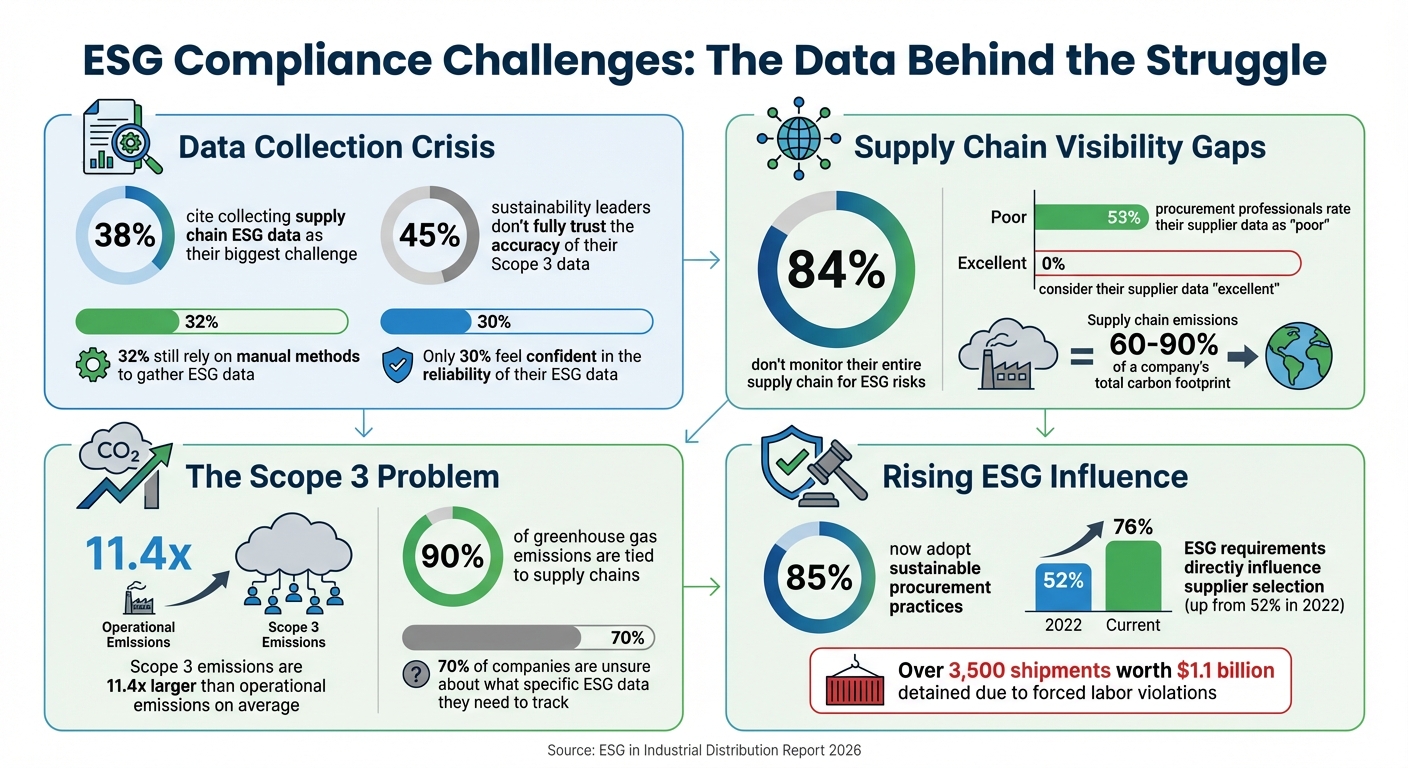
The numbers tell the story. About 38% of businesses say that collecting supply chain ESG data is their biggest challenge, and 45% of sustainability leaders admit they don’t fully trust the accuracy of their Scope 3 data. Many companies still rely on spend-based estimates using industry averages instead of getting specific data from suppliers. This is a big problem since Scope 3 emissions are, on average, 11.4 times larger than a company’s operational emissions, making precise reporting essential.
Smaller suppliers are particularly challenged – they often lack the tools or expertise to measure and report their carbon footprints accurately. Data is scattered across various systems like supplier portals, ERP platforms, and even spreadsheets or emails, making it hard to centralize. To make things more complicated, ESG reporting is no longer just a task for sustainability teams – it now involves procurement, logistics, finance, and operations departments, adding another layer of complexity. And this is just the beginning; distributors also face deeper challenges in achieving full visibility across their supply chains.
Limited Supply Chain Visibility and Due Diligence Risks
Most distributors have little to no visibility beyond their Tier 1 suppliers. In fact, 84% of companies don’t monitor their entire supply chain for ESG risks. This lack of oversight leaves them vulnerable to hidden issues like forced labor, environmental harm, or other unethical practices.
The stakes are high. Under regulations like the EU Deforestation Regulation (EUDR), companies risk having goods seized at borders, facing market entry bans, or even legal penalties. Yet, 53% of procurement professionals rate their supplier data as “poor,” and none consider it “excellent”. This creates what experts call a “data chasm” – a significant gap between the information distributors need and what they can actually verify.
The problem is even worse in emerging markets, where smaller vendors often lack the technology or processes to track ESG performance accurately. Self-reported data is not only incomplete but can sometimes be misleading. As Professor Omera Khan from the University of London points out:
Too few organizations recognize the actual cost of incomplete, outdated, or low-quality supplier data.
Considering that supply chain emissions typically make up 60% to 90% of a company’s total carbon footprint, these blind spots pose a serious liability.
Data Management Problems and Integration Gaps
Even when distributors manage to collect ESG data, organizing and using it effectively is another major hurdle. A surprising 32% of organizations still rely on manual methods to gather ESG data, making the process both slow and resource-heavy.
The challenge doesn’t stop there. Distributors often need to integrate data from multiple internal systems – ERP, HR, EHS, and procurement platforms – that weren’t designed to handle sustainability metrics. Companies track dozens of environmental and social metrics, but these rarely consolidate into a single, reliable source. As MarketGenics Research explains:
The days of ESG reporting as a side-task in Excel sheets are over… Global regulation, investor scrutiny, and capital market expectations are forcing companies to treat ESG data like financial data: controlled, traceable, auditable, and machine-readable.
Another issue is the lack of standardization. Platforms like EcoVadis, CDP, and SEDEX all request similar data, but each in slightly different formats. This leads to reporting fatigue and confusion, increasing the risk of conflicting information. As a result, only 30% of firms feel confident in the reliability of their ESG data. On top of that, fragmented systems often fail to provide the clear audit trails needed for the high-level reporting regulators now demand.
Resource Constraints for Supplier ESG Improvement
Mid-sized distributors face yet another challenge: helping suppliers improve their ESG performance without the necessary resources. Many distributors lack the staff to conduct regular audits, provide training, or offer technical support for suppliers struggling to meet ESG standards.
This resource gap is a big problem, especially since 70% of companies are unsure about what specific data they need to track for ESG compliance. Smaller suppliers, in particular, need templates, tools, and guidance to collect and share accurate ESG data. In today’s market, where strict ESG goals influence supplier selection, providing this support is crucial. But doing so requires time, expertise, and money – resources that many distributors simply don’t have. This leaves both distributors and their supplier networks ill-prepared for the stricter requirements now in force in 2026.
How to Address ESG Challenges in Industrial Distribution
As ESG regulations grow stricter, distributors have an opportunity to turn compliance challenges into strategic advantages. By replacing outdated, manual processes with modern technology and governance frameworks, businesses can centralize data, automate workflows, and gain real-time supply chain visibility. These integrated systems not only simplify compliance but also strengthen supplier relationships.
Use Integrated Sourcing Software to Simplify ESG Processes
Integrated sourcing software can transform ESG data into actionable business insights. Tools like QSTRAT consolidate supplier data, streamline RFQ cycles, and seamlessly connect with existing ERP and CRM systems.
For example, Carl Zeiss utilizes QSTRAT Sourcing to gather and analyze over 50 data points from suppliers during bidding for new product development and engineering changes. Similarly, BAE Systems uses QSTRAT to help suppliers evaluate costs related to labor, raw materials, and transportation, driving improvements in quality and sustainability. These platforms can reduce RFQ cycle times by 30–50%, while creating a centralized repository where ESG metrics are integrated with cost, quality, and delivery data.
These tools also automate ESG data collection from suppliers, flag anomalies using AI analytics, and update ERP systems in real time. Procurement teams can prioritize ESG performance – assigning it 20–30% of the total supplier scorecard – without adding manual data entry. This approach provides visibility into Scope 3 emissions, which account for 90% of a company’s total greenhouse gas footprint, while eliminating labor-intensive processes.
Cloud-based solutions also promote supplier development instead of focusing solely on compliance. Rather than disqualifying underperforming vendors, distributors can track their progress, share improvement templates, and provide guidance. As SourcingTomorrow explains:
The organizations winning on ESG aren’t the ones with the strictest policies. They’re the ones who turned their sustainability standards into a supplier development program.
Apply Technology and Governance Strategies
Technology is essential, but effective governance ensures long-term success. Start by implementing a supplier code of conduct that outlines expectations for sustainability, ethical labor practices, and responsible sourcing in every contract. This is increasingly important as 85% of companies now adopt sustainable procurement practices due to regulatory requirements and compliance risks.
Revise supplier contracts to include ESG performance clauses, complete with timelines for remediation and termination conditions. Companies like Unilever and Schneider Electric use tiered timelines to balance urgency with feasibility: Tier-1 suppliers must meet ESG standards at contract renewal, while Tier-2 and Tier-3 suppliers follow a structured 18–24 month roadmap. This approach supports smaller vendors in building their ESG capabilities.
Standardized reporting frameworks such as GRI, CDP, or SASB ensure supplier data remains consistent, auditable, and comparable. API-based integrations can further connect sourcing software with third-party data engines for real-time verification of certifications and sanctions. Additionally, forming a cross-functional ESG committee – involving procurement, finance, legal, and sustainability teams – helps embed ESG metrics into departmental KPIs, turning them into a core business priority.
Finally, consider setting up an ESG improvement fund to co-invest in sustainability projects with key suppliers. This fosters loyalty and ensures compliance, which is increasingly critical as 76% of procurement executives now say ESG requirements directly influence supplier selection, up from 52% in 2022. Supporting suppliers in meeting these standards reduces regulatory risks while delivering measurable ESG outcomes.
Step-by-Step Guide for ESG Compliance
Getting a handle on ESG compliance might seem daunting, but with a clear plan, industrial distributors can meet regulatory demands, strengthen supplier ties, and reduce risks effectively.
Identify High-Risk Supply Chains
The first step is to categorize your suppliers based on their importance. Suppliers providing critical components or representing significant spending should undergo thorough annual assessments covering environmental, social, and governance aspects. Meanwhile, commodity suppliers can be managed with simpler financial and compliance checks.
Did you know that over 70% of major supply chain disruptions result from poor supplier vetting? This highlights the need to map beyond Tier 1 suppliers. Dive deeper into your supply chain to spot potential issues like labor violations or environmental infractions further down the line.
Perform a materiality assessment to identify key ESG risks and use weighted scorecards to classify suppliers into risk categories: Low (Green), Medium (Yellow), or High (Red).
Pay close attention to regions flagged for high risk. For instance, under the Uyghur Forced Labor Prevention Act, U.S. Customs and Border Protection has detained over 3,500 shipments worth nearly $1.1 billion. If your supply chain touches such regions, proving the absence of forced labor is not just important – it’s legally required.
Once you’ve established these risk tiers, you’ll need to centralize your ESG data for better management and tracking.
Implement Integrated Software for Centralized ESG Management
After identifying risks, the next step is to centralize your data. Integrated sourcing software combines tools like CRM, ERP, costing, and sourcing systems into one platform. This eliminates isolated data silos and improves the accuracy of your reports.
Take QSTRAT as an example. This platform helps distributors manage supplier onboarding, automate rankings, and monitor ESG performance through centralized portals. Companies like Carl Zeiss use QSTRAT to consolidate over 50 supplier data points during product development, cutting RFQ cycle times by 30–50%.
AI tools enhance this process by flagging anomalies and comparing real-time ESG scores between suppliers. Pre-built templates for global standards like CSRD, GRI, and CDP allow for quick creation of audit-ready documents. Plus, API integrations ensure seamless data flow between your ERP systems, enabling real-time decision-making.
Supplier portals are another game-changer. These digital platforms simplify data submission for vendors, reducing manual entry and helping suppliers handle multiple customer requests efficiently. By embedding ESG criteria into RFx documents and supplier scorecards, you ensure sustainability metrics play a role in contract decisions from the outset.
Centralizing your data sets the stage for ongoing, real-time ESG performance monitoring.
Track Progress Toward ESG Goals
ESG compliance isn’t a one-and-done task – it’s an ongoing process. Replace annual reviews with real-time tracking using automated data feeds from ERP and procurement systems. A strong assessment program leads to fewer disruptions, fewer defects, and better ESG ratings.
Monitor key metrics like environmental data (Scope 1, 2, and 3 emissions, energy efficiency, waste diversion rates), social data (health and safety records, labor practices, diversity spend), and operational metrics such as on-time delivery (aim for 95%+) and defect rates.
The shift from spend-based estimates to primary data is critical. While spend-based calculations can provide a baseline for emissions, modern regulations like CSRD demand primary data directly from suppliers for assurance that meets investor standards. Start with self-assessment questionnaires (SAQs) for immediate insights, and then move to automated data collection via integrated platforms.
"Visibility isn’t optional. If you can’t see what’s happening past your primary suppliers, you can’t manage the risk, and regulators won’t accept ignorance as a defense." – Skill Dynamics
Set clear KPIs for each risk tier and review progress quarterly. For Medium/Yellow-risk suppliers, create improvement plans with specific milestones. For High/Red-risk suppliers, implement immediate corrective actions with firm deadlines – or start looking for replacements. Regular tracking turns ESG compliance from a regulatory chore into a strategic advantage.
Conclusion
Industrial distributors face hurdles in managing ESG priorities like Scope 3 emissions, fragmented systems, and limited resources. However, the path forward is clear: using centralized technology, integrating software, and fostering strong supplier relationships can turn compliance obligations into a strategic edge.
Cloud-based platforms like QSTRAT bring together CRM, ERP, costing, and sourcing data into one streamlined system. This integration eliminates the need for clunky spreadsheets, speeds up RFQ cycles by 30–50%, and provides real-time supply chain visibility. With AI-driven automation, distributors can flag potential issues early, creating smarter and more resilient operations.
The stakes are significant – regulations have already led to the detention of over 3,500 shipments valued at nearly $1.1 billion due to forced labor violations. Meanwhile, up to 90% of greenhouse gas emissions are tied to supply chains. The distributors staying ahead of the curve are those embedding ESG considerations into sourcing from the outset, automating compliance processes, and treating suppliers as true collaborators.
"Real-time data, centralized process-management software and customized artificial intelligence platforms can drive supply chain transparency, supplier accountability and measurable sustainability gains." – Andreas Eschbach, Founder and CEO, Eschbach
These insights highlight the importance of integrating ESG criteria into every layer of the supply chain. By adopting platforms like QSTRAT to centralize supplier data, distributors can go beyond compliance to achieve fewer disruptions, reduced costs, and stronger supplier partnerships. ESG isn’t just about avoiding penalties – it’s about creating a supply chain that benefits everyone involved.
FAQs
What ESG data should I request first from suppliers?
Start by asking your suppliers for their carbon footprint data, specifically covering Scopes 1, 2, and 3. This information reveals both their direct and indirect impact on the climate. It’s especially important for meeting regulations like the CSRD and aligning with broader sustainability objectives. Prioritizing this data ensures you’re on track with compliance while addressing environmental responsibilities.
How can I get reliable Scope 3 data from smaller suppliers?
Gathering dependable Scope 3 data from smaller suppliers often comes with its hurdles, especially since many lack the resources for detailed tracking. To make the process smoother, be specific about the data you need, the standards to follow, and the format for submission. Focus on your key suppliers first – this ensures you’re collecting the most impactful data.
Additionally, offering guidance to suppliers on how to track their emissions can go a long way. Using tools that simplify communication and data sharing can also boost participation and accuracy, while minimizing the risk of overwhelming them with requests.
How does QSTRAT help centralize ESG reporting and audits?
QSTRAT simplifies ESG reporting and audits by providing digital tools designed to improve supply chain visibility, ensure data accuracy, and monitor compliance. These capabilities enable organizations to meet regulatory requirements and perform detailed ESG audits with greater efficiency.
Related Blog Posts
You may also like

Top 7 Tools For Supplier Relationship Management
Compare seven SRM platforms by features, integrations, and scalability to find the right supplier management solution.

Supplier Certification: Why It Matters for Compliance
Supplier certification is a strategic safeguard that prevents regulatory breaches, supply disruptions, and reputational damage.