


Automotive quoting software simplifies creating accurate, fast quotes for complex automotive projects. It integrates with ERP, CRM, and costing systems, automates RFQs, and provides real-time data for better pricing and supplier decisions. With manufacturers facing tight margins – OEMs averaged 5.4% in Q1 2025 – these tools help prevent costly errors and reduce sourcing timelines from weeks to days.
Key Features You Need:
- ERP & CRM Integration: Access real-time inventory, pricing, and customer data.
- RFQ Automation: Centralize RFQs, automate vendor selection, and eliminate manual errors.
- Supplier Management: Compare performance, pricing, and reliability instantly.
- Customization & Scalability: Handle complex configurations and grow with your business.
- Cloud Access: Collaborate securely across global teams with real-time updates.
Benefits:
- Faster supplier sourcing and quote generation.
- Improved cost accuracy and margin protection.
- Enhanced collaboration with centralized data and workflows.
If your business handles high-volume production and complex pricing, this software can transform how you manage quotes, ensuring accuracy, speed, and profitability.
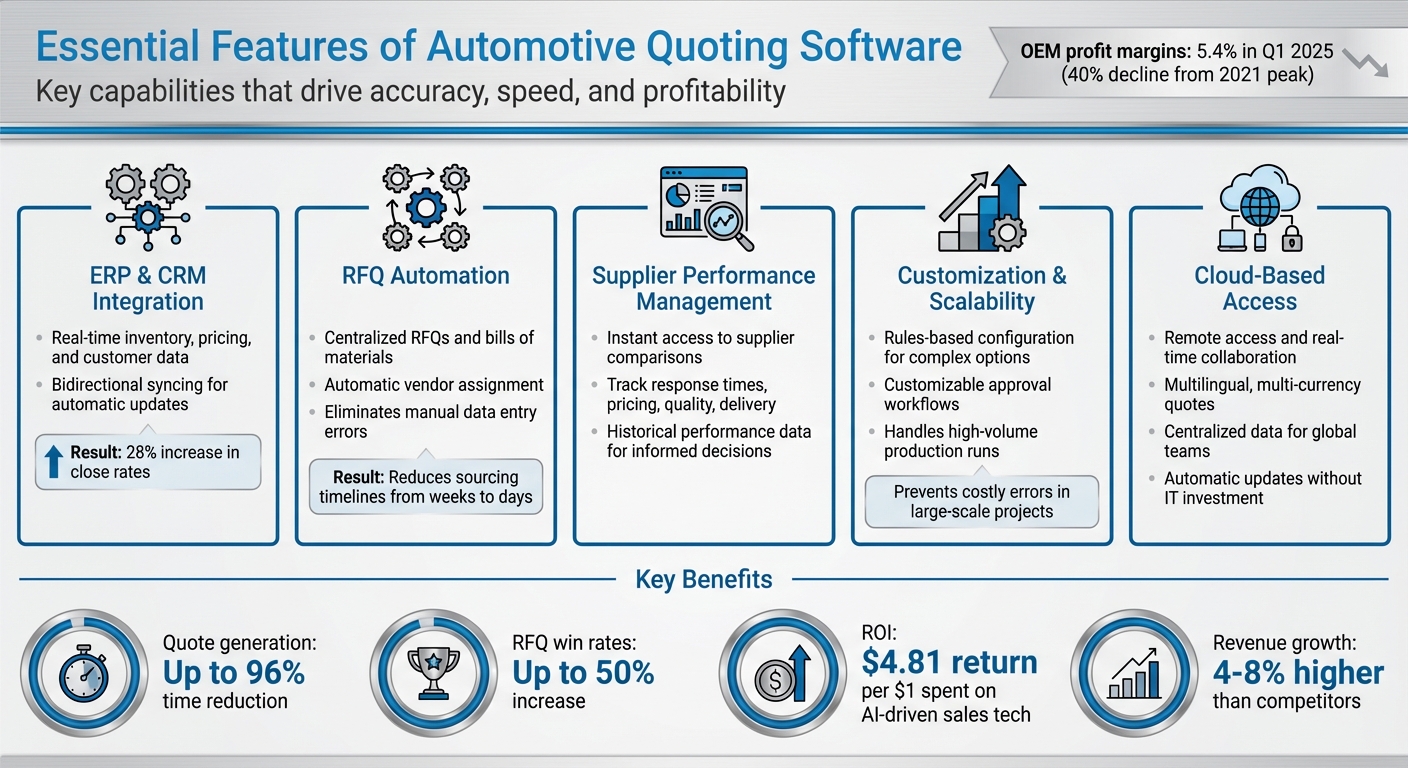
Essential Features of Automotive Quoting Software
Required Features in Automotive Quoting Software
Integration with ERP, CRM, and Costing Systems
Quoting software works best when it connects seamlessly with key enterprise systems like ERP, CRM, and costing platforms. This integration ensures smooth workflows, eliminating inefficiencies caused by disconnected tools. A strong connection with ERP systems allows the software to pull in real-time data on inventory, pricing, product availability, and discount rules. It also enables bidirectional syncing, so quotes can be generated with accurate pricing and orders can be updated automatically in the ERP system.
CRM integration is equally important, giving sales teams access to customer data and quote history in one place. Additionally, connecting with CAD and PLM systems ensures that technical drawings are generated automatically and that configured products can be manufactured without issues. These integrations are not just about convenience – they lead to measurable results. For instance, companies using integrated CPQ software have reported a 28% increase in close rates.
Sharing data across teams like sales, cost engineering, procurement, production, and finance prevents profit loss from spreadsheet errors or outdated information. As CPQ-Integrations.com explains, "CPQ software integrates seamlessly with ERP and CRM systems so that sales reps can access accurate customer information, updated pricing, and real-time product availability data". Combined with automation, these integrations create a more efficient and reliable quoting process.
RFQ Process Automation
Automating the request-for-quote (RFQ) process is a game-changer. By centralizing RFQs and bills of materials in one workspace, quoting software eliminates manual data entry and speeds up proposal generation. Vendors can be automatically assigned based on predefined logic, and supplier responses are captured without the need for additional portals.
Automation also brings real-time visibility into margins and enforces controls to avoid costly spreadsheet mistakes. A Sales Analyst from a Tier 1 Automotive Supplier shared, "I like the visibility of global opportunities. Prior to using [automation software], we would conduct Excel-based reporting… Now, we can check it daily, look at the reports daily, and see what is coming into the system and what needs to be managed".
Built-in workflow management ensures every quote undergoes a standardized review and approval process before it reaches the customer. Additionally, dynamic "what-if" modeling lets teams simulate scenarios like cost changes or capacity constraints, helping to protect margins even under shifting conditions.
Supplier Performance Management
Managing supplier performance is critical for making informed sourcing decisions. Quoting software should include tools that provide instant access to supplier comparisons, award analysis, and historical performance data. It should also track key metrics like response times, pricing competitiveness, quality, and delivery reliability. This data helps identify reliable suppliers and flags those that may pose risks, ensuring sourcing decisions are backed by solid insights.
Customization and Scalability
Automotive projects often involve hundreds of configuration options, from engines to trim packages and digital features. To handle this complexity, quoting software should use rules-based configuration to prevent invalid combinations of parts or features. This ensures that every quote is accurate, compliant, and aligned with customer expectations.
Customizable approval workflows are another must-have feature. For example, the software could trigger alerts or require additional sign-offs when discounts exceed certain thresholds, helping to maintain margin controls. Scalability is also key, especially for large-scale production runs and long-term projects. As product lines expand and dealer networks grow, the software must maintain accuracy and speed, avoiding small errors that could snowball into larger financial losses over time.
Cloud-Based Access
Cloud-based platforms bring flexibility, enabling remote access, real-time collaboration, and secure data sharing for global teams and suppliers. These systems unify all integrated functions, allowing international sales teams to access a centralized acquisition calendar and create multilingual, multi-currency quotes to cater to global markets.
Platforms like QSTRAT (https://qstrat.com) are great examples of how cloud deployment eliminates the challenges of spreadsheet-based systems, such as security risks and version control issues. With everyone accessing the same up-to-date data, teams can collaborate more effectively. Cloud architecture also supports automatic updates and scalability, so businesses can grow their quoting capabilities without heavy IT investments.
sbb-itb-827f251
Benefits of Using Automotive Quoting Software
Faster Supplier Sourcing
Quoting software removes the typical delays that come with sourcing suppliers. Instead of relying on manual methods like emails or phone calls to distribute RFQs, the software takes over, automatically assigning vendors based on predefined categories. Supplier responses are captured electronically, cutting out the need for manual data entry entirely. This centralized system makes it easier to evaluate bids and make award decisions quickly, giving teams a competitive edge. Suppliers also benefit by being able to secure a "first-to-bid" position. With real-time visibility into the process, teams can respond to new opportunities almost immediately. This streamlined RFQ management not only speeds things up but also improves cost accuracy and teamwork.
Better Cost Accuracy and Quote Speed
Manual quoting is prone to errors, especially in automotive production, where even small mistakes can have big consequences in high-volume runs. Quoting software replaces disconnected spreadsheets with a centralized system that uses rules-based configurations to prevent invalid product combinations. This ensures that all departments – sales, engineering, procurement, and finance – work from the same accurate data. Automated calculations factor in up-to-date material costs, labor rates, and pricing tiers, solving the common issue of getting "five different results from five different estimators". What used to take days can now be done in minutes. Features like automated approval workflows and built-in discount controls also protect profit margins. This is especially important given that OEM profit margins dropped to 5.4% in Q1 2025 – a significant 40% decline from their 2021 peak.
Better Collaboration and Communication
On average, automotive suppliers handle 495 RFQs each year. Managing this volume manually often leads to inefficiencies. Quoting software centralizes all critical information – like bills of materials, tooling timelines, cost drivers, and supplier communications – into one platform that everyone involved can access. Built-in communication tools allow teams to discuss quotes and specific line items in real time, reducing the chances of miscommunication.
A CEO from Klesk Metal Stamping highlighted this advantage:
"We have all relevant and related documentation in one centralized and digital location that we can share with our team so there is no miscommunication or risk that we will miss something on the quote".
This system also acts as an institutional memory, keeping critical information accessible even when employees leave the company. Cloud-based access further enhances collaboration, allowing global teams to work together in real time to align on customer expectations and cost targets. A QSTRAT client described the improvement:
"Our team is now utilizing a much more efficient process to collaborate, deliver and evaluate RFQs. This is a significant process improvement for us from the days of managing emails, faxes and spreadsheets".
Considering that only 25% of RFQs result in new business and responding to a single RFQ can cost up to $61,000 for large firms, these efficiency improvements are not just helpful – they’re financially critical.
How to Choose the Right Quoting Software
Identify Your Business Requirements
The first step in selecting quoting software is understanding your pricing complexity. Automotive sourcing, for example, often involves fluctuating material costs, labor rates, overhead, and intricate rules for taxes and discounts. If your business handles high-volume production, you’ll need software that can manage these variables efficiently without slowing down your workflow.
Another critical factor is integration. The software should work seamlessly with your ERP, CRM, accounting, and CAD/CAM systems to maintain real-time, unified data. It’s also essential for the software to support technical file formats like DXF, SolidWorks, and Inventor.
Consider your process requirements as well. High-value quotes often require internal approvals, peer reviews, and version controls to manage changes effectively. Wayne Cathers, Product Owner-Business Systems at SigmaNEST, highlights the importance of automation:
"With a quoting module, all this is automated and standardized… it gives shops that sense of stability that is so important for best business practices".
Lastly, think about scalability. Your software should grow alongside your business, handling an increasing volume of quotes without performance issues. Once you’ve outlined your needs, it’s time to evaluate usability.
Review User Interface and Ease of Use
A user-friendly interface is key to ensuring your team adopts the software quickly. Look for features like drag-and-drop functionality, pre-built templates, and guided selling rules that prevent incompatible product combinations. These tools simplify tasks and cut down on training time, boosting overall efficiency in the quoting process.
Conduct a pilot test with a small group of sales reps. Use real opportunities to measure how the software performs, especially when generating complex, multi-line quotes. Pay attention to its speed and reliability under heavy workloads. As Cloud CPQ adoption is expected to surpass 60% among B2B sales organizations by 2026, mobile and offline access will also be crucial for teams working in the field.
Early involvement of frontline users can provide valuable feedback on usability and help identify workflow challenges. Check for built-in support features like in-app guidance and detailed knowledge bases, which can reduce dependency on IT and shorten the learning curve.
Calculate Cost and ROI
Once you’ve defined your needs and evaluated usability, it’s time to calculate the total investment. Factor in subscription fees, integration costs, data migration, and onboarding expenses. Then, assess the return on investment (ROI) by looking at efficiency improvements, such as faster quote turnaround times and higher RFQ win rates.
The ROI potential is substantial. Sales teams, on average, see a return of $4.81 for every dollar spent on AI-driven sales technology. For quoting software specifically, users have reported up to a 96% reduction in the time it takes to generate quotes. Additionally, automated quoting can increase RFQ win rates by as much as 50%. Businesses that prioritize faster and more accurate quoting often see revenue growth 4–8% higher than their competitors.
Use the software’s reporting tools to compare current performance against historical benchmarks. Metrics like profit margins and win rates can help you measure the software’s impact. Automated systems also minimize risks by standardizing quotes, reducing reliance on individual estimators, and preventing errors like underquoting (which cuts into margins) or overquoting (which can lose contracts). These tools not only streamline operations but also help safeguard profitability.
Conclusion
Key Features for Automotive Quoting Software
To choose the best automotive quoting software, focus on features that streamline operations and enhance precision. Integration with systems like ERP, CRM, and accounting platforms eliminates repetitive tasks and ensures smooth data sharing. Automated tools – such as Bill of Materials generation and rule-based pricing that factors in regional tariffs – help reduce quote turnaround times. Tools for supplier performance management allow you to evaluate vendors based on quality, delivery, and cost, enabling smarter negotiations backed by data.
In the automotive parts and repair sector, incorporating OE repair time data and real-time stock availability from multiple suppliers ensures quotes are both accurate and timely. Built-in compliance and engineering rules ensure all configurations meet production standards, while version control and approval workflows safeguard margins and promote team-wide transparency.
Adopting modern sourcing tools can lead to measurable savings. For instance, one Japanese automotive OEM reported savings of 8–13% within just a week of implementing predictive procurement technology.
Steps Toward Smarter Sourcing
After identifying the essential features, the next step is customizing the software to fit your specific sourcing requirements. Consider your pricing models, integration needs, and scalability goals. Testing the software with real-world opportunities can validate its ability to handle complex, multi-line quotes. Faster quoting processes directly boost your chances of winning bids.
These advanced tools pave the way for more strategic sourcing. Modern quoting software turns procurement from a reactive process into a proactive one. It standardizes sourcing activities across locations, enables price comparisons to uncover immediate savings, and ensures consistent vendor evaluations. The result? Faster quotes, better margins, and stronger supplier relationships – all of which help your automotive business stay competitive and poised for growth.
FAQs
How hard is it to connect quoting software to our ERP and CRM?
Connecting quoting software to ERP and CRM systems can range from straightforward to complex, depending on the compatibility of the platforms and the level of integration required. Many modern tools, such as QSTRAT, are built to integrate smoothly, often leveraging APIs or pre-built connectors to facilitate real-time data exchange.
However, when dealing with older systems or heavily customized setups, the process might demand extra development work. With the right planning and approach, these challenges can be addressed, leading to improved efficiency and more accurate data management.
What data is needed to automate RFQs and compare suppliers?
Automating RFQs (Requests for Quotations) and comparing suppliers effectively hinges on having detailed and precise data. This includes supplier information, product specifications, and a breakdown of cost components. Key factors to focus on are:
- Accurate pricing: Ensures clarity and helps avoid unexpected costs.
- Supplier performance metrics: Tracks reliability, delivery times, and past performance.
- Compliance details: Verifies adherence to regulations and standards.
- Cost drivers: Accounts for logistics, customs, and other related expenses.
When these elements are combined with technical requirements and quality standards, it creates a system that promotes transparency. This approach not only validates supplier responses but also ensures consistent comparisons, making it easier to make well-informed decisions.
How do we measure ROI after rolling out quoting software?
To determine ROI, focus on the revenue boost and cost reductions achieved through the software. Pay attention to key indicators like faster quote generation, reduced errors, and higher win rates. For instance, automating the quoting process can dramatically shorten sales cycles and cut down on manual work. Monitor these metrics consistently over time to gauge the financial benefits and overall ROI.
Related Blog Posts
You may also like

Top 7 Tools For Supplier Relationship Management
Compare seven SRM platforms by features, integrations, and scalability to find the right supplier management solution.

Supplier Certification: Why It Matters for Compliance
Supplier certification is a strategic safeguard that prevents regulatory breaches, supply disruptions, and reputational damage.