


When suppliers fail to meet deadlines or deliver defective materials, it can disrupt production and lead to costly delays. A supplier escalation process helps resolve these urgent issues by involving higher management levels in a structured manner. Unlike preventive measures, escalations focus on fixing immediate problems like delivery delays, quality defects, or contract breaches.
Key Takeaways:
- What it is: A step-by-step process to address unresolved supplier issues, moving from operational staff to C-level executives based on severity.
- Why it matters: Prevents production stoppages, reduces downtime, and minimizes financial losses.
- Triggers: Quality failures, delivery delays over 48 hours, cost deviations above 10%, or unresponsive suppliers.
- Steps: Use an escalation matrix to define roles, timelines, and resolution levels (e.g., operational, tactical, strategic).
- Metrics: Track response times, issue recurrence, and cost impacts to improve efficiency.
A well-defined escalation process ensures issues are resolved quickly, avoiding disruptions while maintaining strong supplier relationships.
Common Triggers for Supplier Escalations
Typical Escalation Triggers
Recognizing when to escalate a supplier issue can help prevent small problems from snowballing into major disruptions. Quality failures often top the list of triggers. These include repeated product defects, materials that fail to meet specifications, or subpar goods that interfere with production. Delivery disruptions are another critical area – especially when suppliers repeatedly miss deadlines or delays extend beyond 48 hours, threatening to halt production.
Contractual and financial issues also demand attention. Examples include breaches of contract, failure to meet agreed-upon KPIs, or unexpected price hikes mid-project without valid justification. Compliance violations – such as those that could lead to legal trouble or harm your company’s reputation – are equally serious. Finally, communication breakdowns are a red flag. If a supplier fails to respond to concerns or show progress within 72 hours, it’s often a sign that operational-level discussions have stalled, requiring higher-level intervention.
For instance, The Timken Company escalates issues to Level B if a supplier ranks in the top 10 for global Discrepant Material Reports (DMRs) over three months or fails to respond to two or more DMRs within 30 days. Level C escalation is triggered by "High Risk DMRs" – such as overheating issues or mixed steel – or a total breakdown in quality system control.
Similarly, Nexteer Automotive employs a Problem Case Management System. A single Problem Case triggers Level 0, two Problem Cases or one customer-impact case lead to Level 1, and four or more Problem Cases result in Level 3 escalation.
Having clear, measurable thresholds ensures that these triggers are handled consistently and effectively.
Setting Escalation Thresholds
Establishing clear thresholds simplifies the decision to escalate. For instance, cost deviations exceeding 10% are a common benchmark in manufacturing, while delivery delays over 48 hours often push an issue from operational to tactical management. In terms of quality, a 30% increase in defect rates typically signals an urgent need for escalation.
Time-based thresholds are just as important. If an issue remains unresolved for 24–48 hours, it should be escalated immediately. Similarly, if a supplier fails to respond to formal complaints within 30 days or shows no progress within 72 hours, higher-level management must step in. In more severe cases, such as falsified records or unauthorized outsourcing, immediate escalation to the strategic level may be required, bypassing lower levels entirely.
| Escalation Level | Typical Trigger Criteria | Resolution Timeline |
|---|---|---|
| Level 1 (Operational) | Single quality defect, delivery delay < 48 hours, or 1–2 problem cases | 24–48 Hours |
| Level 2 (Tactical) | Repeated defects, cost deviations > 10%, or 3 problem cases | 2–5 Days |
| Level 3 (Strategic) | Production stoppage, 4+ problem cases, or worsening under escalation | 1–2 Weeks |
These thresholds provide a structured approach to identifying when and how to escalate, ensuring that problems are addressed before they spiral out of control.
sbb-itb-827f251
Escalation Management : Practice Successful Escalation Management for Manufacturing Operations
Building an Escalation Process
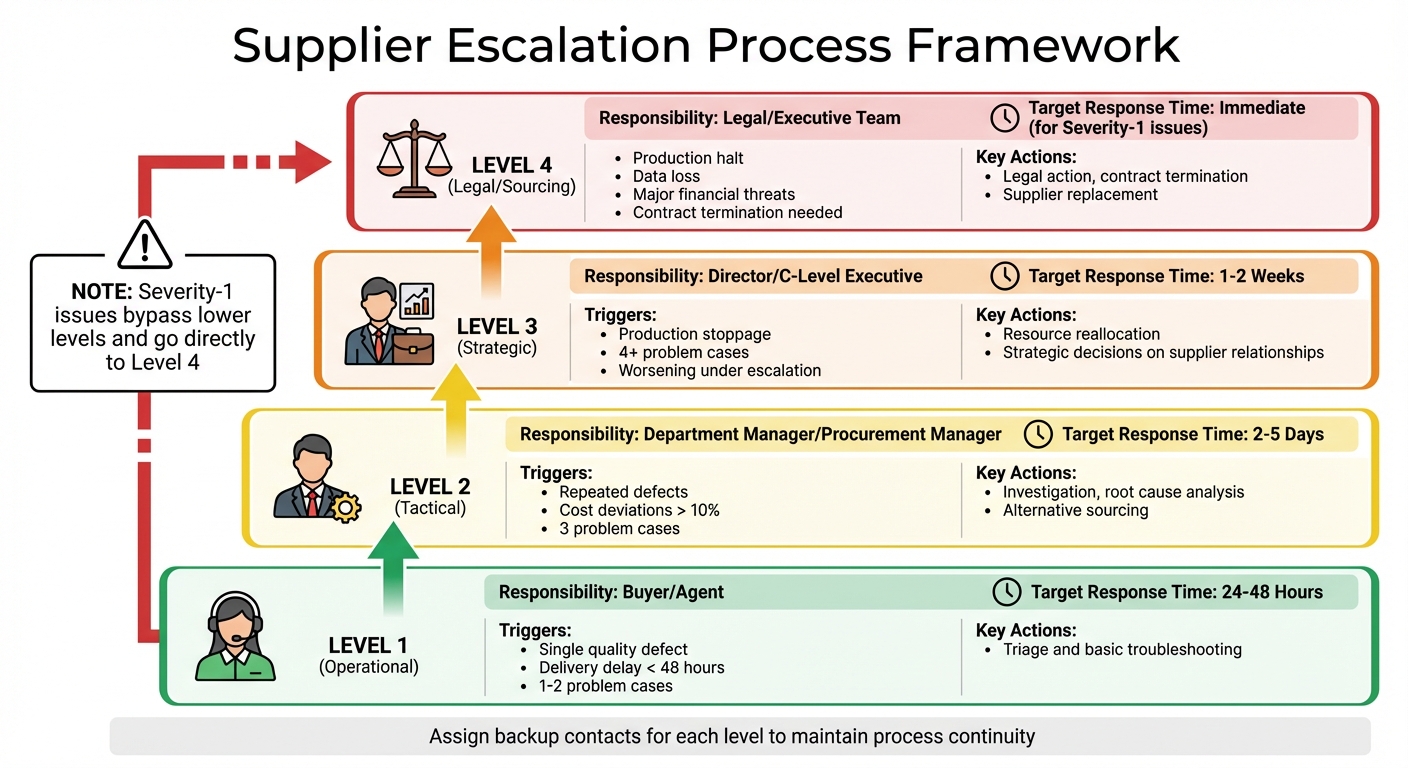
Supplier Escalation Process: 4-Level Framework with Response Times and Triggers
Creating an Escalation Matrix
An escalation matrix acts as your crisis blueprint, detailing who to contact, when to escalate, and how quickly each step needs to happen. Without this structure, key issues can either be overlooked or stall at the wrong level of management.
To build an effective matrix, focus on four essential elements: severity definitions, escalation levels, responsible roles, and response timelines. Instead of naming specific individuals, use job titles like "Lead Engineer" or "Procurement Manager." This keeps the matrix relevant even when team members change, avoiding the risk of it becoming outdated or forgotten.
A typical escalation matrix includes three to four levels:
- Level 1 (Operational): Handles initial contact and basic troubleshooting, often managed by buyers or administrators. Response time is typically 24–48 hours.
- Level 2 (Tactical): Involves department heads or senior staff for more complex issues, with a resolution timeframe of 2–5 days.
- Level 3 (Strategic): Engages directors or C-level executives for high-stakes problems, aiming for resolution within 1–2 weeks.
- Level 4 (Legal/Sourcing): Reserved for critical situations like contract termination or supplier changes, requiring immediate legal intervention.
| Escalation Level | Responsibility | Target Response Time | Key Actions |
|---|---|---|---|
| Level 1 | Buyer/Agent | 24–48 Hours | Triage and basic troubleshooting |
| Level 2 | Department Manager | 2–5 Days | Investigation and alternative sourcing |
| Level 3 | Director/C-Level | 1–2 Weeks | Resource reallocation and key decisions |
| Level 4 | Legal/Executive | Immediate (if Sev-1) | Legal action or contract termination |
Make sure to assign backup contacts for each level so the process remains functional during absences like vacations. Regularly review and update the matrix – quarterly audits are a good practice to keep contact details and severity criteria current.
Once your matrix is ready, follow a clear and structured process to escalate issues efficiently.
Escalation Process Steps
Using the matrix as a guide, here’s how the escalation process unfolds from detection to resolution. Start by documenting any issue that meets escalation criteria, including details like the supplier’s name, the type of issue, financial risks, and deadlines.
At Level 1, the buyer or support agent works to resolve the issue through direct communication with the supplier and basic troubleshooting. If the problem isn’t resolved or worsens, it escalates to Level 2, where procurement managers investigate root causes and explore alternative solutions. For issues with serious financial or operational risks, Level 3 comes into play, requiring directors to make strategic decisions about resources and supplier relationships.
For the most severe incidents – like production halts, data loss, or major financial threats – the process skips lower levels entirely. These Severity-1 situations demand immediate escalation to Level 4, with no delay. As one expert put it, "Your job isn’t to fix this; your job is to sound the alarm". It’s also important to differentiate between hierarchical escalation (moving up the chain of command for decisions or budgets) and functional escalation (redirecting to specialized teams like Legal or InfoSec), as some issues may require both paths.
This structured approach ensures timely resolutions while minimizing downtime and risks.
Communication and Documentation Standards
Clear communication and thorough documentation are essential for a smooth escalation process. Teams need to agree on what qualifies as an "issue" versus an "emergency" to avoid unnecessary confusion or missed critical incidents.
Every escalation should include:
- A clear problem description
- Actions taken so far
- Any agreements or decisions made
- The reasoning behind those decisions
- Final outcomes
Organize and store the escalation framework and contact lists in easy-to-access locations, such as a company wiki or pinned team channels. Integrated helpdesk tools can also be useful for quick reference. Ensure tasks are closed only after suppliers provide the required evidence, which should then be validated by a Quality Engineer. Automated reminders can help track statuses and avoid delays caused by unclear responsibilities.
After resolving significant issues, conduct post-mortems to review the matrix’s effectiveness, identify any bottlenecks, and update contact information as needed. Keep discussions focused on solutions rather than assigning blame – this approach helps maintain healthy supplier relationships. Digital platforms equipped with automated alerts and tracking features can further improve response times and accountability.
Measuring Escalation Process Performance
Once you’ve established an escalation matrix and set clear thresholds, the next step is measuring how well the process works. Tracking performance metrics turns your escalation framework into a tool for ongoing improvement, connecting process design with practical outcomes.
Key Performance Indicators for Escalations
Start by monitoring escalation frequency and rate – how often issues are escalated per supplier over a given timeframe. A high rate could indicate underlying issues in supplier selection or development. Keep an eye on Mean Time to Response (MTTR) at each escalation level to see how quickly your team acts when problems arise. For a broader view of efficiency, measure the time from when an escalation is triggered to when it’s fully resolved, and track the percentage of cases closed within your defined timelines.
Another key metric is issue recurrence rates, which reveal whether your corrective actions are long-lasting or just temporary fixes. Additionally, calculate the cost impact of escalations, factoring in staff hours, production downtime, and the expense of sourcing alternative suppliers. Finally, evaluate solution quality by gauging whether internal stakeholders and customers are satisfied with the resolution.
In high-performing supply chains, incident frequency usually stays under 0.5%, while mature supplier groups often maintain defect and return rates below 1%. Structured escalation processes have been shown to cut response times by up to 60%, as seen in the automotive industry.
| Metric | Before Structured Process | After Implementation |
|---|---|---|
| Average Response Time | 3 Days | 8 Hours |
| Annual Production Stoppages | >12 | 0 |
| Annual Cost Savings | $0 (Reactive) | $2.3 Million (Preventive) |
Consider this example from a November 2025 automotive supplier case: Stage 1 addressed delays of up to 24 hours through purchasing clerks. Stage 2 escalated issues to procurement managers to find alternative suppliers. Stage 3 involved C-level management for critical production stoppages, requiring decisions within 4 hours. The result? The company avoided 12 production stoppages in just one year.
With these metrics in place, the next step is using the data to refine and improve your escalation process.
Using Data to Improve Escalation Processes
Data analytics can pinpoint weak spots in your escalation process, just as clear documentation and communication serve as its backbone. For example, track metrics like Time to Escalate and multi-escalation rates to identify delays and gaps in ownership. Analyze the Time to Escalate (the period between identifying a problem and involving management) at different percentiles – median, 75th, and 90th – to locate bottlenecks. A high multi-escalation rate – cases that require escalation more than once – often points to unclear ownership, poor knowledge transfer, or insufficient authority at lower levels.
Visual tools like Sankey diagrams can map common escalation paths, highlighting where issues tend to stall. In mixed-support settings, functional escalation rates generally range from 15% to 30%, while top-performing organizations keep them between 10% and 20%. Escalations to managers or executives should ideally stay below 2% to 5%; higher rates may indicate systemic policy or service quality issues.
Use Pareto analysis on standardized escalation reason codes (e.g., "authority limit", "knowledge gap", or "product defect") to identify which areas need the most attention. Heatmaps of escalation rates by supplier, product category, or region can help you spot trends and geographic or category-specific trouble spots. If you notice frequent managerial escalations for minor financial adjustments, consider expanding the authority of operational buyers to handle these issues within set limits.
Transparency is key when sharing metrics with your suppliers. As Wali Alam, Founder of the Quality Institute of America, explains:
"Organizations that succeed in supplier quality management use metrics not as punitive tools, but as a basis for collaboration, risk reduction, and continuous improvement".
How QSTRAT Supports Supplier Escalation Management
Handling supplier escalations becomes much smoother with the right tools in place. QSTRAT’s cloud-based platform streamlines the entire process – from identifying issues to resolving them – by automating workflows, centralizing communication, and delivering real-time insights into supplier performance. This ensures manufacturers and distributors can tackle critical supplier challenges effectively.
QSTRAT Features for Escalation Management
QSTRAT simplifies escalation management with configurable approval workflows that automatically route alerts based on the severity of issues like delivery delays, quality concerns, or contract violations. When performance thresholds are breached, the system ensures that the appropriate management level is looped in at the right moment. Real-time dashboards consolidate supplier KPIs, automatically flagging problems and eliminating the need for manual tracking.
During escalations, the platform’s features – like secure messaging portals, shared workspaces, and automated notifications – enable real-time collaboration while maintaining SOX-compliant documentation. Suppliers can respond easily through system-generated emails and e-forms, keeping communication streamlined.
QSTRAT’s impact is evident in its numbers: over $5 billion in RFQs processed across 22 countries, with some teams operational in just five days. BAE Systems, for example, has used QSTRAT not only for price comparisons but also as a way to educate suppliers. They shared:
"For BAE, QSTRAT Sourcing is much more than a great tool to compare price, labor, raw material, packaging, and transportation among our suppliers. It’s helping BAE become a better manufacturer by using QSTRAT Sourcing as a learning tool for suppliers. Through this process we are driving our quality initiatives forward".
These tools and features empower teams to address supplier issues efficiently and effectively.
Benefits for Manufacturing and Distribution Teams
QSTRAT’s automation significantly reduces the time it takes to resolve escalations by triggering alerts and notifications that speed up response times. It integrates seamlessly with existing CRM and ERP systems, breaking down data silos that often slow down escalation processes.
For industries like aerospace and medical device manufacturing, QSTRAT offers traceable documentation and workflows designed to meet quality and regulatory requirements. The platform can analyze over 50 data points from qualified suppliers, supporting rigorous Supplier Quality programs and ensuring FDA compliance. In the automotive sector, QSTRAT aids New Product Introduction processes, manages global quote teams to meet cost goals, and monitors supplier performance in real time.
By using shared performance scorecards and real-time communication tools, QSTRAT encourages collaborative problem-solving, fostering stronger supplier relationships rather than adversarial ones. This approach not only resolves problems faster but also promotes long-term fixes. Built-in analytics track key metrics – such as escalation frequency, average resolution times by severity, and recurrence rates – allowing teams to refine their strategies based on data.
With these features, QSTRAT equips manufacturing and distribution teams to handle supplier escalations with precision and efficiency.
Conclusion
Handling supplier escalations effectively hinges on having a clear, structured process in place. This process should outline escalation levels, responsibilities, and timelines to address critical issues quickly and efficiently. Without such a framework, problems like quality defects, delivery delays, and cost overruns can persist, disrupting production and weakening your leverage with suppliers.
The numbers back this up: implementing a structured escalation process can cut response times for critical procurement issues by as much as 60%. The most effective models typically feature 3 to 4 escalation levels, ranging from operational teams to strategic management, with clearly defined thresholds (e.g., delivery delays exceeding 48 hours or cost deviations above 10%). These thresholds help eliminate confusion and ensure timely action.
Thorough documentation is another key component. Beyond offering legal protection, it turns reactive problem-solving into proactive supplier management by highlighting recurring issues. Tracking patterns like escalation frequency, resolution times, and repeat problems enables teams to move away from constantly "putting out fires" and toward more strategic decision-making.
Modern cloud-based tools like QSTRAT take this a step further by addressing the inefficiencies of manual tracking and scattered communication. With features like automated workflows, real-time performance tracking, and centralized documentation, these platforms streamline the escalation process. They also help preserve institutional knowledge, ensuring the system remains effective even during staff transitions. This allows teams to focus on optimizing supplier relationships instead of chasing updates.
The ultimate aim is to resolve critical issues promptly while fostering strong, collaborative supplier partnerships. By combining structured processes with advanced technology, supplier escalations become less of a crisis and more of a manageable part of supply chain operations.
FAQs
How do I decide when to escalate a supplier issue?
Persistent supplier issues, such as repeated failures in quality, delivery, or compliance, call for escalation when corrective actions don’t resolve the problems. To keep tabs on supplier performance, it’s essential to monitor key performance indicators (KPIs) and risk indicators. Escalation becomes critical when these failures begin to disrupt operations, create compliance risks, or threaten the supply chain’s stability. A well-structured review process helps tackle these challenges effectively, ensuring problems are addressed while reducing operational risks.
What should an escalation matrix include?
An escalation matrix lays out a clear, step-by-step framework for handling issues, especially when they involve suppliers. It should detail tiered support levels, specifying how and when to escalate a problem to the next level. Key components include:
- Progression criteria: Define the conditions under which an issue moves to a higher tier.
- Contact details: Provide up-to-date information for all relevant stakeholders, ensuring quick communication.
- Severity or priority levels: Establish categories to rank issues based on their urgency or impact.
- Escalation procedures: Outline the exact steps for involving higher management or advanced support teams.
When these elements are in place, it creates a structured and efficient way to tackle supplier-related challenges, minimizing delays and confusion.
How can I measure if escalations are effective?
To gauge how well escalation processes are working, focus on a few key areas:
- Track resolution times: Monitor how long it takes to resolve issues after escalation. Shorter times often indicate a smoother and more effective process.
- Evaluate corrective actions: Assess whether the steps taken to address problems are solving the root cause and preventing recurrence.
- Review supplier performance metrics: Regularly analyze data like delivery timelines, quality rates, or compliance scores to spot patterns or areas needing improvement.
Incorporate structured performance reviews and leverage real-time data to identify trends. This approach helps ensure that your escalation processes align with your overall supplier management goals.
Related Blog Posts
You may also like

Top 7 Tools For Supplier Relationship Management
Compare seven SRM platforms by features, integrations, and scalability to find the right supplier management solution.

Supplier Certification: Why It Matters for Compliance
Supplier certification is a strategic safeguard that prevents regulatory breaches, supply disruptions, and reputational damage.