


Manufacturers lose time, money, and deals when relying on outdated quoting methods like spreadsheets and email. Centralized quote tools solve these issues by automating workflows, reducing errors, and speeding up approvals. Here’s what you need to know:
- Manual quoting costs manufacturers up to 5% of annual revenue.
- 88% of decision-makers lose deals due to inefficiencies.
- 71% of manufacturers take over a day to create a single quote.
Centralized tools consolidate data, enforce pricing rules, and integrate with existing ERP/CRM systems. They improve accuracy by validating product specs, shorten sales cycles, and provide real-time access to critical data. The result? Faster quotes, fewer errors, and higher profitability.
Example: QSTRAT, a leading platform, has processed over $5 billion in RFQs globally, cutting RFQ turnaround times from 8 days to just 48 hours.
For manufacturers, adopting centralized quoting tools isn’t optional – it’s the key to staying competitive in today’s fast-paced market.
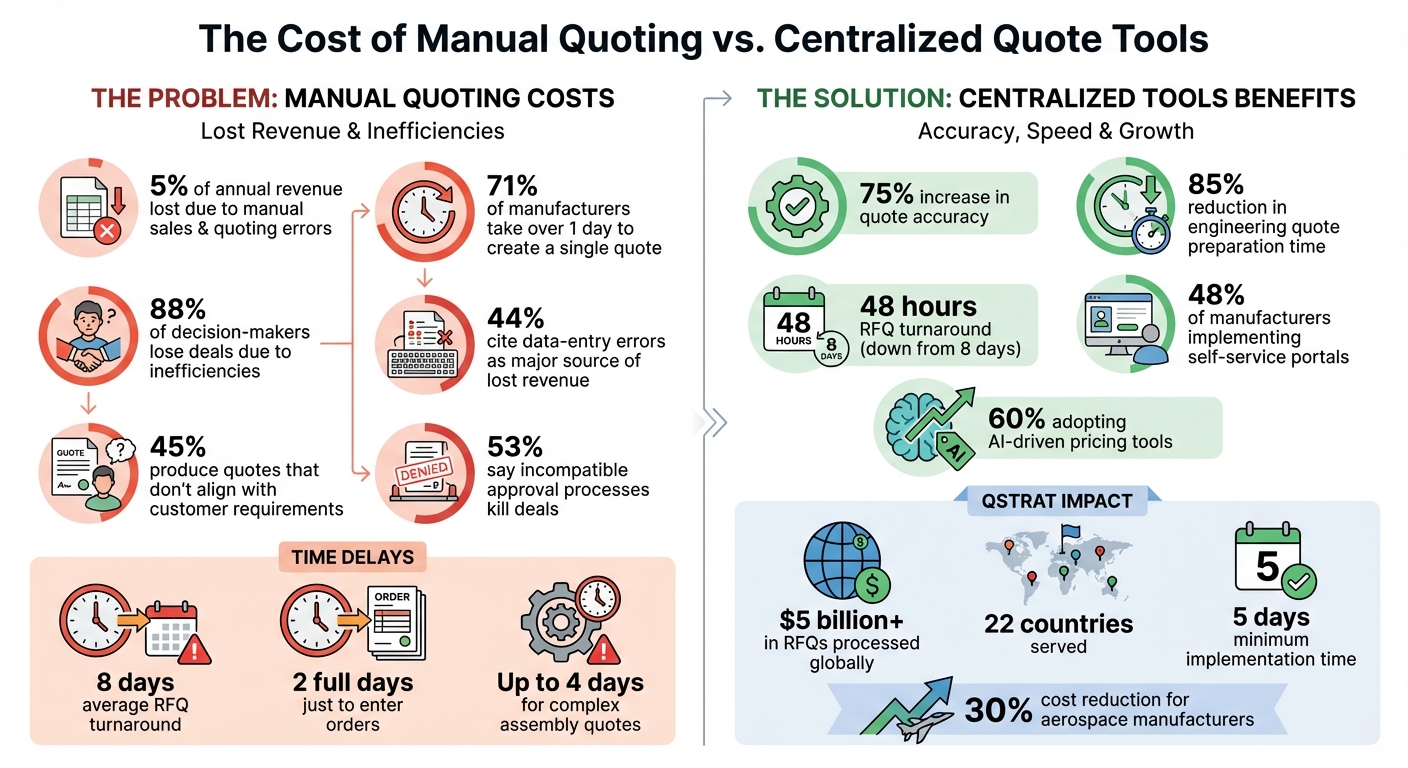
The Cost of Manual Quoting: Key Statistics for Manufacturers
ERP Software for Manufacturing: Streamline Quote Generation and Save Time with M1
sbb-itb-827f251
Problems with Scattered Quoting Processes
When quoting systems are spread out across multiple platforms, manufacturers face a host of challenges. These disjointed methods slow down operations, cut into revenue, and shake customer confidence – sometimes causing deals to fall apart before they even begin. Let’s dive into the specific obstacles tied to manual and decentralized quoting.
Manual Errors and Inconsistent Pricing
Quoting with spreadsheets is a recipe for mistakes. Sales teams frequently encounter data-entry errors and formula mishaps when manually inputting pricing, material costs, or product specs. It’s no wonder that 44% of manufacturers point to data-entry errors as a major source of lost revenue. Even a single pricing mistake can cost thousands of dollars or drive a customer away.
On top of that, decentralized quoting systems lead to inconsistent pricing. Without a unified set of rules, sales reps may offer varying discounts to similar customers, resulting in revenue losses and a loss of trust. Configuring complex products manually adds another layer of risk – quotes often don’t align with production capabilities, leading to expensive rework and unhappy customers.
And it’s not just about accuracy – these manual processes slow everything down, dragging out the quoting timeline.
Longer Sales Cycles and Delayed Approvals
While errors cut into profits, inefficiencies bog down the sales cycle. Scattered systems force teams to waste time chasing information. Sales reps may spend hours retrieving pricing data, manually verifying inventory, or waiting for approvals. This constant back-and-forth frustrates customers who are ready to move forward.
Fragmented systems make the situation worse by complicating approval workflows. For instance, 53% of manufacturers say that incompatible approval processes are a major reason manual quoting kills deals. Take the example of an air movement and control equipment manufacturer: before switching to a centralized system, it took them two full days just to enter orders. For complex assemblies, some manufacturers report that generating a single quote can take up to four days.
Limited Visibility and Real-Time Data Access
Fragmented systems also block access to critical, real-time data. Data silos between sales, finance, and operations prevent teams from seeing current inventory levels, accurate production costs, or the latest supplier performance stats. This means quotes are often based on outdated information, leaving them out of sync with customer needs.
The lack of centralized visibility creates another problem: teams can’t easily track quote history or reuse past configurations. Instead, they’re forced to start from scratch for every request, recalculating costs and lead times for jobs they’ve already handled. This duplication of effort doesn’t just waste time – it also increases the chance of inconsistencies across quotes for similar products.
Centralized Quote Tools: A Modern Solution
Manufacturers no longer need to struggle with scattered quoting systems. Centralized quote tools bring all quoting activities under one roof. These platforms automate workflows, enforce pricing rules, and integrate seamlessly with ERP and CRM systems. By replacing outdated methods, they provide manufacturers with a streamlined, efficient way to manage quotes. Let’s dive into what makes these tools so effective.
What Are Centralized Quote Tools?
Centralized quote tools offer a single, automated solution to the chaos of fragmented quoting processes. Acting as a secure hub for quoting data, they consolidate material costs, labor rates, and process information in one place. When a Request for Quote (RFQ) comes in, the system can pull key details and generate Bills of Materials (BOMs) automatically – no need for manual input.
But they don’t stop at consolidation. These tools validate configurations against production capabilities, ensuring that product designs are both feasible and compliant with business rules. This eliminates the risk of incompatible feature combinations that can arise with manual quoting methods.
By replacing sticky notes, shared drives, and endless email chains with a centralized system, manufacturers can tie all documentation directly to part files or line items. Jeff Marone, CEO of Klesk Metal Stamping, highlights the impact:
"We have all relevant and related documentation in one centralized and digital location that we can share with our team so there is no miscommunication or risk that we will miss something on the quote".
Core Features of Centralized Quote Tools
These platforms don’t just simplify quoting – they also make it smarter and faster. Here’s how:
- Dynamic Pricing: Centralized tools use variables like volume discounts, customizations, and account-specific mark-ups to calculate prices automatically, delivering tailored quotes quickly.
- Secure Quote Repository: All communications and specifications are stored in one place, making it easy to retrieve and edit historical RFQs. No more starting from scratch with every request.
- Supplier Communication Tools: Automated emails and eForms simplify supplier interactions, creating a complete audit trail with time, date, and name stamps. This is especially helpful for regulatory compliance.
Together, these features revolutionize the quoting process, making it faster, more accurate, and consistent. They’re the backbone of the improved workflows and reliability that centralized quote tools bring to manufacturers.
Key Benefits of Centralized Quote Management
Centralized quote management tools address common challenges in the quoting process, delivering measurable improvements. For example, businesses using these tools report a 75% increase in quote accuracy. When nearly half of manufacturing decision-makers (44%) identify data-entry errors as a key reason manual quoting derails deals, the need for automation becomes undeniable. Here’s a closer look at the benefits these tools bring to manufacturers.
Better Accuracy and Fewer Errors
Manual quoting often leads to costly mistakes. In fact, 45% of manufacturers admit that manual processes result in quotes that don’t align with customer requirements. This means almost half of all quotes could fail before they even reach the customer. Centralized tools solve this issue by using rule-based configurations to validate product specs against actual production capabilities. This ensures sales teams can’t quote components or features that can’t be manufactured.
Errors in manual sales and quoting processes cost B2B manufacturers 5% of their revenue annually due to rework, rejected quotes, and lost deals caused by pricing errors. With automated validation, every required field is completed and checked before a quote is finalized. Integration with ERP and CRM systems ensures consistent, accurate data across departments.
"CPQ software can automatically calculate the correct price taking all of these variables into consideration, helping ensure the accuracy of pricing within your quotes."
– Tarak Patel, Aleran Software
This enhanced accuracy also speeds up the quoting process, reducing delays caused by errors.
Faster Quote Generation and Approvals
Manual quoting is notoriously slow – 71% of manufacturers take at least a full day to produce a single quote. Centralized tools can cut RFQ turnaround times from 8 days to just 48 hours and reduce engineering quote preparation time by up to 85%. This speed advantage is crucial in competitive markets. Instead of spending hours double-checking specifications and recalculating costs, engineers can focus on higher-priority tasks. Real-time integration with machine data and ERP systems ensures instant access to material availability and labor costs, eliminating back-and-forth delays with other departments.
Approval processes also become smoother. These tools generate quotes formatted for enterprise systems like SAP Ariba and Coupa, fitting seamlessly into existing approval workflows without requiring manual adjustments. This is critical since 53% of manufacturing decision-makers cite complex approval processes as a significant barrier when using manual quoting.
Better Collaboration and Visibility
Centralized systems eliminate data silos that often hinder manufacturing teams. When quote details are scattered across emails, spreadsheets, and personal drives, teams lack access to complete and up-to-date information. A unified platform ensures that sales reps, engineers, and managers work with the same real-time data, while role-based permissions protect sensitive information.
Supplier collaboration also improves. Buyers can compare bids in real time, speeding up the award process. Automated reminders ensure suppliers submit bids on time, while standardized eForms prevent confusion caused by inconsistent formats. Additionally, the system logs every interaction with time-stamped audit trails, which are essential for SOX compliance and maintaining accountability.
Manufacturers are also extending visibility to external partners. Nearly 48% of manufacturers are implementing self-service customer portals, allowing dealers and distributors to configure products and generate quotes within pre-set pricing rules. This transparency accelerates the sales process while maintaining control over pricing and margins.
Higher Profitability Through Dynamic Pricing
Accurate pricing directly impacts profitability. Centralized tools use real-time data – like volume discounts, customizations, and account-specific markups – to calculate prices automatically. This eliminates the guesswork and manual errors that can erode margins. Sales reps can instantly see how different configurations affect pricing, helping them guide customers toward more profitable options.
AI-driven pricing tools are also making waves, with 6 in 10 manufacturers adopting these systems to refine pricing strategies. By analyzing historical data, competitor pricing, and market trends, these tools recommend optimal prices that boost win rates while protecting margins.
"AI-enabled quoting and buying experiences aren’t nice-to-have features – they’re business-critical. The data clearly shows that manufacturers clinging to manual processes are losing real revenue."
– Brenda Nobleza, Vice President of Channel Solutions, Epicor
Easy Integration with Existing Systems
Modern centralized quote tools integrate seamlessly with ERP, CRM, and costing systems, creating a unified operational environment. This means quote data automatically syncs across your organization, eliminating duplicate work and version control issues. Once a quote is approved, production teams can immediately start preparing for the order using accurate specifications and timelines. Material requirements flow directly to purchasing, and revenue projections update in financial systems – all without manual data entry. This streamlined process ensures efficiency and accuracy at every stage.
Why QSTRAT Is the Right Choice for Manufacturers
QSTRAT offers a tailored solution that transforms how manufacturers handle quoting and sourcing. By providing a unified platform, it eliminates the inefficiencies of fragmented quoting processes. Impressively, QSTRAT has supported manufacturers in issuing over $5 billion in RFQs across 22 countries. One of its standout features is the speed of implementation – some clients have been fully operational in as little as five days.
Simplified Supplier Sourcing and Quoting
QSTRAT’s eForm technology simplifies supplier communication significantly. Suppliers no longer need to navigate complex portals; instead, they can respond to RFQs using standard PDF readers, requiring no extra training or costs. The platform automates the workflow, from requisitions to approvals, and uses AI-driven tools to flag quotes outside acceptable ranges while providing benchmarking data to help reduce material costs. Additionally, the reuse feature allows manufacturers to quickly locate and edit similar previous RFQs, saving time on quote generation. All interactions are logged with SOX-compliant audit trails, ensuring transparency and accountability.
Integration and Scalability for Growing Businesses
QSTRAT integrates effortlessly with existing CRM, ERP, and costing systems, creating a centralized hub for quoting and sourcing data. Manufacturers can load sourcing events directly from costing data or spreadsheets, and the platform provides side-by-side comparison tools for supplier responses, streamlining award selection. Deployment options are flexible, with cloud, on-premise, or hybrid setups available to meet varying security needs. Whether for small teams or global enterprises managing complex supply chains, QSTRAT scales to support operations as businesses expand.
Industry-Specific Applications
QSTRAT addresses the unique needs of highly regulated industries. For aerospace manufacturers, it manages supplier onboarding and AS9100 risk-based qualification processes, helping companies cut costs by up to 30% through improved procurement interfaces. Medical device manufacturers benefit from built-in support for FDA requirements, process validation, and Approved Supplier Lists (ASL). High-tech manufacturers can track RoHS and REACH compliance, while automotive suppliers use the platform to navigate the demanding New Product Introduction (NPI) process and meet cost targets with ABC costing.
BAE Systems exemplifies QSTRAT’s impact, using it to analyze costs across labor, raw materials, packaging, and transportation. For BAE, the platform is more than a price comparison tool:
"For BAE, QSTRAT Sourcing is much more than a great tool to compare price, labor, raw material, packaging, and transportation among our suppliers. It’s helping BAE become a better manufacturer by using QSTRAT Sourcing as a learning tool for suppliers."
– BAE Systems
Similarly, Carl Zeiss uses QSTRAT to gather over 50 data elements from suppliers during the bidding process, leveraging this information to conduct trial runs and transition products to full production volumes.
Conclusion
Manual quoting processes often lead to lost revenue, delayed approvals, and missed deals – problems that fragmented workflows and frequent errors only make worse.
Centralized quoting tools tackle these challenges head-on by combining CRM, ERP, and sourcing systems into one unified platform. They eliminate the need for manual data entry, speed up approval workflows, and offer real-time insights into pricing and supplier performance. The result? Faster turnarounds, fewer mistakes, and improved profitability. For manufacturers today, these tools are becoming essential.
QSTRAT is a prime example of this kind of solution. It addresses these pain points with rapid deployment and features tailored to compliance needs, helping manufacturers achieve both efficiency and accuracy. With over $5 billion in RFQs issued across 22 countries and implementation times as short as five days, QSTRAT delivers results quickly. Whether you’re in aerospace, medical devices, automotive, or high tech, the platform is built to scale with your needs while ensuring full audit trails and regulatory compliance.
For manufacturers looking to modernize their quoting processes, centralized tools aren’t just an improvement – they’re a must-have. The real question is no longer if you should adopt them, but how soon you can get started.
FAQs
What should a centralized quote tool include?
A centralized quote tool is designed to simplify and optimize the quoting process. Key features include centralizing supplier data, automating RFQs (Requests for Quotes) and approvals, and providing real-time analytics. By integrating with systems like CRM, ERP, and costing tools, it ensures workflows run smoothly without interruptions.
Collaboration also gets a boost with automated notifications and approval processes, keeping everyone on the same page. Additionally, supplier performance can be monitored through scorecards, offering insights that help with better decision-making. These capabilities work together to enhance efficiency, improve transparency, and make the quoting process more effective overall.
How hard is it to integrate quoting with our ERP and CRM?
Integrating quoting with your ERP and CRM systems is a simple process that can typically be completed within a few weeks. Tools such as QSTRAT make this integration smooth, cutting down on manual tasks, reducing errors, and accelerating approval workflows. The result? A more streamlined operation and improved efficiency across the board.
How can we measure ROI after switching from spreadsheets?
Transitioning to centralized quoting tools like QSTRAT can deliver measurable results, especially when you focus on tracking key metrics. For instance, businesses often see quote generation speeds increase by up to 10x, approval times cut down by 95%, and a noticeable drop in errors.
Beyond these, benefits like smoother supplier communication, better transparency, and significant time savings all add to the overall efficiency. When you compare the system’s cost – starting at $300 per month – with these improvements, the profitability becomes clear. Plus, with real-time analytics, you can continuously monitor and fine-tune your ROI for long-term success.
Related Blog Posts
You may also like

Top 7 Tools For Supplier Relationship Management
Compare seven SRM platforms by features, integrations, and scalability to find the right supplier management solution.

Supplier Certification: Why It Matters for Compliance
Supplier certification is a strategic safeguard that prevents regulatory breaches, supply disruptions, and reputational damage.