


Robotic Process Automation (RPA) is reshaping supply chain management by automating repetitive, error-prone tasks. From tracking inventory to handling returns, RPA helps businesses save costs, boost efficiency, and reduce manual errors. Companies like Schneider Electric and DHL have already seen results – cutting task times from hours to minutes and improving productivity by up to 40%.
Key RPA Use Cases:
- Inventory Tracking: Automates stock monitoring, real-time updates, and system integrations.
- Order Processing: Speeds up order validation, shipping label creation, and system syncing.
- Supplier Management: Handles onboarding, performance tracking, and compliance checks.
- Invoice Processing: Extracts invoice details, performs three-way matching, and reduces processing costs.
- Shipment Tracking: Tracks milestones, updates systems, and sends real-time notifications.
- Demand Forecasting: Gathers and formats data for predictive models, improving accuracy.
- Returns Management: Automates return orders, inventory updates, and refund processing.
Why It Matters:
- Error Reduction: Manual processes cause 71% of supply chain errors. RPA eliminates these issues.
- Cost Savings: Companies report savings of 30%–70% and ROI within 6–9 months.
- Scalability: RPA handles high transaction volumes without needing extra staff.
If you’re managing repetitive tasks in your supply chain, RPA could be the solution to streamline operations and focus on strategic growth.
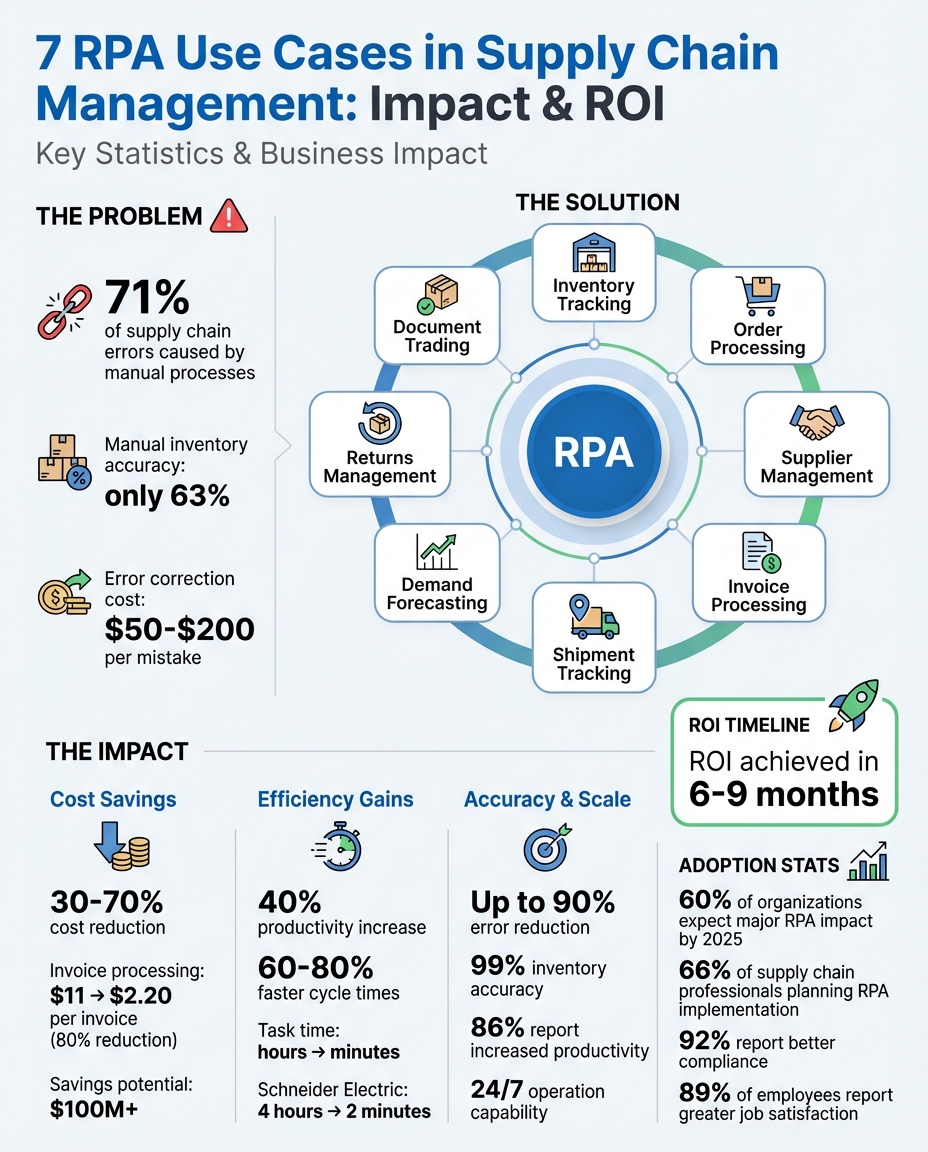
RPA Impact on Supply Chain: Key Statistics and ROI Metrics
1. Inventory Tracking
Automation of Repetitive Tasks
Inventory tracking often involves repetitive, time-consuming tasks like creating SKU records, uploading purchase orders, and generating daily reconciliation reports. This is where RPA (Robotic Process Automation) steps in. RPA bots can manage these high-volume, rule-driven tasks without making errors. They monitor stock levels in real-time across multiple warehouses, triggering alerts or even placing purchase orders automatically when inventory dips below a certain threshold. This constant monitoring eliminates the delays caused by manual checks that are done periodically.
By automating these processes, businesses lay the groundwork for better system integration.
Integration with ERP/CRM Systems
RPA doesn’t just automate tasks – it connects systems that typically operate in silos. By integrating with ERP and CRM platforms, RPA ensures that inventory data is consistent and updated in real-time across your operations. For example, bots can pull data from shipping labels, web forms, or scanned documents and instantly input it into your ERP system as products are received, moved, or sold. This eliminates the need for costly custom API development while ensuring all systems reflect the same inventory numbers at the same time.
Take Amazon, for instance. They used AI-driven RPA tools to automate warehouse inventory tracking and categorization, improving processing accuracy by 45% and cutting manual data input costs by 30%. Similarly, Procter & Gamble adopted RPA for inventory and ledger management, reducing their non-manufacturing workforce by 15% (about 7,000 roles) and significantly lowering operational expenses.
"RPA can automatically update inventory records across various systems in real-time as products are received, moved, or sold. This eliminates the need for manual data entry and reduces the risk of errors." – Gleematic AI
Error Reduction and Efficiency Gains
Manual inventory management is prone to errors, with an average accuracy rate of just 63%. Mistakes can be costly, sometimes reaching $1,000 per SKU. RPA eliminates these issues by automating data entry tasks like SKU creation and supplier record updates. Bots can also generate daily reconciliation reports and variance tickets, quickly pinpointing mismatches between physical inventory and digital records.
The benefits go beyond accuracy. RPA can cut cycle times for inventory processes by 60–80%. Companies have reported cost savings ranging from 30% to over 70%, and 86% of organizations using RPA have noted increased productivity.
Scalability Across Supply Chain Processes
One of the standout features of RPA is its ability to scale. Whether it’s managing seasonal demand spikes or adapting to market changes, automated systems can handle high transaction volumes with ease. By integrating with IoT sensors or optical scanners, RPA can track goods across multiple dimensions, automating tasks like cycle-counting and sending notifications. This adaptability ensures that inventory tracking keeps up with the evolving needs of your business.
| Inventory Task | RPA Application | Benefit |
|---|---|---|
| Master Data Entry | Automated SKU and location entry | Reduces manual input and data errors |
| Stock Monitoring | 24/7 tracking against reorder points | Avoids stockouts and overstocking |
| Reconciliation | Daily variance reporting and ticketing | Speeds up discrepancy identification |
| System Syncing | Bridging WMS, ERP, and CRM data | Provides real-time supply chain visibility |
sbb-itb-827f251
2. Order Processing
Automation of Repetitive Tasks
RPA (Robotic Process Automation) is transforming order processing by taking over repetitive tasks, streamlining the journey from order receipt to fulfillment. These bots handle routine steps like extracting order details, validating data, and generating confirmations or shipping labels. They operate 24/7, clearing backlogs overnight so that orders are ready for fulfillment the next business day. This constant operation eliminates delays caused by high order volumes during peak hours or after business hours.
Take Ashok Leyland, for example. This commercial vehicle manufacturer uses RPA to process 10,000 invoices daily. Their bots extract data from various supplier email templates and cross-check it against purchase orders, reducing processing costs to a quarter of what manual methods required. Similarly, AM Transport implemented Boomi Flow under CTO Jason Doris’s guidance to automate tasks like creating bills of lading and sending customer notifications. These tasks, which previously required manual coordination across EDI integrations, Salesforce, and AWS, are now handled seamlessly.
This automated system integrates smoothly with existing platforms, creating a unified and efficient workflow.
Integration with ERP/CRM Systems
RPA acts as a bridge between different systems, mimicking human actions to connect legacy software, Excel files, and modern ERP/CRM platforms. This ensures real-time inventory updates as soon as an order is placed, helping businesses avoid overstocking or stockouts. For instance, when a customer places an order, the bot checks the ERP’s inventory, updates the CRM with the order status, and initiates the fulfillment process – all within minutes.
A European food producer offers a great example of this. By automating shipment status updates with RPA, they cut manual effort for customer inquiries by 40–60%. The bots handled tasks like opening emails, finding shipment records in the ERP, and sending automatic replies to customers. This kind of integration creates a single, reliable source of information, ensuring consistency across inventory levels, pricing, and customer updates.
Error Reduction and Efficiency Gains
Manual data entry can lead to costly mistakes, with corrections ranging from $50 to $200 per error. RPA eliminates these issues by automating data entry and validating order details in real time. What once took hours now takes just minutes. This shift has led to a 43% reduction in resources needed for order-to-cash processes.
"By automating the process with RPA, the team can ensure there is consistency and reduced likelihood of delays or errors in the process." – Kapil Kalokhe, Senior Director of Business Advisory Services, Saggezza
Consider SF Supply Chain, which saved 74,000 working hours across multiple locations by automating warehouse and order-related tasks with RPA. Beyond saving time, 92% of businesses report better compliance because bots follow strict protocols and generate automatic audit trails. These records are invaluable during audits or when resolving order discrepancies. And because RPA is scalable, it maintains consistent performance during high-demand periods.
Scalability Across Supply Chain Processes
RPA’s scalability is a game-changer for managing fluctuating demand. During busy seasons or promotional events, bots can handle thousands of additional orders without the need for overtime or temporary staff. Walmart is a prime example, utilizing over 500 bots to automate supply chain and back-office tasks. These bots process more than 200 million invoices and 2.3 million payrolls, saving the company millions in operational costs.
This scalability isn’t just about volume. Bots can be quickly reprogrammed to adapt to new order types, shipping methods, or regulatory requirements, making them a flexible solution as businesses grow and evolve.
DHL Supply Chain Robotic Process Automation RPA
3. Supplier Management
Supplier management, much like inventory tracking and order processing, benefits greatly from the precision and efficiency that RPA brings to the table.
Automation of Repetitive Tasks
RPA takes on the heavy lifting in supplier management by automating time-consuming tasks like onboarding. This includes collecting documentation, validating compliance, running credit checks, and preparing RFQ packages. By reducing manual effort, companies can speed up vendor evaluations significantly.
Take HBL Bank, for instance. They used RPA to handle supplier screening and other back-office tasks, saving an impressive 341,000 working hours annually while achieving a 98% accuracy rate in sanction screening. Similarly, a European food producer saw a 25–50% improvement in cycle times and a 15–45% reduction in processing time after deploying RPA bots for tasks like RFQ preparation, vendor communication, and credit checks.
RPA also enhances supplier performance tracking. Bots can monitor metrics in real time, generate detailed reports, and send automated reminders when certifications or documents need updating. For example, an industrial manufacturer uses RPA bots to gather and compare monthly sales forecasts, manufacturing capacity, and supply data from its global supplier network. This real-time analysis helps pinpoint constraints and discrepancies early on.
This level of automation creates a solid foundation for seamless integration with other systems.
Integration with ERP/CRM Systems
RPA acts as a bridge between legacy and modern systems, pulling supplier data from emails, web forms, and PDFs directly into ERP/CRM platforms. This ensures data consistency and accelerates decision-making.
"RPA acts like a bridge between your systems, creating a smooth automation flow that boosts efficiency." – COAX Software
This capability proves invaluable in processes like supplier onboarding and performance tracking. Bots can connect directly with vendor portals and retailer systems, synchronizing inventory data in real time to support just-in-time supply chains. By 2025, 60% of organizations globally expect RPA to have a major impact on their supply chains. Many are already seeing results, such as a 32% reduction in resources needed for vendor and talent management. Tools like QSTRAT complement this by offering cloud-based solutions that integrate supplier sourcing, performance management, and quoting processes with existing systems. This eliminates manual data transfers and creates a single, reliable source for supplier information.
Error Reduction and Efficiency Gains
Managing suppliers manually is resource-intensive and prone to errors. RPA minimizes these issues by automating data validation and handling routine inquiries, cutting manual effort by 40–60%. For example, 92% of pharmaceutical manufacturers report improved regulatory compliance after adopting RPA. Bots can also handle repetitive tasks like checking shipment statuses. They log into portals, retrieve relevant records, and send automated updates.
"Saving as little as a few minutes per transaction, these kinds of bots can free up valuable time over the course of tens of thousands of iterations enabling planners, buyers and engineers to focus on more rewarding and higher value-add activities." – Mark Hermans, Managing Director, PwC
Scalability Across Supply Chain Processes
RPA’s scalability makes it a game-changer for supplier management, especially during periods of high demand. By deploying additional bots, companies can quickly adapt to fluctuating needs, diversify suppliers, and respond to disruptions. Bots can track item costs across multiple suppliers simultaneously, securing the best pricing. They can also analyze geopolitical changes to suggest alternative sourcing or shipping options.
Integrating AI and machine learning takes this a step further, enabling bots to handle more complex tasks like evaluating vendor documents and running supply–demand simulations. This combination of automation and cognitive capabilities allows businesses to tap into a broader network of local vendors, building supply chains that are more flexible and prepared for unexpected challenges.
4. Invoice Processing
After supplier management, invoice processing is another area where RPA steps in to simplify and improve traditionally labor-intensive tasks. Known for being a bottleneck in many organizations, invoice processing has seen a transformation thanks to RPA’s ability to handle tasks with speed and precision. Historically, over half of all invoice processing required at least 76% manual effort, and manual data entry errors could cost businesses up to 20% of their annual revenue. With RPA, this process is no longer a drain on time or resources.
Automation of Repetitive Tasks
RPA bots can monitor email inboxes dedicated to receiving invoices in formats like PDFs, Word documents, or scanned images. Using technologies like OCR (Optical Character Recognition) and NLP (Natural Language Processing), these bots extract essential details such as invoice numbers, dates, vendor information, and line-item amounts.
The process becomes even more efficient with three-way matching. Bots compare invoice data against Purchase Orders and Goods Receipts stored in ERP systems, flagging any discrepancies for human review. For instance, a large U.S. wholesale retailer used UiPath Document Understanding to automate the processing of 7,000 monthly invoices from gas and freight vendors. This reduced the time per invoice from 5 minutes to just 30 seconds, achieving 93% straight-through processing and saving over 160 hours each month.
Integration with ERP/CRM Systems
RPA doesn’t just automate tasks – it ensures smooth data integration with ERP systems. Bots can securely log into platforms like SAP or Oracle, verify vendor information, and post transactions, cutting manual input time by 60%.
Schneider Electric provides a great example of this efficiency. By implementing RPA, they reduced their invoice processing time from four hours to just two minutes, with the automation setup completed in only 2.5 days. For businesses relying on older systems, RPA acts as a bridge, connecting legacy platforms without the need for costly API upgrades.
Error Reduction and Efficiency Gains
Manual processes are responsible for 71% of supply chain errors, with the cost of fixing a single data entry mistake ranging from $50 to $200. RPA significantly reduces these issues. Canon, for example, achieved nearly 90% straight-through processing for 40,000 invoices in just nine months. Similarly, Thermo Fisher Scientific processed 824,000 invoices annually with 85% accuracy and cut processing time by 70%.
"Now, instead of someone having to spend up to five minutes processing a single invoice, the AI-enhanced robot handles that same document automatically in about 30 seconds." – Ahmed Zaidi, Co-founder and Chief Automation Officer, Accelirate
The financial benefits are equally compelling. Automated invoice processing can lower the cost per invoice by 80%, from $11 to $2.20, while reducing errors to as little as 1%.
Scalability Across Supply Chain Processes
RPA shines when businesses face peak periods or rapid growth. Advanced systems can even assign fraud risk scores to invoices, adding an extra layer of security without slowing down operations. For example, SF Supply Chain implemented RPA across multiple locations, saving 74,000 working hours.
To make RPA scalable, creating a feedback loop is essential. A "Validation Station" allows human operators to review invoices flagged with low confidence scores. These corrections are then used to train the machine learning model, improving accuracy over time. This approach ensures that as invoice volumes increase, the system becomes smarter and more efficient, adapting to handle the workload without compromising speed or quality.
5. Shipment Tracking
Shipment tracking, like inventory management and order processing, benefits greatly from RPA (Robotic Process Automation). By automating repetitive tasks, RPA eliminates the need for manual intervention, streamlining operations and reducing errors. After invoice processing, shipment tracking becomes a critical focus area, as RPA continuously monitors shipments and removes the need for manual checks across carrier portals. In fact, 66% of supply chain professionals plan to implement RPA in logistics and warehousing.
Automation of Repetitive Tasks
RPA bots work around the clock, tracking key shipment milestones such as "on hand at origin", "confirm on board", "out for delivery", and "proof of delivery." These bots pull status updates from multiple carrier websites, update internal systems in real time, and immediately notify customers of any delays.
"RPA bots can also generate notifications to customers if there’s a delay, enhancing customer experience with practice and real-time order updates." – Shirley Hung, Vice President, Everest Group
For international shipments, RPA simplifies the added complexities of managing customs documentation, storage arrangements, and inspection schedules across various third-party systems. This is especially helpful for businesses handling large transaction volumes, where manual tracking would be both resource-intensive and prone to delays.
The real-time data collected by RPA integrates seamlessly into broader systems, providing a unified and up-to-date view of shipment progress.
Integration with ERP/CRM Systems
RPA serves as the connective tissue between disparate systems, linking transportation management tools, ERP software, internal databases, and external carrier platforms. Bots log into these systems, retrieve shipment details, and update ERP and CRM platforms automatically. This integration ensures that shipment data is consistent across the organization. For example, when a shipment status changes in the carrier system, bots update the ERP and trigger corresponding actions in the CRM, such as notifying customers or alerting sales teams about potential delivery delays.
For companies reliant on outdated mainframe systems, RPA provides a cost-effective way to achieve connectivity without the need for expensive system overhauls. By synchronizing shipment data across platforms, RPA not only improves communication but also enhances overall supply chain responsiveness.
Error Reduction and Efficiency Gains
Manual entry of shipment details, such as destination addresses or SLAs, often leads to costly mistakes. RPA eliminates these errors by automating the capture and transfer of information between systems, achieving near-perfect data accuracy. This precision allows logistics teams to focus on more urgent tasks, such as managing distressed shipments.
"Digitally enabled processes reduce employee effort and time spent in back-end processes, freeing up time to engage with dissatisfied customers." – Shirley Hung, Vice President, Everest Group
In addition to reducing errors, automation is projected to impact 56% of logisticians’ work time. Bots can handle routine inquiries, enabling customer service teams to dedicate their attention to more complex issues, improving overall efficiency.
Scalability Across Supply Chain Processes
RPA aligns with the broader goals of supply chain transformation by scaling effortlessly to accommodate growing transaction volumes. Bots can integrate new customer accounts into existing workflows without requiring additional staff. During peak periods, automated systems can manage transaction volumes that are two to five times higher without compromising performance. This ensures consistent service levels, even during demand surges.
Modern RPA platforms also incorporate AI to optimize delivery routes by analyzing factors like traffic, weather, and vehicle capacity. This combination of automation and advanced analytics allows supply chain operations to expand efficiently while staying agile enough to respond to changing conditions. As businesses grow, RPA systems evolve alongside them, managing more shipments and increasingly complex logistics networks without driving up operational costs.
6. Demand Forecasting and Planning
RPA takes demand forecasting to a whole new level by automating the collection and preparation of data needed for predictive models. Unlike operational tasks like shipment tracking, this process addresses the challenge of anticipating future customer needs. RPA bots gather data from sales reports, customer orders, market trends, and even IoT sensors, consolidating it into a single system for analysis. This eliminates the time-consuming manual task of pulling data from spreadsheets, emails, and other sources, freeing up planning teams to focus on strategy.
Automation of Repetitive Tasks
One of RPA’s strengths lies in automating routine tasks like data collection and formatting, which allows AI and machine learning models to generate highly accurate predictions. For instance, bots can pull hourly updates on sales figures or weather conditions, enabling teams to adjust supply and demand plans quickly. By aggregating data from multiple sources – such as CRM systems for customer trends, ERP systems for inventory levels, and external files – RPA ensures datasets are consistent and error-free, improving the accuracy of forecasts.
"RPA processes act as the plumbing to more complex technological supply chain elements." – Asim Rahal, IT Service Provider
These bots also clean, reformat, and prepare data for central analytics systems, allowing teams to focus their energy on strategic decision-making. Organizations using RPA report capacity increases of 20% to 52%, with bots performing tasks up to 10 times faster than humans.
Integration with ERP/CRM Systems
RPA seamlessly integrates with CRM and ERP systems, automatically updating forecasting models with real-time data. This ensures that models reflect current market conditions, such as seasonal trends or sudden shifts in customer behavior. Once demand plans are created, RPA bots communicate this data to stakeholders, transporters, and logistics teams directly from the ERP system. They also cross-check sales forecasts against manufacturing capacity, flagging any constraints or discrepancies for human review. This synchronization ensures all departments work with the same up-to-date information. By 2025, 60% of organizations expect RPA to play a major role in supply chain improvements, with companies reducing manual data entry by 65% to 80%. This level of automation helps teams anticipate and respond to demand changes with ease.
Error Reduction and Efficiency Gains
By automating data collection, RPA eliminates transcription errors and ensures consistency across analytics platforms. Traditional forecasting often relies on limited historical data, but RPA-enhanced methods incorporate more complex variables like weather patterns, social media sentiment, and economic trends. This results in more accurate predictions and reduces the manual effort required for supply and demand planning by 20% to 40%.
Organizations automating 50% to 70% of their tasks can achieve cost savings of 20% to 35% annually. With precise data handling, forecasting models receive high-quality inputs, and bots can automatically flag potential issues – such as mismatches between forecasts, manufacturing capacity, and supply data – before they disrupt operations.
Scalability Across Supply Chain Processes
RPA offers a scalable solution for handling growing data volumes, preventing bottlenecks often caused by manual processes. It can reduce operational expenses by 30% and cut data entry errors by up to 90%. During peak seasons or business expansions, bots can manage increased workloads without requiring additional staff. When combined with AI, IoT, and digital twins, RPA enables supply chains to move from reactive to proactive models, predicting and addressing potential disruptions before they occur.
For companies using platforms like QSTRAT, which integrates CRM, ERP, costing, and sourcing systems, RPA enhances demand forecasting by ensuring supplier performance and quoting data flow seamlessly into planning models. This results in a more agile and accurate forecasting process, helping businesses stay ahead of market demands.
7. Returns Management
RPA is reshaping returns management by simplifying reverse logistics, building on the advancements already seen in inventory, order, and invoice processes.
Handling product returns has traditionally been a labor-intensive part of the supply chain. With RPA, this process becomes streamlined and largely automated. Bots can oversee the entire returns lifecycle – from creating Return Merchandise Authorizations (RMAs) and Return Goods Authorizations (RGAs) to processing refunds and updating inventory systems – removing the need for manual data entry into ERP or WMS platforms.
Automation of Repetitive Tasks
One of RPA’s strengths is taking over repetitive documentation tasks. Bots can extract customer details and order information from emails, generate return labels, create return orders automatically, and even use AI-powered image recognition at warehouse docks. This allows them to classify returned items quickly – whether they’re salable, defective, or require vendor repair – and route them to the proper destination without delay.
"Return handling can be fully automated thanks to clearly defined processes." – AltexSoft Editorial Team
A practical example of this comes from August 2025, when Infosys implemented a UiPath unattended bot for a major computer chip manufacturer. The bot automated B2C Return Management Authorization, syncing data between Microsoft Dynamics and SAP. This saved 10,080 hours annually, freeing up 42 full-time employees for higher-value tasks.
Integration with ERP/CRM Systems
RPA bots act as a seamless link between CRM platforms like Microsoft Dynamics and ERP systems such as SAP. They eliminate the need for manual ticket creation by synchronizing data automatically. Bots manage the entire RMA lifecycle – from authorizing returns based on preset rules to creating return orders and initiating refunds. For distributors handling Return to Vendor (RTV) processes, RPA can interpret vendor policies and submit RTV requests automatically, helping protect profit margins.
In March 2025, Itransition deployed an RPA solution for a global returns management company working with over 200 carrier partners. This resulted in a 1.5× improvement in processing speed.
Error Reduction and Efficiency Gains
Manual returns processes are responsible for 71% of supply chain errors, but RPA can reduce these mistakes by up to 90%. Bots operate with near-perfect accuracy, minimizing documentation errors and handling credit reconciliation automatically.
This level of precision also translates into cost savings. Companies can reduce processing costs by 30%–70%. While manual processes often achieve only 63% inventory accuracy due to the unpredictable nature of returns, RPA systems can maintain accuracy levels as high as 99% through constant monitoring and real-time record updates.
Scalability Across Supply Chain Processes
RPA offers the flexibility needed to manage varying return volumes without requiring additional staff. Bots work 24/7, processing returns as they come in and updating inventory records immediately after warehouse processing. Customers benefit from real-time updates and acknowledgment emails throughout the return process, adding a layer of transparency.
For companies using platforms like QSTRAT, which integrate CRM, ERP, costing, and sourcing systems, RPA takes returns management a step further. Supplier performance data and vendor policies flow seamlessly into the process, enabling bots to identify items eligible for vendor returns based on preloaded agreements. This creates a more efficient reverse logistics system that not only supports profitability but also enhances customer satisfaction.
Conclusion
The seven RPA use cases discussed – inventory tracking, order processing, supplier management, invoice processing, shipment tracking, demand forecasting, and returns management – help eliminate operational bottlenecks and reduce costs. Did you know that manual processes are responsible for 71% of all supply chain errors?. Companies that adopt RPA often report cost savings between 30% and 70%, along with productivity boosts of 40% and labor cost reductions of up to 30%. A well-planned implementation can result in savings exceeding $100M, automating tasks previously handled by over 1,000 employees. Most businesses recover their investment within six to nine months, making RPA one of the quickest ways to achieve measurable ROI in supply chain operations.
RPA doesn’t just save money – it also enhances scalability and adaptability. By connecting ERPs, CRMs, and legacy systems without requiring expensive upgrades, businesses can handle surges in demand without needing to hire additional staff. For instance, companies can reduce resources needed for order-to-cash processes by 43% and cut invoicing requirements by 34%. Think of RPA as the digital plumbing that links systems together, offering real-time visibility without the need for costly API customizations. For organizations already using platforms like QSTRAT, which integrate CRM, ERP, costing, and sourcing systems, RPA extends automation across the entire supply chain – from supplier sourcing to managing returns.
"The adoption of these technologies is no longer a matter of competitive advantage but of survival." – Sivasubramanian Kalaiselvan
To transition from manual processes to RPA, start small. Focus on high-volume, rule-based tasks like invoice processing or order entry. Automating processes such as inventory tracking and supplier management can provide clear metrics for success, such as reduced errors, time saved, or direct cost savings. Establish a Center of Excellence to manage governance and scale automation efforts effectively. And don’t forget to address employee concerns – highlight that RPA removes repetitive tasks rather than replacing jobs. In fact, 89% of employees report greater job satisfaction after automation is introduced.
FAQs
How does robotic process automation (RPA) enhance inventory tracking accuracy?
RPA improves inventory tracking by automating repetitive tasks such as data entry and updating stock levels. This ensures records are updated in real time, cutting down on human errors and providing dependable data for smarter decision-making.
By working seamlessly with tools like ERP systems and inventory management software, RPA can monitor stock levels, identify inconsistencies, and produce precise reports. The result? Better control over inventory, less waste, and smoother operations.
How much can businesses save by using RPA in supply chain management?
Implementing robotic process automation (RPA) in supply chain management can lead to dramatic cost reductions – often between 30% and 70%. In fact, some companies have reported saving over $100 million by automating tasks that once relied heavily on manual labor.
RPA simplifies processes like inventory tracking, order processing, and supplier communication. By doing so, it cuts down on inefficiencies, reduces errors, and trims labor costs. These financial benefits give businesses the chance to redirect resources toward growth initiatives while enhancing the overall efficiency of their supply chain.
How can RPA work with existing ERP and CRM systems?
RPA (Robotic Process Automation) connects effortlessly with ERP and CRM systems by automating repetitive, rules-based tasks like data entry, report creation, and form filling. These bots replicate how humans interact with these systems, which means businesses don’t need to overhaul their software or rely on complex API integrations. This makes RPA especially handy for older, legacy platforms that might not support modern integration methods.
When implementing RPA, companies usually start by mapping out their current processes to identify tasks suitable for automation. From there, they create automation scripts and test them to ensure everything runs smoothly within their systems. Once in place, RPA improves data accuracy, speeds up processing times, and frees employees to tackle more strategic projects – all of which can lead to a more efficient supply chain.
Related Blog Posts
You may also like

Top 7 Tools For Supplier Relationship Management
Compare seven SRM platforms by features, integrations, and scalability to find the right supplier management solution.

Supplier Certification: Why It Matters for Compliance
Supplier certification is a strategic safeguard that prevents regulatory breaches, supply disruptions, and reputational damage.