

Ultimate Guide to Risk Management in High-Tech Supply Chains
- January 30, 2026
- 24 Mins Read
- 2136 Views

High-tech supply chains are more vulnerable than ever, facing challenges like cybersecurity threats, semiconductor shortages, and geopolitical tensions. Managing these risks requires identifying weak points, assessing their impact, and implementing strategies to mitigate disruptions. Here’s what you need to know:
- Key Risks: Cyberattacks, counterfeit parts, supplier instability, and external factors like natural disasters or tariffs.
- Risk Assessment: Use tools like risk heat maps, supplier scorecards, and scenario simulations to prioritize and address vulnerabilities.
- Mitigation Strategies: Diversify suppliers, nearshore operations, and build inventory buffers to reduce dependency and ensure stability.
- Technology Role: Leverage AI, digital twins, and real-time monitoring to improve visibility and decision-making.
- Continuous Monitoring: Regularly update risk assessments, track KPIs like recovery time and supplier performance, and refine strategies for resilience.
This guide breaks down the steps to safeguard your supply chain, from identifying risks to implementing effective solutions, ensuring operations stay resilient in a volatile environment.
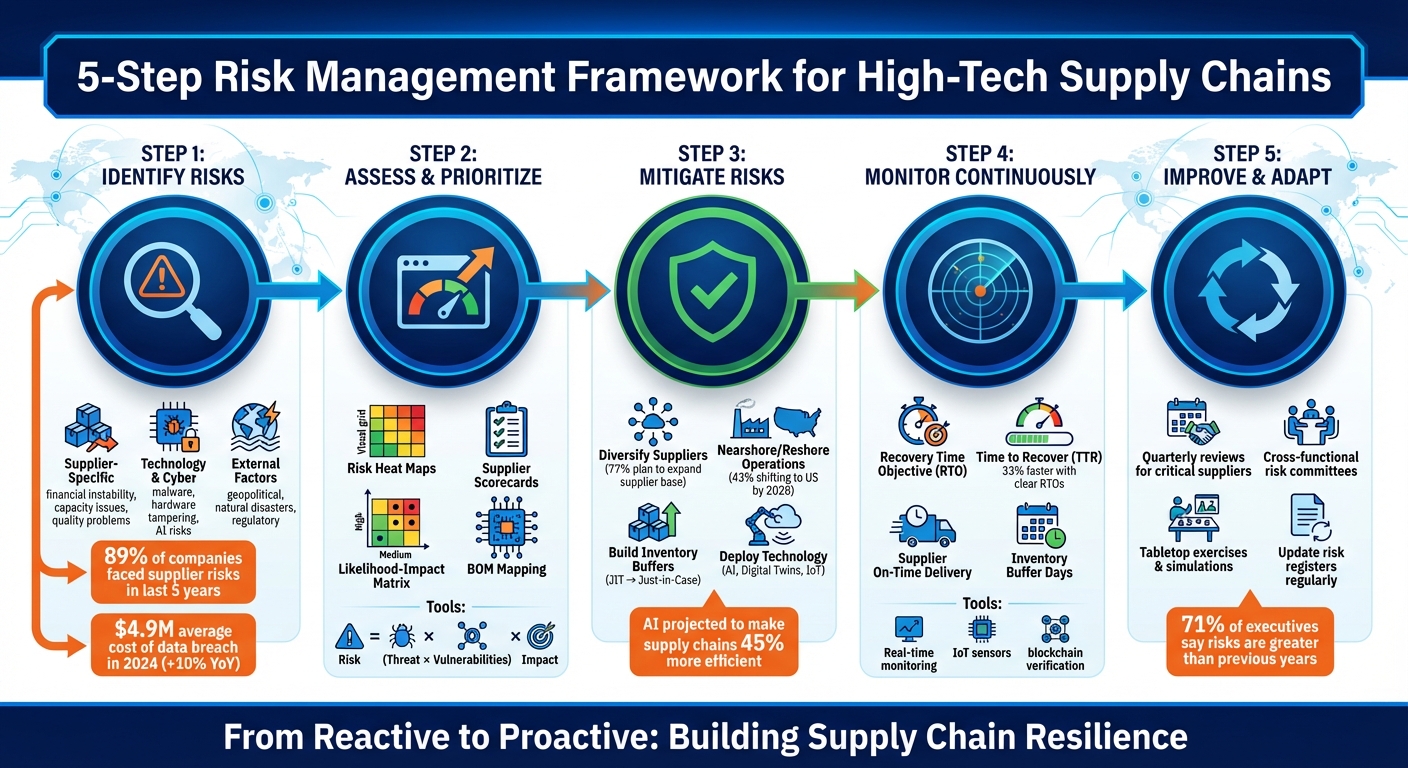
5-Step Risk Management Framework for High-Tech Supply Chains
The Biggest Risks Facing Supply Chains In 2025
sbb-itb-827f251
Identifying Risks in High-Tech Supply Chains
Pinpointing risks across every layer of the supply chain is essential for high-tech companies. One major challenge is the lack of visibility into tier-two suppliers, which can allow risks to go undetected. Even when primary suppliers are well-managed, their own vendors could introduce vulnerabilities, creating a domino effect.
Risk identification starts by categorizing potential threats, as each category requires its own detection strategy. For example, financial instability among suppliers – such as slim profit margins or worsening credit health – can lead to abrupt bankruptcies that disrupt production. Operational issues like capacity shortages or delivery delays often hint at deeper infrastructure or management problems. In the high-tech industry, quality and integrity risks are particularly concerning. Counterfeit components or tampered products can jeopardize entire product lines. The stakes are high: the global average cost of a data breach hit $4.9 million in 2024, marking a 10% increase from the previous year.
To tackle these risks, tools like risk scoring, heat maps, and vulnerability mapping are invaluable. These methods highlight potential hazards, rank them by severity, and identify weak points across departments. Regular supplier audits are also crucial, focusing on financial health, credit stability, and regulatory compliance. Enterprise Risk Management platforms offer prebuilt risk libraries to ensure no threat is overlooked. It’s also important to assess fourth-party risks – those stemming from your suppliers’ suppliers – which can cascade through the network. The following sections break down specific risk categories and how to detect them.
Supplier-Specific Risks
Suppliers often represent the most immediate risks to high-tech operations. Financial instability is a key concern; suppliers operating on thin margins or struggling with cash flow are at risk of sudden closures. Capacity issues, like an inability to scale production during demand surges, and delivery delays can also wreak havoc on just-in-time manufacturing schedules. Quality control problems, such as defective components, can lead to costly recalls and damage a brand’s reputation.
High-tech supply chains also face unique integrity risks. Counterfeit products can enter the system through unauthorized distributors, and tampered components can introduce backdoors that persist even after security updates. The National Institute of Standards and Technology (NIST) highlights this issue:
"Threat actors intentionally target the suppliers of more cyber-mature organizations to take advantage of the weakest link" – NIST
This tactic bypasses strong security measures by exploiting less-secure vendors with trusted access.
Continuous monitoring is key to catching these risks early. Track metrics like delivery times, defect rates, and inventory turnover to identify problems as they arise. Scenario modeling, such as business impact analyses and tabletop exercises, can simulate supplier failures to test your response plans. Regular credit reviews and financial audits can reveal warning signs like mounting debt or weakening balance sheets. For quality and integrity, implement counterfeit testing protocols and ensure that suppliers adhere to secure manufacturing practices.
| Supplier Risk Category | Identification & Assessment Method |
|---|---|
| Financial Instability | Credit health reviews, financial audits, and monitoring of narrow margins |
| Operational Failures | Tracking delivery delays, capacity shortfalls, and infrastructure age |
| Quality & Integrity | Quality control audits, testing for counterfeits, and manufacturing practice reviews |
| Cybersecurity | Third-party security assessments, data handling audits, and C-SCRM framework alignment |
| Reputational/Ethical | Vetting for compliance with labor, environmental, and social standards |
Technology and Cyber Risks
Technological vulnerabilities bring a different set of challenges. Unlike supplier issues, these risks often stem from the interconnected nature of modern tech ecosystems. Cyber threats exploit trust within these networks, targeting software update mechanisms or third-party providers with privileged access. This allows malicious code to spread through trusted channels, potentially affecting thousands of users. For instance, the 2024 Crowdstrike outage resulted in over $5 billion in direct losses for Fortune 500 companies.
These vulnerabilities can emerge at any stage of the product lifecycle – design, development, production, distribution, or even disposal. Malicious actors might compromise software updates to distribute malware or use dependency confusion to trick systems into downloading harmful packages. Hardware tampering can embed backdoors in firmware, while AI systems introduce risks like model poisoning, where training data is manipulated to produce harmful outputs.
To detect such risks, go beyond static vendor checklists. Use Software Bills of Materials (SBOMs) to track all components in your supply chain, making it easier to identify vulnerabilities when new flaws are discovered. Cryptographic signatures and integrity checks ensure that software and hardware remain authentic and unaltered. Behavioral analytics can help spot subtle anomalies that might indicate AI-driven attacks. Additionally, monitor for unauthorized changes in update metadata or discrepancies in SBOMs that could signal dependency confusion attempts.
External Factors Affecting Supply Chains
External disruptions like geopolitical conflicts, natural disasters, and regulatory shifts can ripple through global supply chains. For example, during the 2018 trade war, spot rates for freight from China to the U.S. West Coast surged by over 70%.
Extreme weather events are another major disruptor. In 2024, more than 76% of European shippers reported supply chain interruptions due to events like droughts in the Panama Canal, wildfires in North America, and flash floods in Dubai. These incidents damaged infrastructure and delayed shipments. Rising container shipping emissions – up 13.8% globally in the first 10 months of 2024 – reflect longer routes and increased fuel use as companies navigated around affected areas. By March 2025, air cargo rates had jumped 20%, driven by a mix of weather and geopolitical pressures.
To manage these risks, supply chain visibility must extend beyond first-tier suppliers. Digital twin technology can help by creating virtual models of supply chains, allowing companies to simulate and validate changes before implementing them. Real-time data monitoring provides insights into freight rates, schedule reliability, and carbon emissions, enabling smarter procurement decisions. As Emily Stausbøll, Senior Analyst at Xeneta, puts it:
"There is no single ‘best solution’ in such a complex market – it is a case of each shipper understanding their own supply chains, assessing the risks, and using data to gain insights and make evidence-based decisions" – Emily Stausbøll, Senior Analyst at Xeneta
AI-powered analytics can further support decision-making by improving contract risk analysis, demand forecasting, and inventory management.
Assessing Risks in High-Tech Supply Chains
After identifying risks in high-tech supply chains, it’s essential to assess them systematically. The goal? Focus on vulnerabilities that could have the greatest impact, not just those that occur frequently.
Start by using quantitative methods and visual tools to simplify complex data for decision-makers. A common formula for calculating risk is: Risk = (Threat × Vulnerabilities) × Impact. This requires teams to quantify vulnerabilities consistently, whether it’s analyzing semiconductor shortages or preparing for cyberattacks.
Supplier tiering is another key step. Group suppliers based on their importance to operations and the sensitivity of the data they handle. For example:
- Tier 1 suppliers: Require thorough, ongoing reviews.
- Tier 2 suppliers: Need standard due diligence.
- Tier 3 suppliers: Only basic oversight is necessary.
This approach prevents wasting resources on less critical relationships while ensuring high-priority risks get the attention they deserve. Considering that 89% of companies have faced supplier-related risks in the last five years, regular reassessment is crucial. As one expert advises:
"Supply chain risk management should be an ongoing process, with quarterly reviews for critical suppliers and annual audits across the entire supply chain" –
In fast-paced industries, waiting a year between reviews could leave your supply chain vulnerable to new threats.
Risk Assessment Tools
Several tools can help evaluate and manage risks effectively:
- Supplier scorecards: Standardize vendor evaluations with both binary questions (e.g., "Is the supplier SOC 2 compliant?") and measurable metrics (e.g., "What percentage of employees passed security training?"). This ensures consistent benchmarks across your supplier network.
- Supply Chain Risk Scorecard (SCRS): Quantifies risks across seven categories, such as lead times, geopolitical risks, and natural disasters. For instance, a sole-sourced component with a 26-week lead time scores higher on the risk scale than one with multiple suppliers and a two-week lead time. As Ron Keith of Supply Chain Resources Group Inc. puts it:
"A sole-sourced part generally has more risk than a part with multiple sources, and a part with a 26-week lead time is far more difficult to react to than a part with a two-week lead time" – Ron Keith, Founder and Executive Director of Supply Chain Resources Group Inc.
- Risk heat maps: Translate numerical risk scores into visual formats, making it easier for executives to identify and prioritize vulnerabilities. These maps are especially useful during budget planning.
- Scenario simulations: Test response plans using realistic scenarios, such as counterfeit components entering the supply chain or malicious firmware updates. These simulations help validate whether your current controls are effective.
- Bill of Materials (BOM) mapping: Dive deeper into your supply chain to uncover hidden risks. For example, trace your top revenue-generating products to identify shared dependencies among Tier 1 and Tier 3 suppliers. This could reveal a concentration risk that might not be apparent at first glance.
| Assessment Tool | Primary Function | High-Tech Application |
|---|---|---|
| Risk Heat Map | Visualizes probability vs. impact | Prioritizing which electronic components need buffer stock |
| BOM Mapping | Identifies geographic dependencies | Detecting concentration of sub-tier suppliers in high-risk zones |
| TCO Calculator | Calculates hidden sourcing costs | Comparing domestic vs. overseas high-tech manufacturing |
| SCRM Questionnaire | Evaluates vendor security posture | Assessing cybersecurity risks in software/firmware updates |
Likelihood-Impact Analysis
The likelihood-impact matrix is a go-to tool for prioritizing risks. It plots risks on a grid with one axis for likelihood and another for impact. Most organizations use either a 3×3 or 5×5 grid, with the latter offering more detail for complex supply chains.
To make the matrix effective, define clear thresholds:
- Likelihood: Use probability ranges like Highly Unlikely (<10%) to Highly Likely (>91%).
- Impact: Set financial markers, such as losses under $1,000 being "Insignificant" and losses over $1 million being "Catastrophic".
Weight criteria based on the supplier’s risk profile. For instance, a supplier handling sensitive intellectual property might score higher for "Data Encryption" and "Breach History" than a general office supplier. This ensures the scoring reflects business priorities.
The matrix highlights which risks need immediate action. As Matthew McGill from HBS explains:
"A very High impact rating could make a risk a top priority, even if it has a low likelihood" – Matthew McGill, Senior Information Security Consultant at HBS
For example, a rare but catastrophic event – like a major data breach – might warrant more resources than a frequent but minor issue, like shipping delays.
Regular updates are essential. While annual reviews are common, quarterly assessments are better for critical suppliers in high-tech industries. The landscape changes quickly, with new vulnerabilities, geopolitical shifts, and fluctuating supplier health. It’s worth noting that 80% of small to medium-sized manufacturers currently operate reactively when it comes to supply chain disruptions, often due to outdated risk assessments.
| Likelihood Level | Probability Range | Description |
|---|---|---|
| 5: Highly Likely | >91% | Almost certain to occur; requires immediate mitigation. |
| 4: Likely | 61% – 90% | Bound to reoccur; needs a consistent mitigation strategy. |
| 3: Possible | 41% – 60% | May happen about half the time; requires regular attention. |
| 2: Unlikely | 11% – 40% | Relatively low chance; keep under observation. |
| 1: Highly Unlikely | <10% | Extremely rare; lowest priority for resource allocation. |
Mitigating Risks with High-Tech Strategies
Once risks are assessed, the next step is taking action – both immediate and long-term. Relying solely on reactive crisis management, or "firefighting", doesn’t create the resilience needed to handle future disruptions. Interestingly, only 10% of companies have developed the comprehensive resilience capabilities required to thrive during major disruptions.
The shift from a reactive to a proactive approach is essential. Short-term actions like increasing safety stock or negotiating cost-sharing with suppliers can address immediate vulnerabilities. Meanwhile, long-term strategies – such as multi-tier supply chain mapping, nearshoring production, and diversifying suppliers – lay the groundwork for sustained stability. As Wolfgang Schnellbächer from BCG puts it:
"The philosophy of risk management must transition from reactive firefighting to proactive management and reduction of risk exposure."
Building resilience starts with these strategies, which protect against immediate risks while fostering long-term adaptability.
Diversifying Supply Chains
One of the biggest risks in high-tech manufacturing is relying on a single supplier for critical components. When disruptions like natural disasters, bankruptcies, or geopolitical conflicts hit, operations can grind to a halt. To counter this, 77% of surveyed companies plan to expand their supplier base to reduce dependency and boost resilience.
The first step is identifying where your vulnerabilities lie. For example, an automotive Tier-1 supplier used AI to uncover a sole dependency on one steel mill. This insight led to adjustments in their supplier data management.
Dual sourcing is a practical way to start. By onboarding a secondary supplier for critical components, you create a safety net. Companies often begin with smaller orders to test quality and capacity before gradually increasing the secondary supplier’s share based on performance and risk assessment.
Nearshoring and reshoring are also gaining traction. These strategies reduce lead times and limit exposure to geopolitical risks. While nearshoring may increase per-unit costs, it often lowers the Total Cost of Ownership (TCO) by cutting freight expenses, tariffs, and disruption-related costs. In fact, by 2028, 43% of surveyed firms plan to shift more of their manufacturing to the U.S..
Geographic diversification is equally important. Even with multiple suppliers, relying on the same transport routes or raw material sources can leave you exposed. A labor strike or natural disaster at a key port, for example, could disrupt your entire operation.
| Strategy | Short-Term Approach | Long-Term Approach |
|---|---|---|
| Diversification | Onboarding secondary sources for critical parts. | Reshoring/Nearshoring and building regional supplier ecosystems. |
| Technology | Real-time news alerts and manual risk tracking. | AI-based predictive analytics and Digital Twin simulations. |
| Inventory | Increasing safety stock for immediate "at-risk" items. | Integrating SIOP and TCO models to optimize buffer levels. |
| Governance | Crisis task forces for immediate disruptions. | Cross-functional risk boards and risk-aware cultural training. |
Diversifying supply chains is just one piece of the puzzle. Leveraging technology can further reduce risks.
Using Technology for Risk Management
Technology has revolutionized how supply chain risks are identified and addressed. AI-driven predictive analytics, for instance, can detect vulnerabilities before they escalate into major disruptions. Traditional AI helps structure data and forecast disruptions, while Generative AI automates tasks like supplier evaluations and risk assessments.
Take the example of a global brewery that used predictive algorithms to analyze supply trends for molded glass vials. The data revealed rising costs for soda ash and limestone – key raw materials – prompting the procurement team to secure supplies, lock in long-term contracts, and identify alternative vendors before a shortage occurred.
Digital twin technology adds another layer of resilience. By creating a virtual model of your supply chain, you can simulate changes – like switching suppliers or adjusting inventory – without risking real-world consequences. The global market for digital twins is expected to grow significantly, reaching up to $150 billion by 2032.
Real-time monitoring tools provide critical visibility. IoT sensors track goods in transit, monitoring factors like location, temperature, and humidity to flag potential issues early. Automated systems can also identify anomalies, such as sudden dips in delivery performance, without requiring manual checks.
AI is projected to make supply chains 45% more efficient in ensuring timely and error-free deliveries. However, these tools are only effective when paired with a broader risk management strategy and teams equipped to act on the insights.
Technology and supply chain diversification lay the groundwork, but resilient inventory practices are equally crucial.
Building Resilience with Inventory Buffers
The "Just-in-Time" (JIT) inventory model has long been a staple of supply chain management, minimizing costs by relying on on-demand deliveries. However, recent disruptions have exposed its weaknesses. An increasing number of companies are now adopting a "Just-in-Case" approach, building safety stock and inventory buffers to handle volatility.
The challenge is finding the right balance. Excess stock ties up capital, while insufficient buffers leave companies vulnerable to shortages. A smart approach is to segment your inventory: decentralize storage for predictable, low-value items and centralize high-value, unpredictable components.
Sales, Inventory, and Operations Planning (SIOP) can help fine-tune buffer levels over time. By combining demand forecasting with capacity planning, SIOP creates a continuous adjustment cycle that responds to real-time market changes. This dynamic method outperforms traditional, static safety stock models.
For critical materials, strategic reserves can ensure production continuity during disruptions. Additionally, over 75% of companies now verify that their critical suppliers have robust contingency plans, including their own buffers and risk strategies. Resilience is not just about internal measures – it’s about ensuring your entire supply network is prepared to handle shocks.
Monitoring and Continuous Improvement in High-Tech SCRM
Proactive risk mitigation is only part of the puzzle – ongoing monitoring and consistent refinement are essential to maintain a resilient supply chain. Building resilience isn’t a one-and-done effort; it’s a continuous process. Effective risk management requires regular updates and vigilance to stay ahead of emerging threats. Recent global events have highlighted just how crucial it is to keep assessing risks over time.
By reviewing disruptions and near-misses, companies can uncover weak points and improve their strategies. This process begins with tracking the right metrics, using tools to identify problems early, and establishing feedback loops that drive ongoing improvements. This kind of active monitoring creates a solid foundation for refining risk management practices at every stage.
Key Performance Indicators (KPIs) for Monitoring
The right KPIs are like a health check for your supply chain, offering insights into its risk levels and overall performance. For instance, the Supplier Score combines factors such as financial stability, geopolitical risks, compliance, quality, and cybersecurity into a single rating. This gives businesses a quick way to spot high-risk suppliers.
Metrics like Recovery Time Objective (RTO) and Time to Recover (TTR) measure how quickly a supply chain can bounce back from disruptions. Companies with clear RTOs recover about 33% faster than those without. Inventory Buffer Days show how long operations can continue without new stock, while Supply Chain Event Frequency & Impact Cost tracks how often disruptions occur and their financial toll. According to recent data, 89% of companies have faced supplier risk events in the past five years.
| KPI Category | Metric Example | Purpose |
|---|---|---|
| Resilience | Time to Recover (TTR) | Evaluates the ability to minimize the impact of disruptions |
| Reliability | Supplier On-Time Delivery | Highlights areas where suppliers or logistics may need adjustments |
| Efficiency | Inventory Turnover | Ensures storage is optimized for production, not excess inventory |
| Quality | Incoming Material Quality | Tracks costs and time lost due to defective materials |
| Visibility | End-to-End Visibility | Provides critical insights for proactive risk management |
Real-Time Monitoring Tools
Static KPIs are useful, but real-time tools take monitoring to the next level by offering dynamic, actionable insights. Platforms like FourKites and Shippeo use machine learning to generate predictive ETAs, factoring in variables like weather, traffic, and port congestion. This allows businesses to adjust production schedules before delays hit.
IoT sensors and GPS trackers provide constant updates on the location and condition of valuable components during transit. Smart sensors can even monitor environmental factors like temperature and humidity, helping to protect sensitive electronics. Automated alerts further simplify monitoring by flagging sudden financial changes or spikes in defect rates, reducing the need for manual oversight. Blockchain technology is also making waves, creating tamper-proof records to verify product authenticity and origin, which is especially important in combating counterfeits in the electronics industry. Tools like Smartsheet centralize data from multiple sources into easy-to-read dashboards, making it simpler to spot trends and anomalies at a glance.
Continuous Improvement Practices
Insights from monitoring should drive action. Regularly update the risk register to reflect market changes and evaluate the effectiveness of current strategies. Conduct supplier reviews to adjust risk ratings and fine-tune protocols.
Form cross-functional risk management committees that include representatives from procurement, logistics, IT, legal, and leadership teams to ensure diverse perspectives are considered. Tabletop exercises (TTX) and "what-if" scenarios are excellent ways to simulate potential incidents, identify weaknesses in plans, and improve response strategies. Standardized risk checks and playbooks for common issues – like price fluctuations or delayed shipments – help create a proactive culture where early warning signs are addressed promptly. Together, these practices enhance the effectiveness of proactive risk mitigation, creating a robust framework for managing high-tech supply chains.
Using QSTRAT for High-Tech Risk Management
High-tech supply chains are complex, requiring tools that can keep pace with their demands. QSTRAT’s cloud-based platform rises to this challenge by consolidating sourcing, quoting, and supplier management into a single, efficient system. Handling over 500,000 RFXs annually across 22 countries, QSTRAT demonstrates its ability to manage the scale and intricacy of high-tech manufacturing.
One standout feature is its seamless integration with ERP and CRM systems, which eliminates data silos. Lisa Anderson highlights how ERP systems now enable faster decision-making and advanced automation, fostering better collaboration between customers and suppliers. This integration offers real-time insights into procurement, production, and sales, ensuring smoother operations across the board.
QSTRAT Features for Risk Identification and Mitigation
QSTRAT takes a proactive approach to managing supplier risks with its specialized tools. For example, risk-based qualification scorecards are custom-designed for high-tech sectors. Aerospace manufacturers adhering to AS9100 standards benefit from automated requalification checks, ensuring compliance and continuous supplier monitoring.
The platform’s automated e-RFQ system reduces errors and simplifies vendor assignments. Vendors can be categorized and assigned efficiently, and their responses are validated without needing them to use a separate portal. Decision support tools allow procurement teams to compare supplier responses effectively, reducing the chance of partnering with unreliable suppliers.
Additionally, QSTRAT offers centralized quoting libraries and AI-driven contract management. These features ensure quotes remain compliant and automate crucial compliance reviews, which is especially important for industries like aerospace, medical devices, and electronics. This level of precision helps companies adapt to shifting market conditions and protects profit margins. Organizations using QSTRAT have reported saving millions annually through improved sourcing and supplier management practices.
Supplier performance tracking is another critical feature. Beyond basic metrics, QSTRAT evaluates responsiveness (such as speed and flexibility) and communication quality (clarity and transparency), ensuring suppliers meet long-term reliability standards.
Benefits of Integrating QSTRAT into High-Tech Supply Chains
Integrating QSTRAT creates a single source of truth, eliminating duplicate records and conflicting data. This is particularly valuable when mapping sub-tier suppliers, where risks increase significantly. For instance, Tier 2 suppliers face a 21% higher disruption risk than Tier 1, while Tier 3 suppliers see a 38% higher risk. Digital tools integrated with ERP systems provide visibility into these deeper tiers, a critical capability given that 90% of companies lack the resilience to withstand major supply chain disruptions.
By adopting QSTRAT, manufacturers strengthen their risk mitigation strategies and improve overall supply chain resilience. Workflow automation allows managers to focus on addressing critical risks. Companies that embrace digital transformation in risk management have nearly doubled the effectiveness of their supplier risk strategies – a crucial advantage in a landscape where 89% of businesses have encountered supplier risk events in the past five years.
Beyond identifying risks, QSTRAT simplifies and enhances supply chain management, offering a comprehensive solution for high-tech manufacturers.
Conclusion
Effectively managing high-tech supply chain risks has become a matter of survival. A survey of 639 executives revealed that 71% felt their companies face greater risks from supply chain disruptions than in previous years, and 72% anticipate these risks will continue to grow. The message is clear: disruptions can lead to massive recalls, costing hundreds of millions in industries like electronics and automotive.
To navigate these challenges, companies must shift from simply reacting to crises to actively preventing them. Jennifer Rosa from NIST emphasizes this proactive approach:
"Resilience doesn’t just mean reacting to catastrophic changes to remain in business. Rather, resilience means being proactive about understanding and anticipating all kinds of inevitable change and putting in place the strategies and tactics that allow a company to be both stable and agile at the same time" – Jennifer Rosa, NIST
This proactive mindset involves looking beyond Tier 1 suppliers, implementing scoring systems to assess risks, and fostering a culture that prioritizes awareness and preparation.
Modern technology is a key enabler in this effort. Digital tools now offer the multi-tier visibility and real-time monitoring capabilities necessary to spot early warning signs – like quality issues or geopolitical developments – before they escalate into full-blown crises. Platforms such as QSTRAT provide integrated solutions for sourcing, quoting, and supplier management, breaking down data silos and giving teams the unified view they need for swift, informed decisions.
In addition to leveraging technology, adopting a broader cost perspective is crucial for building resilience. Moving from a focus on unit price to Total Cost of Ownership (TCO) allows companies to consider factors like freight, tariffs, lead times, and reliability. This often makes domestic sourcing and strong relationships with trusted suppliers more advantageous than cheaper offshore options. Strategies like maintaining inventory buffers, including protective clauses in RFPs, and balancing KPI scorecards further enhance resilience against both anticipated and unexpected risks. Together, these tactics represent the comprehensive approaches discussed throughout this guide.
FAQs
What are the best ways to identify and manage risks in high-tech supply chains?
To manage risks in high-tech supply chains effectively, a structured plan is key. Start by mapping your entire supply chain, detailing every supplier and vendor involved. This step helps you pinpoint where components originate and uncover potential weak spots. Pay close attention to manufacturing practices and look out for risks such as counterfeit parts or inadequate security measures.
Next, implement risk management policies aligned with recognized industry standards, like those from the National Institute of Standards and Technology (NIST). Regular risk assessments are essential to evaluate the security and integrity of your supply chain. It’s also important to foster collaboration among teams like cybersecurity, procurement, and legal. This cross-departmental effort helps identify risks more thoroughly and ensures effective mitigation strategies are in place.
By combining comprehensive supply chain mapping, adherence to established standards, and regular evaluations, companies can address vulnerabilities head-on and build stronger, more secure supply chains for high-tech operations.
How does technology improve risk management in high-tech supply chains?
Technology plays a transformative role in managing risks within high-tech supply chains by improving visibility, evaluation, and response strategies. Tools like AI, data analytics, and automation empower businesses to keep track of supplier performance, anticipate potential disruptions, and take proactive steps to address risks. The result? Operations run more smoothly, and supply chains become more resilient to unexpected challenges.
Digital tools also strengthen collaboration and transparency among stakeholders, making it easier to pinpoint vulnerabilities such as counterfeit parts or cybersecurity risks. By integrating risk management into daily workflows, companies are better equipped to navigate challenges and protect their supply chains from new and evolving threats.
Why is it important to work with multiple suppliers to strengthen supply chain resilience?
Working with multiple suppliers is a smart way to build a stronger, more reliable supply chain. Why? It helps you avoid depending too much on just one supplier. This can be a lifesaver when unexpected issues like delays, shortages, or other disruptions pop up.
By spreading your supplier network, you gain extra flexibility. It makes it easier to keep operations running smoothly and adjust to shifts in the market. This is especially important in high-tech industries, where even small hiccups in the supply chain can throw off production schedules and delivery goals.
Related Blog Posts
You may also like

Top 7 Tools For Supplier Relationship Management
Compare seven SRM platforms by features, integrations, and scalability to find the right supplier management solution.

Supplier Certification: Why It Matters for Compliance
Supplier certification is a strategic safeguard that prevents regulatory breaches, supply disruptions, and reputational damage.