


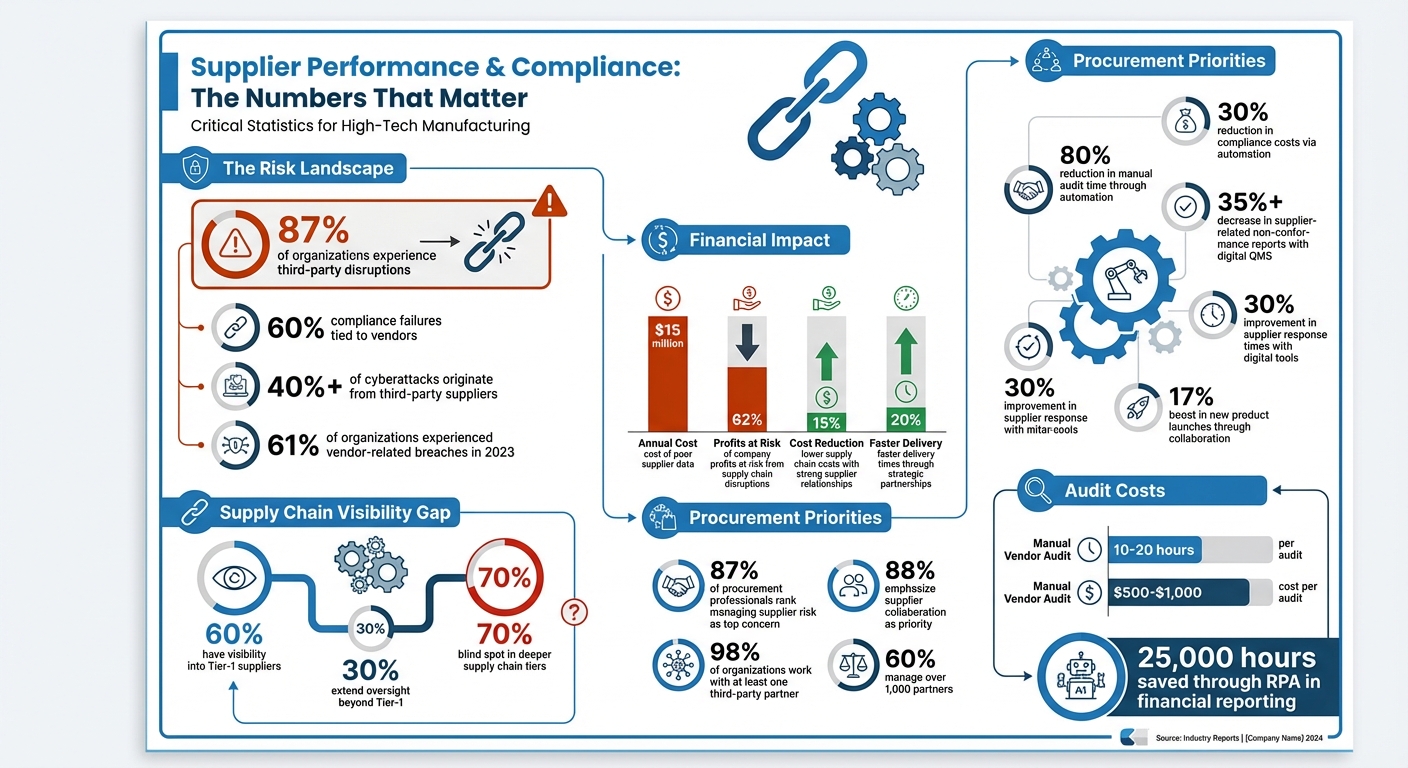
High-tech manufacturers face growing risks from hidden supply chain vulnerabilities, including counterfeit components, cybersecurity threats, and quality issues. With 87% of organizations experiencing third-party disruptions and 60% of compliance failures tied to vendors, addressing these challenges is urgent. Here’s how you can improve supplier performance and compliance:
- Set Clear KPIs: Focus on 5–7 core metrics like First Pass Yield, On-Time Delivery, and Innovation.
- Conduct Regular Audits: Use risk-based segmentation to prioritize critical suppliers and uncover potential issues.
- Leverage Technology: Automate tracking, integrate ERP systems, and use AI tools for real-time monitoring.
- Build Relationships: Treat suppliers as partners, not just vendors, to achieve shared goals.
- Focus on Compliance: Include legal, safety, and ethical standards in your evaluations.
Supplier Performance Management: Key Statistics and Impact Metrics
Essential Strategies for Supplier Management: Optimizing Performance, Governance & Compliance
Setting Up Key Performance Indicators (KPIs) for Suppliers
Clear KPIs transform supplier management from a reactive process into a proactive strategy. Without measurable goals, manufacturers often miss early warning signs – issues like defective parts or delayed shipments only become apparent once they disrupt operations. Poor supplier data costs businesses roughly $15 million annually, and 87% of procurement professionals now rank managing supplier risk as their top concern.
A strong KPI framework blends lagging indicators (e.g., defect rates that reflect past performance) with leading indicators, such as supplier change management effectiveness, which help anticipate future problems. To keep the data actionable, focus on 5–7 core metrics tied directly to business objectives. Overloading scorecards with too many metrics dilutes their impact. A balanced approach might allocate 30% weight to quality, 30% to cost, 20% to delivery, and 20% to innovation. However, priorities should adjust based on current business goals – during a product launch, for example, innovation metrics might take precedence over cost.
"The best way to create quality metrics for scorecards is to have a discussion with stakeholders about their business objectives and about how a supplier can help them achieve those."
– Suman Sarkar, Partner at 3S Consulting
Selecting KPIs for High-Tech Manufacturing
High-tech manufacturing requires KPIs that address both obvious failures and subtle process inefficiencies. Metrics like First Pass Yield (FPY) highlight inefficiencies by measuring the percentage of materials that meet standards without rework during processing. Similarly, the Supplier Defect Rate tracks the percentage of incoming materials that fail quality checks, serving as a critical indicator of supplier reliability.
Other key metrics include Supplier Change Management Performance, which evaluates how well suppliers handle changes to materials, processes, or sub-suppliers. Poor change management is a leading cause of unexpected defects in complex manufacturing settings. Additionally, Corrective Action Responsiveness (CAPA Effectiveness) measures not just how quickly suppliers address quality issues, but whether their solutions prevent future problems.
Delivery metrics also play a crucial role. On-Time Delivery (OTD) directly affects production schedules, as delays can lead to costly disruptions or even halt production lines entirely. Supply chain disruptions can wipe out as much as 62% of a company’s profits, underlining the importance of reliable delivery.
For companies looking to stay competitive, tracking Innovation and R&D Capability is essential. Suppliers that introduce fresh design ideas or technical improvements can provide a significant advantage. As Gary Gustafson, President of G-Force Consulting, notes:
"Keeping the pipeline full of new supplier-driven innovations should be just as important as PPM (parts per million), cost reduction, and other metrics".
| KPI Category | Specific Metric | Relevance in High-Tech |
|---|---|---|
| Quality | First Pass Yield (FPY) | Detects process variation before nonconformities arise |
| Agility | Change Management Performance | Prevents defects caused by unapproved changes |
| Financial | Cost of Poor Supplier Quality (CoPQ) | Quantifies quality failures in financial terms |
| Logistics | On-Time Delivery (OTD) | Ensures production schedules remain uninterrupted |
| Strategic | Innovation Metric | Drives competitive advantage through supplier innovation |
In regulated industries like aerospace, medical devices, and automotive manufacturing, include Compliance Rate alongside innovation and delivery metrics to ensure adherence to legal, safety, and environmental standards. Non-compliance can result in fines and reputational damage. The FDA’s emphasis on "Quality Management Maturity" highlights the importance of using quality metrics to drive continuous improvement rather than simply meeting minimum standards.
These KPIs not only clarify performance expectations but also guide how and when to analyze supplier data.
Tracking and Analyzing Supplier Performance Data
Once KPIs are established, the next step is implementing effective tracking methods to support timely, data-driven decisions.
The frequency of monitoring should align with supplier importance. Critical suppliers – those essential to operations – should be evaluated monthly or quarterly, while standard or low-risk suppliers can be reviewed annually. This tiered approach ensures resources are focused where they are needed most without creating unnecessary administrative work.
Data collection can range from manual methods, like surveys and forms, to automated systems using RFID, barcodes, or ERP integration. Automation reduces subjectivity, provides real-time insights, and accelerates data analysis. Modern platforms with AI capabilities can even send instant alerts, a feature particularly useful in high-tech industries like aerospace.
To ensure fair comparisons, normalize data by expressing metrics per million units rather than absolute numbers. This avoids penalizing high-volume suppliers unfairly. When calculating the Cost of Poor Supplier Quality (CoPQ), include all related costs – such as rework, scrap, line stoppages, and customer returns – not just inspection failures.
Combining multiple metrics into a single weighted score can simplify comparisons and support strategic decisions. As Gerard Blokdyk, CEO of The Art of Service, explains:
"A balanced scorecard that measures and tracks vendor performance on various levels related to organizational strategy"
can promote continuous improvement. Interestingly, suppliers often improve their performance simply because they know they’re being monitored – a phenomenon called the Hawthorne Effect.
Position performance tracking as a collaborative effort rather than a punitive one. By fostering a sense of partnership, you encourage suppliers to actively participate and share accountability for improvements. Companies that work closely with their suppliers tend to grow twice as fast as those that don’t.
A robust KPI framework also lays the foundation for audits and risk assessments, ensuring thorough oversight of supplier performance.
Conducting Supplier Audits and Risk Assessments
Supplier audits and risk assessments are essential tools for moving from a reactive approach to a proactive strategy in supplier management. While KPIs help measure supplier performance, audits dig deeper to uncover the reasons behind issues and offer ways to prevent them. With over 40% of cyberattacks originating from third-party suppliers and 61% of organizations experiencing vendor-related breaches in 2023, regular audits are now critical for safeguarding both operations and reputation.
Scaling these audits, however, is no easy task. While 60% of companies report visibility into their Tier-1 suppliers, only 30% extend their oversight beyond that first tier. This gap creates vulnerabilities, particularly in high-tech manufacturing, where risks like counterfeit parts or hidden malicious functionality in deeper supply chain layers can jeopardize entire product lines. A structured and consistent audit program helps address these blind spots, creating a standardized evaluation process across all supplier relationships.
Planning and Executing Supplier Audits
The foundation of any effective audit lies in risk-based segmentation. Not all suppliers require the same level of scrutiny. Suppliers can be classified based on factors like their business impact, spending levels, or country-specific risks. For instance, critical suppliers managing sensitive data or essential components may need detailed on-site audits, while low-risk vendors might only require a review of their documentation.
Before conducting an audit, it’s essential to define KPIs and Service Level Agreements (SLAs) to provide clear benchmarks for evaluating results. In high-tech manufacturing, this process should go beyond basic quality checks to include areas like financial stability, cybersecurity measures, and ethical or social practices, such as labor law compliance and environmental considerations.
| Audit Focus Area | Key Metrics/Checkpoints | High-Tech Relevance |
|---|---|---|
| Quality | Defect rates, compliance with specifications | Ensures component reliability in complex assemblies |
| Cybersecurity | Data privacy, NIST compliance | Protects intellectual property and prevents cyberattacks |
| Financial Health | Stability, dependency on single customers | Reduces risk of disruptions due to vendor insolvency |
| Operational | Lead times, on-time delivery rates | Supports "just-in-time" manufacturing flows |
| Ethical/Social | Labor law adherence, environmental impact | Maintains brand integrity and regulatory compliance |
For high-tech industries, audits should also address ICT-specific risks, such as counterfeit components and hidden malicious functions. Using standardized methodologies and centralized platforms ensures consistency and comparability across audits. This not only builds trust with regulators but also simplifies internal decision-making processes.
The goal of an audit isn’t to penalize suppliers for shortcomings. Instead, it’s about working together to create improvement plans with clear timelines and measurable goals.
Automation can also make a big difference, cutting manual audit time by up to 80%. For example, manual audits typically take 10–20 hours per vendor and cost between $500 and $1,000 each. From 2019 to 2022, Adidas implemented a program that included clear selection criteria, robust communication channels, and post-onboarding training sessions. By adding grievance channels and support systems, they boosted satisfaction rates for complaint resolution from 39% in 2019 to 77% in 2022.
"Supplier onboarding can be a nightmare"
– Anders Lillevik, ex-CPO at Fannie Mae
To avoid last-minute compliance issues, consider using a "Supplier Expiration Radar" – a rolling 90-day tracker for expiring certifications, insurance, or tax documents. Additionally, a "Fast-Track Lane" with internal SLAs (e.g., 24-hour turnaround) can help onboard and audit low-risk suppliers quickly, freeing up resources for more strategic, high-risk vendors.
Identifying and Managing Supplier Risks
Once audits are complete, risk assessments help pinpoint vulnerabilities before they can disrupt operations. These assessments highlight potential issues like counterfeit products, poor manufacturing practices, or malicious functionality. Conducting pre-contract due diligence allows you to set risk thresholds for approving or rejecting suppliers.
Standardized questionnaires offer a broad view of risks across areas like security, privacy, and ESG compliance. Mapping this data to frameworks like NIST or the Digital Operational Resilience Act (DORA) helps identify non-compliance areas that need attention. For instance, the updated NIST SP 800-161r1, released in November 2024, provides guidance on Cybersecurity Supply Chain Risk Management (C-SCRM), integrating risk assessments into procurement decisions.
Continuous monitoring is another key element. Instead of relying on outdated annual reviews, real-time assessment exchanges keep risk data current, reducing blind spots. With 98% of organizations working with at least one third-party partner and 60% managing over 1,000 partners, this approach is critical for maintaining oversight.
"With so much uncertainty around global trade, businesses need to stay ahead of tariff impacts before they disrupt operations."
– Will McNeill, VP of Market Intelligence, apexanalytix
To streamline decision-making, set objective risk thresholds for approving, restricting, or denying vendor relationships based on their scores. Automating workflows can simplify onboarding and provide accountability through real-time tracking and dashboards. For high-risk or complex vendors, supplement baseline compliance data with additional, targeted questions.
Periodic risk-simulation drills can help test your team’s ability to detect, escalate, and resolve vendor-related issues quickly. Additionally, establishing a Data Health Index – a quarterly score for the accuracy and completeness of supplier data – ensures reliable audit trails.
Technology plays a significant role in scaling risk management. Automation can reduce compliance costs by up to 30%. For example, Robotic Process Automation (RPA) in financial reporting can save up to 25,000 hours of rework caused by human error. Choose compliance tools that integrate seamlessly with ERP systems like Oracle or SAP to maintain a single source of truth for supplier data.
"Automation in vendor risk management helps teams scale VRM without sacrificing consistency, speed, or oversight."
– Panorays
The move from static annual reviews to continuous monitoring is a game-changer. AI-powered tools can now predict supplier issues and flag delays before they occur. Cloud-based collaboration platforms also enable instant communication and shared dashboards between manufacturers and suppliers. In today’s high-tech manufacturing landscape, this tech-driven approach is no longer optional – it’s essential for staying competitive and compliant.
sbb-itb-827f251
Using Technology for Supplier Performance Management
Say goodbye to manual tracking and the chaos of spreadsheets. Managing a large network of suppliers across multiple tiers can quickly become a logistical nightmare, especially when relying on outdated tools like email chains. These methods often create blind spots that lead to costly mistakes. That’s where integrated software solutions come into play.
Modern supplier performance management (SPM) software pulls data from systems like ERP, S2P (Source-to-Pay), and CLM (Contract Lifecycle Management) to create a unified source of truth. This eliminates the need for manual data entry and ensures that critical performance metrics – like On-Time-In-Full (OTIF) deliveries and Parts Per Million (PPM) defect rates – are calculated using real-time data you can trust. Instead of scrambling to piece together scattered information, procurement teams gain a clear and centralized view of supplier performance and risks.
But it doesn’t stop there. Advanced technology now enables predictive management. AI-driven tools can identify anomalies in KPIs, predict trends like increasing defect rates, and even automate corrective actions. For example, if a supplier’s performance drops below a set threshold, the system can automatically trigger Corrective and Preventive Actions (CAPA), ensuring accountability and quick resolution. This proactive approach helps prevent minor issues from escalating into production delays or other costly disruptions.
For industries with strict regulatory requirements, compliance tracking becomes much simpler. Digital platforms can monitor certifications (like ISO or FDA), track expiration dates, and even automate reminders to avoid last-minute scrambles. These tools reduce the risk of audit failures by ensuring all compliance documentation is up-to-date and easily accessible.
Connecting ERP and Sourcing Software
To fully harness the power of technology, integrating your systems is essential. The depth of this integration determines whether your supplier performance system becomes a game-changer or just another tool. By connecting your SPM platform to core systems – like ERP and S2P – early in the process, you can map events such as purchase orders and contract expirations directly to KPIs. This eliminates delays and reduces the chance of manual errors.
Different types of solutions offer varying integration capabilities:
- S2P Suite Modules: Ideal if your organization already uses a standardized procurement suite. These modules offer strong internal connections but may vary in ERP compatibility.
- ERP-Embedded SPM Tools: These tools integrate seamlessly with financial and transactional data, making them perfect for companies that prioritize financial reporting.
- Best-of-Breed Platforms: These provide broad connectivity across ERP, S2P, and CLM systems, offering flexibility for diverse needs.
- AI-Native Orchestration Tools: Using event-driven architecture, these tools predict issues and automate fixes across multiple systems.
Take QSTRAT’s cloud-based platform as an example. It centralizes supplier data and integrates seamlessly with existing CRM and ERP systems. By combining sourcing, quoting, and performance management in one place, manufacturers can avoid the fragmentation that often leads to errors. Built-in workflows and two-way communication tools also allow suppliers to address issues in real-time, fostering collaboration.
Before diving into full-scale integration, standardize your data models. Normalize supplier IDs across regions and ensure metric formulas are consistent. A 60–90 day pilot program with a specific group of suppliers can help you fine-tune rules and workflows before rolling out the system more broadly. When introducing the software to suppliers, present it as a tool for partnership rather than surveillance. Shared scorecards and supplier portals let vendors track their own performance and address issues proactively, building trust and collaboration.
Real-Time Monitoring and Reporting
Annual reviews are no longer enough. Supply chains today demand real-time monitoring, which shifts procurement teams from reactive reporting to proactive control. This approach helps detect potential disruptions – like delivery delays or quality issues – before they escalate. Executive dashboards offer a high-level view of trends, enabling leadership to make strategic decisions without getting bogged down in day-to-day details.
Real-time monitoring streams data directly from ERP and S2P systems, calculating KPIs as transactions occur. Automated alerts flag issues immediately, allowing teams to resolve them before they impact production. For high-tech manufacturers, where a single defective part can halt production or lead to recalls, this level of visibility is indispensable.
Instead of manually reviewing every supplier, procurement teams can use tiered monitoring. Critical and strategic suppliers receive detailed monthly reviews, while automated alerts handle standard or low-risk vendors. AI tools can also predict trends in metrics like OTIF, enabling early intervention when performance starts to slip.
Digital Quality Management Systems (QMS) take this a step further by reducing non-conformance reports (NCRs) tied to suppliers by over 35%. Supplier portals allow vendors to access scorecards, upload compliance documents, and respond to CAPAs directly – streamlining communication and cutting down on administrative work. This self-service model speeds up resolutions and ensures everyone stays on the same page.
For regulated industries, audit readiness becomes a breeze. Modern SPM platforms can generate detailed, exportable reports in minutes, complete with data lineage showing how each KPI was calculated and which systems provided the data. This means you’re always prepared for audits, whether they’re internal or external.
Real-time monitoring also refines how you calculate total cost of ownership (TCO). Beyond the purchase price, these tools track the "Cost of Poor Quality" (COPQ), including factors like rework, scrap, and warranty claims. This insight helps procurement teams make smarter decisions, sometimes choosing a higher-priced supplier whose reliability ultimately lowers overall costs.
"AI-powered, integrated SPM is a strategic lever for resilience. It transforms fragmented, rear-view reporting into predictive, closed-loop management that protects revenue."
– Andrew Stroup, Founder, Leverage
With 88% of procurement leaders emphasizing supplier collaboration as a top priority in the past two years, the right technology should support partnership, not just oversight. Real-time data sharing, transparent scorecards, and automated workflows lay the groundwork for stronger supplier relationships that drive both innovation and competitive edge.
Building Supplier Relationships and Ethical Procurement
While real-time monitoring and integrated software can streamline operations, the real key to long-term success lies in strong supplier relationships. Technology and data play a role, but the real advantage comes from treating suppliers as partners rather than just vendors. Companies that invest in these relationships often see 15% lower supply chain costs and 20% faster delivery times. These benefits translate directly into reduced expenses and quicker operations.
Shifting from a transactional approach to a strategic one takes effort. Start by segmenting suppliers using tools like the Kraljic Matrix, which divides them into categories: strategic, leverage, bottleneck, and non-critical. Prioritize strategic partners – those providing essential components – by conducting biannual on-site visits to evaluate production, safety, and operational practices. These visits often uncover crucial insights into a supplier’s discipline and reliability.
Financial flexibility also plays a big role in strengthening these partnerships. For example, offering early payment options during uncertain market conditions can help suppliers stay resilient. This not only supports their operations but also positions your company as a preferred customer. Being a "customer of choice" – representing a significant portion of a supplier’s business – can lead to better pricing, priority access, and early adoption of new technologies.
Working Collaboratively with Suppliers
Collaboration starts with setting clear expectations and involving cross-functional teams to share knowledge. This process, often called relationship learning, allows suppliers to address potential design or quality issues early, preventing costly disruptions. Companies that embrace this approach report a 17% boost in new product launches.
Digital tools can also make a big difference, improving supplier response times by 30%. For example, platforms that integrate sourcing and performance management enable two-way communication, making processes smoother.
Take the case of Serial 1, an e-bike manufacturer. In 2024, they switched to a centralized procurement system using specialized software. This change eliminated manual tasks, provided transparent purchase order tracking, and reduced stockouts. The result? Improved operational profits and a more efficient supply chain. This example highlights how the right tools can turn supplier collaboration into a strategic advantage.
It’s important to avoid treating suppliers as adversaries. As Graham Scott of Jabil puts it:
"SRM benefits both parties – it is the backbone of successful supplier relationships".
Instead of using data requests solely for cost-cutting, share your own success stories and tools with suppliers. This builds trust and encourages transparency, helping suppliers open up about their challenges. Such practices not only strengthen partnerships but also pave the way for ethical and responsible sourcing.
Supporting Ethical Sourcing and Sustainability
Ethical procurement isn’t just about compliance – it’s a way to reduce risk and maintain high standards across the supply chain. Past failures in transparency have shown how costly poor supplier vetting can be. Aligning supplier efforts with sustainability goals can help avoid these issues while reinforcing accountability.
The CDP Supply Chain initiative, which includes over 340 members with $6.4 trillion in purchasing power as of 2022, illustrates the growing focus on responsible sourcing. Many organizations concentrate their efforts on a small group of key suppliers, typically those accounting for 75% to 80% of total spend. This targeted approach makes it easier to implement ethical standards without overwhelming procurement teams.
When requesting sustainability data, keep it simple. For example, ask straightforward questions like "Are you measuring emissions?" to avoid burdening suppliers with complex requirements. For smaller suppliers, provide tools like built-in emissions calculators or spreadsheets to assist them in reporting.
Building capacity is another way to support suppliers. Offer technical help, such as training sessions or help desks. Adidas is a great example of this. By introducing grievance channels and post-onboarding training, they improved supplier satisfaction with complaint resolution from 39% in 2019 to 77% in 2022. Adidas also ranked 2nd out of 37 companies for transparency in forced labor policies, according to KnowTheChain.
Third-party platforms like SEDEX, GRI, or the Supplier Ethical Data Exchange can simplify the process of sharing labor, health, safety, and environmental data. These platforms protect sensitive business information while reducing the reporting workload for suppliers. Similarly, industry alliances like the Electric Utility Industry Sustainable Supply Chain Alliance (EUISSCA), which includes the 16 largest utilities in the U.S., work to standardize assessments and minimize redundancy.
At the heart of ethical procurement is transparency and communication. As Jack Pellegrino, Director of Purchasing and Contracting at the County of San Diego, explains:
"The Ivalua Supplier Relationship Model has been a key part of our strategy to engage with the community and small businesses in our region".
Conclusion
By combining clear KPIs, thorough audits, and well-chosen partnerships, integrated technology creates a solid foundation for effective supplier management. Strong supplier performance and compliance practices are key to maintaining resilience in high-tech manufacturing.
QSTRAT simplifies supplier management by consolidating data, automating compliance processes, and delivering real-time insights. This transforms procurement from a reactive cost-cutting exercise into a forward-thinking strategy. When performance metrics, audit outcomes, and compliance records are housed in one place, decisions can be made faster and with greater precision – an essential edge for industries like aerospace, medical devices, and other advanced sectors.
Shifting from basic vendor management to building strategic supplier relationships can lead to major operational gains. But achieving this requires open communication, aligned objectives, and systems that encourage ongoing feedback and development.
Ethical sourcing plays a critical role, protecting your brand, meeting regulatory requirements, and aligning with customer values. Incorporating ethical practices into your strategy not only reduces risk but also supports sustainable business growth. Focusing on key supplier relationships and shared standards ensures stability and long-term success.
To stay ahead, define measurable KPIs, perform regular risk evaluations, use advanced technology, and treat suppliers as true partners. As regulations evolve, managing supplier performance effectively goes beyond improving efficiency – it becomes a crucial factor for staying competitive and ensuring operational continuity.
FAQs
What are the best ways for high-tech manufacturers to manage supplier risks and ensure compliance?
High-tech manufacturers can tackle supplier risks and ensure compliance by putting a solid supply chain risk management (SCRM) strategy in place. The first step? Assemble a cross-functional team. This team should bring together experts from procurement, cybersecurity, legal, and logistics to pinpoint and evaluate potential risks. These risks might include counterfeit parts, substandard manufacturing practices, or cybersecurity vulnerabilities.
Keeping an eye on things consistently is just as important. Regularly review supplier performance, run vulnerability scans, and leverage tools like Software Bill of Materials (SBOMs) to boost transparency and traceability. When these practices are woven into procurement workflows, manufacturers can better manage risks, stay compliant, and create a stronger, more reliable supply chain.
What are the most important KPIs for measuring supplier performance?
When assessing how well suppliers are performing, key performance indicators (KPIs) play a crucial role in ensuring both reliability and compliance. Here are some essential metrics to keep an eye on:
- Quality metrics: This includes tracking things like defect rates or how well products align with agreed specifications.
- On-time delivery: Measures how often suppliers stick to the delivery schedules they commit to.
- Cost management: Focuses on cost-effectiveness and whether suppliers stay within budget expectations.
- Regulatory compliance: Ensures suppliers meet required industry standards and legal obligations.
- Relationship strength: Looks at factors like communication, responsiveness, and overall collaboration.
By monitoring these KPIs, companies can get a clearer view of supplier performance, which helps maintain high standards and fosters strong, dependable partnerships.
How can technology improve supplier performance and ensure compliance?
Technology has become a cornerstone in boosting supplier performance and ensuring compliance, thanks to tools that improve visibility, automation, and efficiency across the supply chain. With advanced platforms, businesses can track supplier performance in real-time, automate compliance processes, and simplify communication. This ensures that suppliers consistently meet both quality expectations and regulatory requirements.
By using systems like ERP (Enterprise Resource Planning) and CRM (Customer Relationship Management), companies can centralize critical data, make better decisions, and address challenges like delays or quality issues before they escalate. Secure data-sharing practices and supply chain risk management tools also help safeguard against potential vulnerabilities, creating a more transparent and dependable supplier network. Embracing these technologies allows businesses to build stronger supplier partnerships while maintaining compliance in fast-paced, tech-driven manufacturing settings.
Related Blog Posts
You may also like

Top 7 Tools For Supplier Relationship Management
Compare seven SRM platforms by features, integrations, and scalability to find the right supplier management solution.

Supplier Certification: Why It Matters for Compliance
Supplier certification is a strategic safeguard that prevents regulatory breaches, supply disruptions, and reputational damage.