


Want faster, more accurate quotes? Modern quoting libraries are transforming manufacturing by centralizing data, automating workflows, and improving precision. Here’s why they matter:
- Speed and Accuracy: Quoting tools reduce turnaround times by up to 98% and improve quote precision by 75%.
- Standardized Templates: Eliminate inconsistencies and save 73% of the time spent creating quotes.
- Automated Pricing: Real-time data ensures quotes reflect current costs, cutting errors by 49%.
- CRM and ERP Integration: Syncs data seamlessly, reducing manual entry and errors.
- Inventory and Supplier Management: Live updates prevent underquoting and delays.
- Analytics: Track win rates, cost accuracy, and supplier performance for smarter decisions.
- Workflow Automation: Speeds up approvals and ensures profitability thresholds are met.
- Vendor Communication: Centralized tools simplify supplier interactions and reduce miscommunication.
- Centralized Data: A single source of truth protects against knowledge loss and boosts efficiency.
Example Impact: Companies like PixelFLEX tripled quotation volume and grew revenue by 30% using these tools.
Quoting libraries like QSTRAT are reshaping how manufacturers handle quotes, ensuring speed, accuracy, and scalability. Ready to move beyond spreadsheets? These systems are the future of manufacturing efficiency.
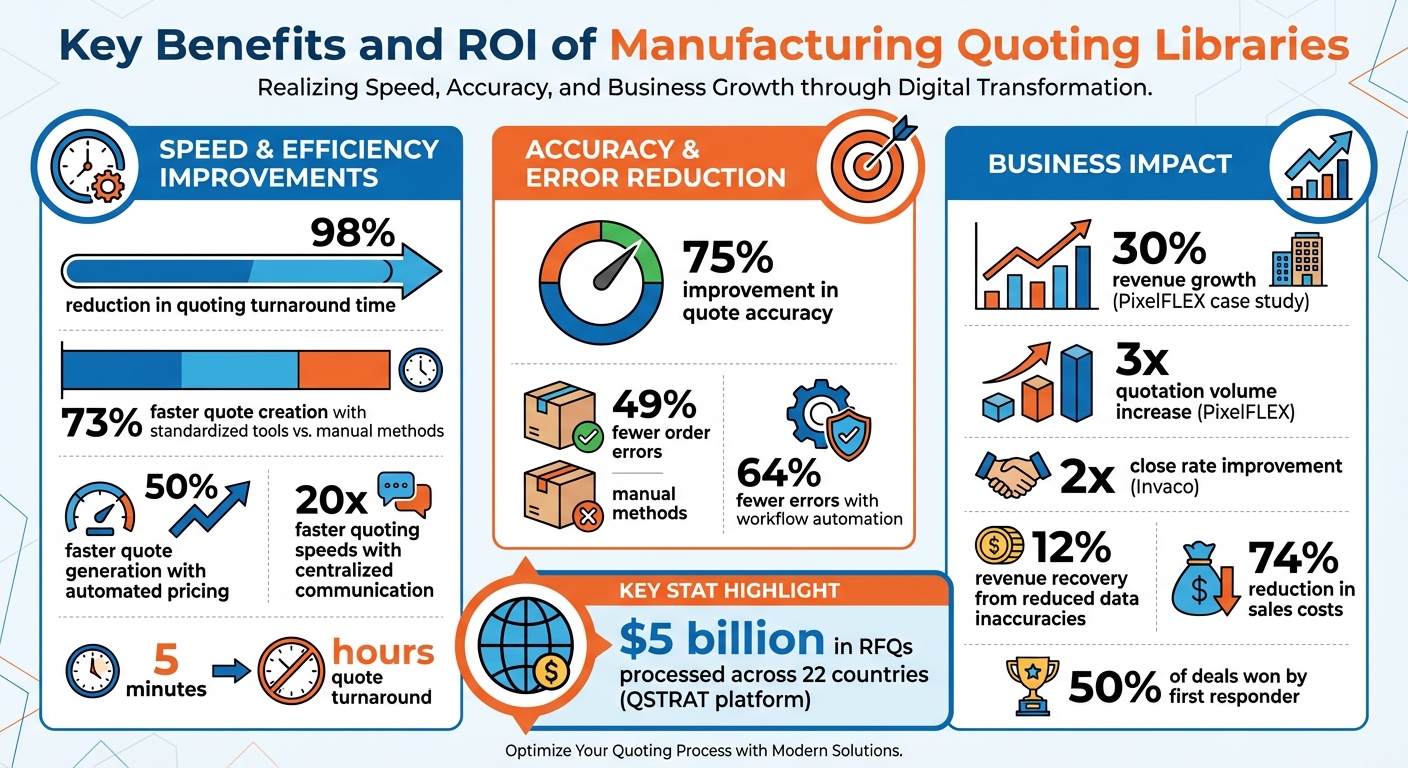
Key Benefits and ROI of Manufacturing Quoting Libraries
ERP Software for Manufacturing: Streamline Quote Generation and Save Time with M1
1. QSTRAT

QSTRAT is a cloud-based platform designed to bring customer, product, and vendor data together in one place. By replacing spreadsheets and disconnected systems, it simplifies the quoting process with features like standardized formats and real-time supplier management.
Standardization of Quoting Formats
QSTRAT ensures consistency with its PDF integration and copy RFQ feature, which updates supplier data across more than 50 elements. This standardization allows the platform to automate pricing and workflows without any hassle.
Automation for Pricing and Workflows
Using custom logic, QSTRAT considers cost drivers and customer-specific details to generate competitive pricing. Its AI-powered validation system flags unusual quotes, while automated vendor selection sends e-RFQs to the right suppliers based on sourcing needs. Impressively, the platform has managed over $5 billion in RFQs across 22 countries, with some manufacturers up and running in just five days.
Seamless Integration with CRM and ERP Systems
QSTRAT integrates smoothly with CRM and ERP systems, pulling in customer requests, Bill of Materials, and automating order entries. This integration ensures a seamless, error-free workflow and supports efficient supplier and inventory management.
Enhanced Supplier and Inventory Management
Beyond comparing prices and costs, QSTRAT provides real-time bid comparisons and automated reminders for suppliers. It also helps foster better supplier relationships and learning opportunities. As BAE Systems put it:
"For BAE, QSTRAT Sourcing is much more than a great tool to compare price, labor, raw material, packaging, and transportation among our suppliers. It’s helping BAE become a better manufacturer by using QSTRAT Sourcing as a learning tool for suppliers".
2. Standardized Quote Templates
Consistency is key when it comes to quoting, and standardized quote templates are a game-changer in achieving it. These pre-built templates eliminate the guesswork and variability often found in manual quoting processes. Wayne Cathers, Product Owner-Business Systems at SigmaNEST, sheds light on the issue:
"Every worker may have their own way of quoting, looking at different metrics and parameters to calculate costs. This can lead to discrepancies and inconsistent quotes and no historically standardized way to track how quotes were handled".
By using standardized templates, businesses can ensure uniformity in metrics, markups, and workflows. The impact is substantial – those who skip standardized tools spend 73% more time creating quotes. And in the fast-paced world of sales, speed matters: 50% of the time, the first business to respond secures the deal.
Templates also simplify training for new estimators. With pre-set rules in place, they can generate accurate quotes right away, safeguarding profit margins during their learning phase. Moreover, templates help retain consistency and institutional knowledge, even when seasoned estimators move on.
Another advantage? Templates enhance professional branding. They automatically incorporate company logos, detailed bills of materials, and 2D/3D technical drawings, creating a polished and professional presentation that can strongly influence a buyer’s decision.
3. Automated Pricing and Cost Calculations
Relying on manual pricing can be a risky game. A tiny mistake – like a typo or an outdated spreadsheet – can lead to costly errors, sometimes amounting to thousands of dollars per quote. In fact, data inaccuracies can chip away as much as 12% of revenue. Automated pricing systems tackle this issue head-on by pulling real-time data directly from ERP and MRP systems. These systems draw from sources like the Bill of Materials (BOM), current inventory levels, labor rates, and material costs, ensuring that every quote reflects up-to-the-minute accuracy.
The benefits go beyond just accuracy. Manufacturers using automated quoting tools can generate quotes 50% faster compared to manual methods. They also see 49% fewer order errors. Once a quote gets approved, these systems can convert it into a sales order with just one click. This eliminates the need for duplicate data entry and speeds up the entire quote-to-order process. This efficiency is especially useful for managing complex pricing challenges.
Automated systems excel in handling intricate pricing scenarios by using rule-based logic. They seamlessly apply volume discounts, promotional margins, and other cost drivers. For products with multiple components – where raw material and shipping costs fluctuate – achieving this level of precision manually would be a daunting task. These systems simplify the process while supporting advanced pricing strategies.
AI adds another layer of sophistication. It flags quotes that fall outside acceptable ranges and offers predictive recommendations based on profitability and market trends. By shifting to dynamic, cloud-based costing, manufacturers create a centralized source of truth for all cost data. This approach replaces error-prone spreadsheets scattered across departments, ensuring consistency and reliability.
4. Integration with CRM and ERP Systems
Connecting your quoting library directly to CRM and ERP platforms eliminates the hassle of entering the same data multiple times. Customer information, product details, and pricing are automatically updated, saving time and reducing errors . Plus, this integration allows sales reps to access real-time inventory levels and Bill of Materials (BOM) data directly within the CRM. This ensures every quote reflects what can actually be produced and delivered . The result? Faster, more accurate quoting.
Here’s a striking fact: sales teams without integrated quoting software take 73% longer to generate quotes compared to those using connected systems. And the benefits aren’t just theoretical – they’ve been proven in practice.
"By leveraging QSTRAT’s suite of products with our existing MFG/PRO and Cyberquery solutions we can now accurately quote, track successes and measure our accuracy of our projected costs versus our true costs when entered into our MFG/PRO system." – BAE Systems
Integration goes beyond data synchronization – it streamlines the entire quote-to-cash process. Once a customer accepts a quote, the system automatically creates order entries in the ERP, eliminating the need for manual re-entry . It also handles billing and invoicing, ensuring a smooth transition from estimates to payments. For manufacturers dealing with complex products, live BOM data ensures quotes stay aligned with current material costs and engineering updates .
In today’s digital landscape, this level of integration isn’t just a luxury – it’s a must. With 77% of B2B buyers now open to completing transactions of $50,000 or more online, real-time accuracy and seamless back-end integration are critical for building buyer confidence and ensuring smooth operations.
5. Real-Time Inventory and Supplier Management
In industries where raw material prices can shift unpredictably – like sheet metal – outdated pricing can wreak havoc on profit margins. That’s where live inventory tracking and supplier data come into play. By ensuring every quote reflects current stock levels and accurate costs, these systems not only speed up the quoting process but also keep pricing competitive and precise.
With real-time tools, manufacturers can leverage Production Quoting, which calculates costs based on actual machine data and material usage, including part nesting on raw material sheets. This approach automatically accounts for scrap material, eliminating the risk of underquoting projects.
"The nested cost is especially important for accurate quotes. With many parts, it’s good to know how many sheets it would take to complete the project… scrap material that can’t be salvaged… needs to be worked into the cost as well." – Wayne Cathers, Product Owner-Business Systems, SigmaNEST
Integrated dashboards allow manufacturers to check internal stock and pricing before reaching out to suppliers for quotes. This avoids unnecessary purchases and ensures quotes are based on current inventory costs. For external sourcing, systems equipped with RSS technology provide real-time updates on material prices.
The benefits are undeniable: faster quoting processes can significantly improve win rates. Advanced quoting modules have even reduced turnaround times from hours to just five minutes. Plus, centralized dashboards help monitor raw material levels and equipment capacity, ensuring quotes are accurate and preventing delays caused by unavailable items.
sbb-itb-827f251
6. Analytics and Reporting
Understanding how quotes perform is essential for manufacturers aiming to stay efficient. Built-in reporting tools turn raw quoting data into actionable insights by tracking key metrics like win/loss ratios, conversion rates, and pricing trends. These insights enable manufacturers to make smarter decisions, improving both pricing strategies and overall operations.
By comparing estimated costs with actual results, manufacturers can refine their pricing approaches over time. This kind of data works hand-in-hand with the automated pricing and integration features mentioned earlier, creating a feedback loop that drives continuous improvement. Centralized data analytics further strengthens this process, offering a complete picture of quoting performance through tools like quoting libraries.
The benefits of these insights are tangible. For instance, PixelFLEX saw its quotation volume triple and experienced a 30% growth in LED display production after adopting specialized quoting software. Similarly, Invaco, an armored vehicle manufacturer, doubled its close rate by using transparent, customized pricing tools. These advancements not only boost close rates but also help cut down operational costs. Some manufacturers have achieved staggering results, like a 97% reduction in time-to-quote and a 74% drop in sales costs, thanks to automated intelligence tools.
Analytics also goes beyond pricing, keeping an eye on operational efficiency. Platforms can track metrics like turnaround time, cost per quote, and supplier performance, helping manufacturers identify and address workflow bottlenecks. Knowing which suppliers contribute to successful bids – based on pricing and responsiveness – allows manufacturers to strengthen partnerships and negotiate better deals.
Real-time data plays a critical role here. Scott Murcray, CFO at Pure Wafer, shared his experience:
"I’m spending less time creating the reports now, and much more time actually analyzing the data with senior management to understand what it means".
Automated dashboards have replaced tedious manual spreadsheets, freeing up teams to focus on strategic analysis rather than time-consuming data entry. This shift allows businesses to make faster, more informed decisions.
7. Workflow Automation and Approval Processes
Manual approval chains can slow everything down, leaving quotes stuck in inboxes and customers feeling frustrated. Automated workflows solve this issue by directing quotes through the right approval paths without unnecessary delays.
With rule-based logic, quotes that fall below specific margin thresholds are flagged and sent to senior management for review. This ensures profitability stays intact while keeping the process moving. Jeff Marone, CEO of Klesk Metal Stamping, highlights the value of centralizing everything:
"We have all relevant and related documentation in one centralized and digital location that we can share with our team so there is no miscommunication or risk that we will miss something on the quote".
By automating workflows, businesses not only speed up their response times but also improve the accuracy and reliability of their processes.
The efficiency gains are hard to ignore. Teams relying on manual quoting methods take 73% more time to create quotes compared to those using automation tools. Some manufacturers report response times as fast as 1 second for pricing and availability, making decision-making much smoother. Plus, automation provides a complete audit trail with timestamps and names for every action, which is crucial for meeting SOX compliance requirements.
Beyond just faster approvals, automated systems send instant notifications to keep everyone in the loop. When a quote requires approval, the system alerts the appropriate stakeholders immediately, ensuring nothing falls through the cracks. Once approved, the system can even process orders directly into the ERP system, cutting down on administrative tasks.
To make automation work seamlessly, it’s essential to define clear approval hierarchies, discount thresholds, and backup plans. Organizations that implement these strategies see 73% faster completion times and 64% fewer errors.
8. Two-Way Vendor Communication
Building on automated workflows, effective vendor communication plays a key role in improving quoting speed and accuracy.
When suppliers and manufacturers rely on scattered emails and phone calls, important details often slip through the cracks. Modern quoting libraries address this by embedding direct communication channels within the quote itself. This keeps every conversation tied to specific line items and technical specifications, making it an essential part of the automated quoting process.
This method clears up confusion. Instead of digging through email chains to find a supplier’s clarification, teams can access all discussions directly linked to the relevant component. One QSTRAT client shared their experience:
"Our team is now utilizing a much more efficient process to collaborate, deliver and evaluate RFQs. This is a significant process improvement for us from the days of managing emails, faxes and spreadsheets".
Top platforms go a step further by removing barriers for suppliers. Using eForms and interactive PDFs, vendors can access 3D drawings, review specifications, and submit bids with tools they already have, like Adobe PDF Reader. There’s no need for portal logins, extra software, or training – making it easy and cost-free for suppliers to respond quickly.
This simplicity extends the platform’s global reach. Automated notifications ensure suppliers stay updated on requisitions and deadlines, while manufacturers receive instant alerts when bids come in. Every interaction is time-stamped and logged automatically, creating a complete audit trail that supports SOX compliance.
Manufacturers who adopt centralized communication workflows report quoting speeds up to 20x faster and see a 75% improvement in quote accuracy. By keeping technical drawings, material specifications, and vendor responses in one place, teams avoid miscommunications that can lead to costly mistakes. This streamlined communication showcases the platform’s ability to support precision and efficiency in quoting.
9. Centralized Data Management
Once seamless vendor communication is in place, the next critical element is centralized data management. When all quote-related data is stored in one unified location, teams no longer waste time combing through scattered emails, shared drives, or endless spreadsheets. This central hub becomes the backbone for improved efficiency, supporting everything from automated pricing to real-time analytics.
Having a single source of truth can revolutionize manufacturing operations. Real-world examples show that consolidating documentation in one place not only eliminates miscommunication but also reduces costly errors. Teams can store everything from material quotes and 3D CAD models to outside processing costs, all linked directly to specific part files. This setup allows even less experienced staff to confidently handle complex quotes that previously required senior-level expertise.
The impact? Manufacturers have reported up to a 98% reduction in quoting time. Take PixelFLEX, a specialized LED display producer, as an example: by centralizing its manufacturing documents and inventory data into a unified CPQ dashboard, the company tripled its quotation volume and achieved a 30% growth in production. Another manufacturer doubled its close rate by offering more transparent and customized pricing through centralized proposal software.
But it’s not just about speed. Centralized systems also protect businesses against knowledge loss when key estimators leave. Features like global search functionality let any team member quickly access historical data, previous margins, and material costs, ensuring consistent pricing regardless of who creates the quote. Every change is meticulously tracked with audit trails, helping companies meet SOX compliance requirements.
Conclusion
Modern quoting libraries have reshaped the way manufacturers operate, offering tools like standardized templates, automated pricing, centralized data management, and two-way vendor communication. These features aren’t just conveniences – they’re essential for staying competitive in today’s fast-moving manufacturing landscape. They simplify processes and lay the groundwork for long-term success.
The numbers speak for themselves. Manufacturers using integrated quoting software report impressive results: quoting times cut by 73% to 98%, 75% better quote accuracy, and profit increases of up to 12% thanks to faster response times and the ability to handle more quotes per sales rep.
QSTRAT stands out as a powerful example of how cloud-based quoting platforms are driving this transformation. With over $5 billion in RFQs processed across 22 countries, it showcases the scalability and dependability manufacturers demand. As Mohan Plakkot, CEO of Embrace Software Inc., highlighted:
"QSTRAT provides highly reliable solutions for the industrial space… The universal appreciation for QSTRAT’s products by its customers’ is a testament to the team’s commitment to delivering a superior solution and service".
Moving away from outdated spreadsheets and manual workflows to integrated quoting systems isn’t just an upgrade – it’s a strategic move. These tools enable manufacturers to respond faster, maintain accuracy to protect margins, and grow efficiently without adding unnecessary overhead. In essence, standardized and automated quoting systems turn digital tools into strategic assets that fuel growth and success in the long haul.
FAQs
How do quoting libraries enhance accuracy and efficiency in manufacturing?
Quoting libraries play a crucial role in manufacturing by centralizing essential details such as product configurations, pricing rules, and templates. This centralized approach minimizes manual errors and ensures that all quotes remain consistent and accurate.
With tools offering real-time data access and automated approvals, manufacturers can create accurate, professional quotes in just minutes – no more waiting days. These features simplify workflows, save valuable time, and enable businesses to respond promptly to customer inquiries, ultimately enhancing productivity.
How does automation enhance quoting systems for manufacturers?
Automation is revolutionizing quoting systems, making the process faster and more efficient for manufacturers. With automation, quotes can be generated in just minutes, thanks to features like automatic customer input capture, predefined pricing rules, and real-time data integration from systems like ERP and CRM. This eliminates manual errors and ensures quick response times – something U.S. buyers have come to expect. Plus, sales teams can spend less time on administrative tasks and more time building relationships and closing deals.
Consistency is another major benefit. Automated workflows enforce approval processes, flag unusual discounts, and keep supplier data current. Tools like automated notifications, AI-powered validations, and built-in approvals ensure manufacturers can respond to RFQs with accurate, up-to-date pricing. This reduces disputes, speeds up cash flow, and improves overall business performance.
Ultimately, automation transforms quoting into a competitive edge, enabling manufacturers to deliver fast, precise, and compliant proposals that align with U.S. business standards and drive growth.
Why is it important for quoting libraries to integrate with CRM and ERP systems?
Integration with CRM and ERP systems plays a key role in ensuring quoting libraries have access to up-to-date data, like customer details, pricing, and inventory levels. This connection removes the hassle of manual data entry, minimizes errors, and ensures quotes are both accurate and consistent.
By creating a smooth flow of information between systems, integration also accelerates the quoting process. This means manufacturers can respond to customer inquiries faster, boosting efficiency. The streamlined connectivity not only improves productivity but also supports smarter decision-making throughout the entire quoting process.
Related Blog Posts
You may also like

Top 7 Tools For Supplier Relationship Management
Compare seven SRM platforms by features, integrations, and scalability to find the right supplier management solution.

Supplier Certification: Why It Matters for Compliance
Supplier certification is a strategic safeguard that prevents regulatory breaches, supply disruptions, and reputational damage.