


AI is transforming contract management in manufacturing by tackling inefficiencies, reducing errors, and improving compliance. Traditional methods like emails and PDFs are slow and error-prone, with manual reviews taking an average of 92 minutes per contract. This inefficiency can cost U.S. enterprises up to 9% of their annual revenue and lead to compliance risks. AI tools streamline processes by automating data extraction, risk analysis, and compliance monitoring, saving time and minimizing financial losses.
Key insights:
- AI reduces manual contract review time by up to 50%.
- 63% of U.S. enterprises prioritize contract automation to improve speed and compliance.
- AI-powered tools like QSTRAT integrate with ERP and CRM systems, centralizing data and simplifying workflows.
- Advanced features include risk detection, compliance monitoring, and actionable insights for better decision-making.
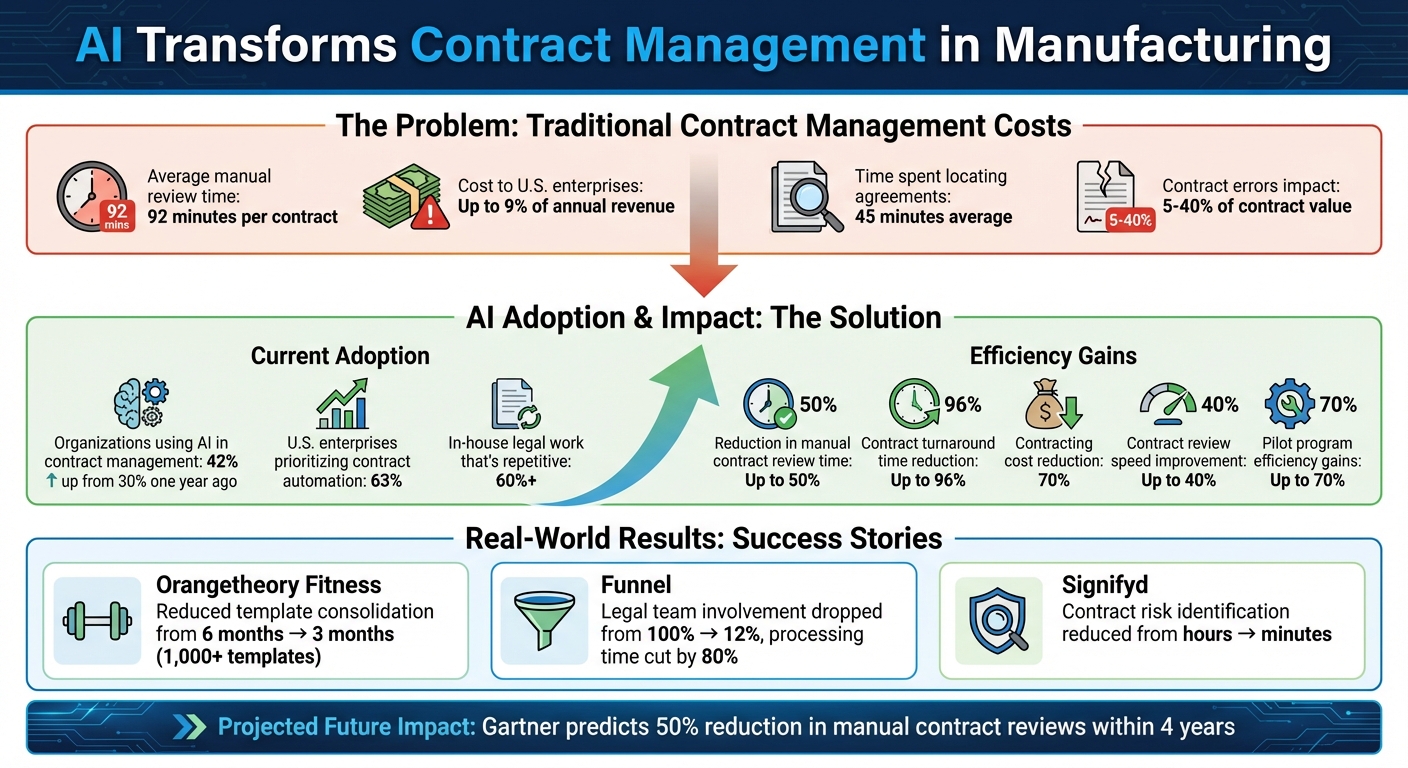
AI Contract Management Impact in Manufacturing: Key Statistics and Benefits
What Are the Benefits of Using AI in Contract Management
How AI Is Used in Manufacturing Contract Management
AI is transforming contract management by automating tasks like review, risk detection, compliance monitoring, and decision-making. This shift allows teams to focus on more strategic responsibilities.
Using AI to Review and Analyze Contracts
AI leverages technologies like natural language processing (NLP), machine learning (ML), and optical character recognition (OCR) to extract critical details – such as terms, clauses, obligations, and metadata – from contracts in various formats. This eliminates the need for manual data entry. According to Gartner, AI is expected to reduce manual input in contract reviews by 50%. Additionally, Icertis reports that using Azure and Azure OpenAI solutions has helped customers speed up contract reviews by as much as 40%.
Charlene Barone, former Director of Legal Ops at Orangetheory Fitness, shared how AI enabled her team to automate redlining across over 1,000 membership agreement templates. This cut the consolidation process from six months to just three months.
Similarly, Cory Sumsion, Head of Commercial Legal at Signifyd, explained that AI allows his team to identify risks in third-party NDAs quickly. Instead of reading the entire document, AI highlights specific concerns, enabling faster modifications or approvals – often within minutes.
By streamlining the analysis process, AI not only accelerates reviews but also lays the groundwork for improved risk management and compliance.
Identifying Risks and Monitoring Compliance
AI systems can spot risks, inconsistencies, and missing clauses early in the contract lifecycle. These tools assign risk scores based on standard contracting guidelines, alerting stakeholders to potential issues before they escalate into compliance problems. Advanced NLP capabilities help identify non-standard terms, problematic language, and regulatory deviations – features that are especially useful in manufacturing, where contracts must adhere to strict industry standards.
For instance, Vodafone‘s Legal and Business Integrity Team used Microsoft 365 Copilot to enhance the speed and accuracy of contract reviews, improving decision-making and turnaround times.
AI also enables comprehensive risk assessments across both third-party agreements and legacy contracts. Real-time compliance monitoring ensures manufacturers stay ahead of contract expirations, obligation deadlines, and regulatory changes, helping to avoid costly penalties and disruptions. These tools provide the oversight needed to manage risks effectively while supporting data-driven decision-making.
Using AI Data Analysis for Better Decisions
AI turns contracts into actionable insights. During negotiations, it analyzes historical contract data, negotiation outcomes, and clause libraries to provide guidance on pricing trends, potential discounts, and common terms. For ongoing management, AI extracts and visualizes detailed contract data – such as metadata, obligations, and rate cards – through role-specific dashboards. This helps procurement teams compare vendor pricing and identify opportunities to consolidate agreements.
Nagel-Group, for example, used Microsoft Copilot Studio and Azure OpenAI to create a knowledge bot capable of quickly identifying contract expiration dates and relevant details.
The adoption of AI in contract management is on the rise, with 42% of organizations now incorporating it into their processes – up from 30% just a year ago. Given that over 60% of in-house legal work involves repetitive, fact-based tasks, this area is particularly suited for automation. By spotting patterns in risk flags and clause deviations, AI enables manufacturers to proactively manage risks while streamlining internal processes and making better use of resources.
Automating Contract Workflows in Manufacturing
AI is reshaping contract workflows in manufacturing by automating repetitive tasks throughout the contract lifecycle. This allows teams to prioritize strategic initiatives while reducing errors. It also paves the way for smooth integration with enterprise systems, which we’ll explore further.
Automating the Contract Lifecycle
AI takes on a variety of contract management tasks, including drafting agreements, extracting critical data, tracking renewals, and monitoring performance – all without manual intervention. Advanced AI systems can extract essential contract details in a matter of seconds, eliminating the need for time-consuming reviews.
Manufacturers are seeing firsthand how automation is transforming the management of supplier agreements, purchase orders, and vendor contracts. By accelerating routine tasks, AI ensures workflows remain efficient and error-free. For instance, automated systems can alert the right team members when a contract is nearing expiration or flag deviations in performance metrics, helping manufacturers avoid costly mistakes and ensuring smooth operations.
Connecting with ERP and CRM Systems
AI-powered contract management becomes even more impactful when integrated with ERP and CRM systems. This connection centralizes contract data, making it easily accessible across the organization. By creating a single source of truth, teams can avoid toggling between multiple applications, saving time and reducing the likelihood of errors.
Victoria Sörving, Chief Legal Officer at Funnel, highlighted the benefits of such integration when her company connected contract management with HubSpot. This move reduced the legal team’s involvement in customer contracts from 100% to just 12% while cutting contract processing time by 80%, allowing the team to focus on higher-value tasks.
Platforms like QSTRAT demonstrate this integration in action by linking sourcing and quoting workflows directly with CRM and ERP systems. This ensures that contract data flows seamlessly between procurement, finance, and operations teams. In manufacturing, where supplier agreements, pricing terms, and delivery schedules need to align across departments, this synchronization is invaluable. Sales teams, for example, can manage contracts directly within their CRM systems, speeding up deal cycles and allowing them to concentrate on closing sales rather than administrative duties.
These integrations also enhance compliance and audit readiness. With contract data securely centralized and integrated with procurement tools, manufacturers can quickly generate reports, track obligations, and demonstrate adherence to regulatory requirements. This fosters better collaboration among legal, sales, finance, and operations teams, ensuring everyone works from the same accurate, up-to-date information.
sbb-itb-827f251
How to Implement AI in Contract Management
Implementing AI in contract management becomes much smoother with a clear and structured plan. For manufacturing teams, starting with a solid understanding of current challenges and aiming for measurable improvements can help sidestep common hurdles.
Reviewing Current Processes and Identifying Problems
The first step is to pinpoint the pain points that are slowing down your contract operations. Deloitte estimates that inefficiencies in this area cost companies over $2 trillion globally each year.
Start by examining where your team faces the most difficulty. For example, manual processes are a major bottleneck – legal teams spend an average of 45 minutes just locating agreements, and 31% of contracting professionals struggle to fully grasp terms, risks, and obligations. Sales teams often deal with slow approval cycles, while scattered contract data across multiple systems makes it tough to enforce terms effectively.
As Krysta Johnson, Sr. Legal Operations Evangelist at Docusign, explains:
"You don’t find a hammer and go searching for a nail–you have to start with the problem to ensure generative AI is the right tool to solve it."
Documenting challenges – such as delays, compliance gaps, lack of visibility, and resource strains – helps you choose an AI solution that directly addresses these issues.
Selecting the Right AI Tool
Once you’ve mapped out the challenges, the next step is finding an AI tool that meets your specific needs. Look for solutions with an API-driven design and features tailored to your industry, such as supplier agreement management or pricing term tracking. These tools should integrate seamlessly with systems like ERP, CRM, and procurement platforms. Proper integration is key – it prevents creating new data silos while resolving existing ones.
When evaluating vendors, define your integration needs clearly and ensure the tool can handle your data’s volume and complexity. For example, platforms like QSTRAT (https://qstrat.com) offer cloud-based solutions that align well with manufacturing workflows and integrate easily with existing systems.
Data security is another critical factor. Verify that the AI software has strong security certifications such as GDPR and SOC 2. Additionally, ensure the platform has transparent processes for identifying vulnerabilities and reporting incidents. Be cautious about allowing your contract data to train public AI models unless you explicitly authorize it.
Testing and Expanding AI Use
After selecting your AI tool, start with a focused pilot project to test its effectiveness. Begin with the most pressing issue, as pilot programs can deliver efficiency gains of up to 70% in contract reviews within just weeks or months.
Develop a contract review playbook that includes a repository of key terms, provisions, and clauses specific to your manufacturing contracts. This clause library should evolve alongside your AI system. Incorporating Human-in-the-Loop (HITL) feedback is also essential to fine-tune AI predictions.
To address employee concerns, openly communicate how AI is meant to boost productivity, not replace jobs. Senior leaders should actively promote the benefits of AI and provide thorough training on how to use the tools effectively. Once you achieve initial successes, gradually expand AI usage to cover additional contract types and departments. Notably, the adoption of AI in contract management is growing – 42% of organizations are now using AI, up from 30% just a year ago.
Conclusion
AI-powered contract management is reshaping how manufacturers handle contracts, turning what was once a tedious process into a strategic advantage. By automating repetitive tasks, identifying risks in real time, and providing actionable insights, AI enables manufacturing teams to close deals faster, cut costs, and make decisions based on solid data rather than guesswork. These benefits translate into clear, measurable improvements in performance.
For example, AI-driven tools can slash contract turnaround times by as much as 96% and reduce contracting costs by 70%. Legal teams benefit from centralized, searchable contract data that’s instantly accessible. Gartner projects that within four years, manual contract reviews will drop by 50%, giving early adopters of AI a significant edge over competitors still relying on outdated methods. Beyond efficiency, AI enhances risk management and compliance by monitoring agreements for problematic clauses, tracking obligations, and sending alerts for upcoming renewals or regulatory changes. This proactive approach helps prevent costly errors, which can affect 5% to 40% of a contract’s total value.
For manufacturers ready to embrace AI, platforms like QSTRAT (https://qstrat.com) offer cloud-based solutions that integrate seamlessly with existing ERP and CRM systems, making the transition smoother.
FAQs
How does AI enhance compliance in manufacturing contract management?
AI streamlines compliance in contract management by automating reviews to identify policy breaches and highlight missing or potentially risky clauses. It ensures consistency in contract language, enforces approval workflows based on set rules, and delivers instant alerts to tackle issues before they grow into bigger problems.
By ensuring contracts stay updated with changing regulations, AI minimizes mistakes, boosts efficiency, and supports manufacturers in building more reliable and compliant partnerships.
What are the benefits of using AI-powered contract management with ERP and CRM systems in manufacturing?
Integrating AI-powered contract management with ERP and CRM systems simplifies workflows by centralizing and automating essential tasks. AI tools can pull out important details – like pricing, renewal dates, and contract terms – and sync them with ERP systems for precise cost tracking. At the same time, they update CRM systems to keep sales teams in the loop about obligations and discounts. This approach minimizes errors, speeds up order-to-cash processes, and ensures data consistency across different departments.
For manufacturers, platforms such as QSTRAT elevate this integration by linking AI-driven contract insights directly to sourcing, quoting, and supplier management processes. This allows for quicker quote generation, automated tracking of supplier performance, and better visibility into cost-to-revenue metrics. The outcome? Shorter sales cycles, lower administrative burdens, and a competitive edge that drives growth, ensures compliance, and boosts operational efficiency.
What steps can manufacturers take to protect sensitive data when using AI for contract management?
To protect sensitive data while using AI in contract management, manufacturers should implement a multi-layered security strategy. Start by applying strong encryption to secure data both when stored and during transmission. Enforce role-based access controls so that only authorized personnel can access specific data. Maintaining detailed audit logs is also crucial for tracking actions, including those generated by AI.
Conduct regular security assessments, such as vulnerability scans and penetration tests, to catch potential risks early. Anonymizing or masking sensitive data in training datasets and storing this information in secure, read-only repositories can further reduce exposure. It’s also wise to include security clauses in vendor contracts, ensuring AI providers comply with regulations like the CCPA and GDPR and promptly report any breaches.
Equally vital is governance. Form a cross-functional team to oversee AI outputs and confirm they meet data privacy and security standards. By combining robust technical measures with effective governance, manufacturers can confidently use AI while keeping their contract data secure.
Related Blog Posts
You may also like

Top 7 Tools For Supplier Relationship Management
Compare seven SRM platforms by features, integrations, and scalability to find the right supplier management solution.

Supplier Certification: Why It Matters for Compliance
Supplier certification is a strategic safeguard that prevents regulatory breaches, supply disruptions, and reputational damage.