


Manual quoting costs manufacturers millions every year. It wastes time, increases errors, and creates inefficiencies across supply chains. Automation solves these problems by integrating systems, reducing quoting times from days to hours, and improving accuracy. Here’s what you need to know:
- Time Savings: Automating quoting cuts turnaround times by up to 93%, enabling responses in 4–8 hours instead of 3–5 days.
- Cost Reduction: Manufacturers lose up to 5% of revenue from inefficiencies. Automation eliminates errors, saving $5M–$8M annually for a $150M manufacturer.
- Improved Accuracy: Real-time data integration reduces pricing mistakes and ensures quotes align with inventory and production capacity.
- Increased Productivity: Sales and engineering teams spend less time searching for data, focusing instead on higher-value tasks.
Automation transforms quoting into a faster, more precise process, helping manufacturers save money, win more deals, and streamline supply chains.
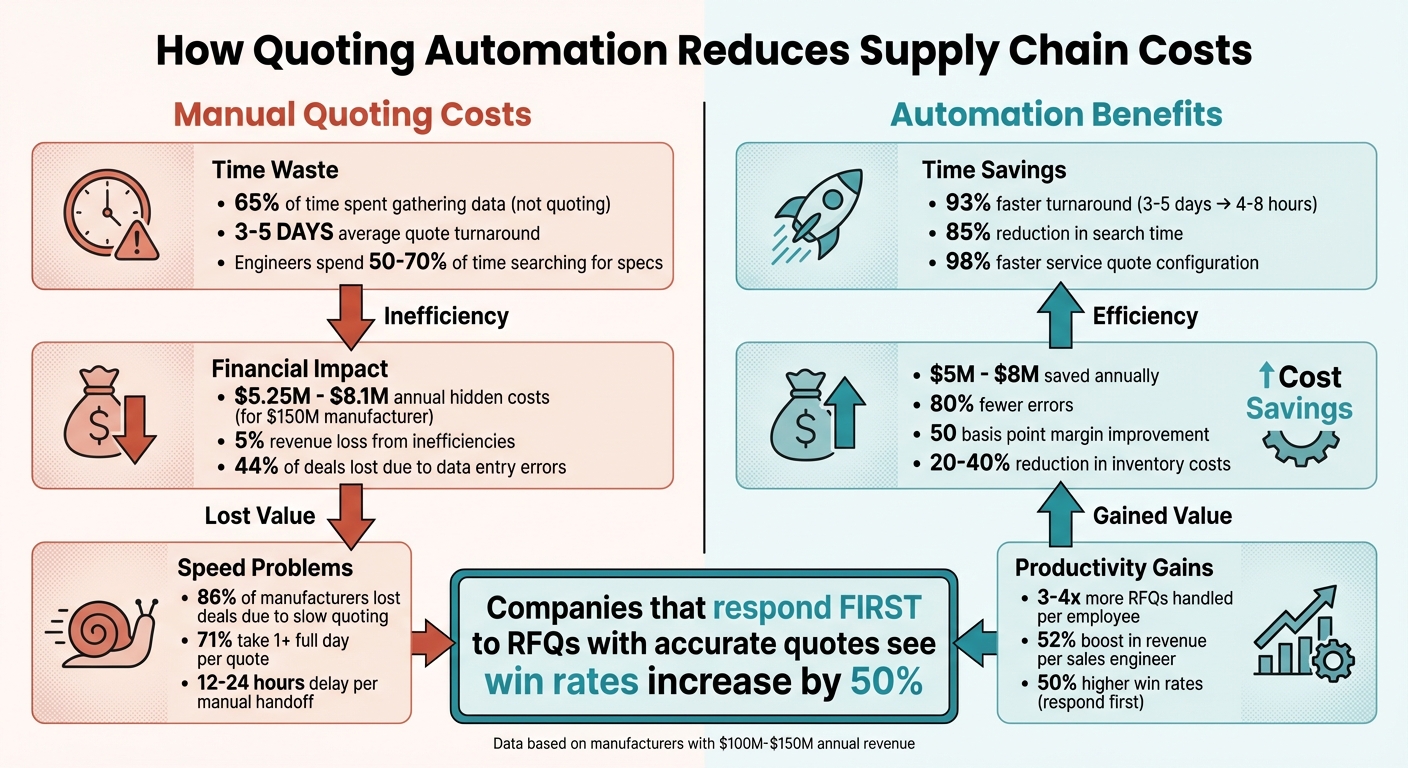
Cost Impact of Manual vs Automated Quoting for Manufacturers
How To Win Business with Automated Quoting
sbb-itb-827f251
Problems with Manual Quoting in Supply Chains
When data is scattered across disconnected systems, teams are forced into lengthy searches that drag out quoting times and drive up costs. This fragmentation not only slows down operations but also leads to errors, missed opportunities, and poor decision-making – issues that directly impact profitability. The result? Delayed quotes, inflated expenses, and a supply chain that struggles to keep up.
Time-Consuming Processes and Higher Costs
Manual quoting is a time sink. In an average 11.5-hour quoting process, only 1.5 hours (13%) are spent assembling the quote itself. The bulk of the time – 7.5 hours (65%) – is wasted on gathering and verifying data from systems like ERP, PLM, and CRM, which don’t communicate effectively. Engineers, for instance, spend 50–70% of their time hunting down part specs and CAD files instead of focusing on critical tasks.
This inefficiency carries a hefty price tag. For a $150 million discrete manufacturer, hidden costs from manual quoting can range from $5.25 million to $8.1 million annually. On top of that, manual handoffs introduce an additional 12–24 hours of delay, and 70% of manufacturers are still using outdated spreadsheets to cobble together data.
Pricing Errors and Inaccuracies
Manual quoting doesn’t just waste time – it also leads to costly pricing mistakes. Errors like mistyped discounts, miscalculated totals, and reliance on outdated spreadsheets cause revenue losses. In fact, 44% of manufacturers point to data entry mistakes as a key reason for losing deals.
The inconsistencies don’t stop there. Without automated rules, different estimators can quote wildly different prices for the same product. Newer staff often lack the experience to account for key costs, such as finishing operations, leading to quotes that underrepresent actual production expenses. Meanwhile, sales reps may offer unapproved discounts – like slashing prices by 20% – to close deals quickly, further eating into profit margins.
"If you can’t get the quote right, what else will go wrong?"
– Andrew Parker, CPQ Integrations
Slow Quote-to-Order Cycles
In today’s fast-paced market, delays in quoting can mean missed opportunities. A staggering 86% of manufacturers admit they’ve lost deals due to inefficient quoting processes, with 71% taking at least a full day to generate a single quote. On the other hand, companies that respond first to an RFQ (Request for Quote) see their win rates improve by 50%.
Approval bottlenecks only make matters worse. Complex manual approval workflows are the top reason (53%) for lost deals, delaying the transition from quote to delivery. Sales reps relying on manual methods average about 14 quotes per month, compared to 20.9 quotes for those using automated systems. The gap in productivity is clear – and in a world where B2B buyers expect fast, seamless experiences akin to shopping on Amazon, these delays are no longer tolerable.
Cost Drivers Affected by Inefficient Quoting
Inefficient quoting processes don’t just create headaches – they also drive up costs across the supply chain. For a $150 million manufacturer, these inefficiencies can add between $5.25 million and $8.1 million to annual expenses. Let’s break down the key areas where costs spiral out of control.
Labor Expenses and Overhead
One of the biggest cost drains comes from lost productivity. Sales representatives, for instance, spend only 28% of their time selling, with the other 72% consumed by tasks like manual quoting. It’s no wonder that 43% of sales reps cite quote generation as their single biggest time sink.
Engineers face similar inefficiencies. They spend 50–70% of their time searching for part specifications instead of solving complex problems. Take the case of a $120 million aerospace component manufacturer: before adopting AI-powered tools, engineers spent 60% of their time hunting for specs. After implementation, that figure dropped to 15%, allowing them to focus on higher-value work.
The problem doesn’t stop there. Inter-departmental coordination adds another layer of delays and costs. Each handoff between departments slows the process, and the lack of standardized data means companies often pay extra to train new hires who must rely on undocumented "rules of thumb" left behind by departing employees.
These inefficiencies have a direct financial impact on manufacturers, as shown below:
| Cost Category | Annual Impact for $150M Manufacturer |
|---|---|
| Sales Productivity Loss | $900,000–$1,200,000 |
| Margin Erosion (Reactive Pricing) | $750,000–$1,500,000 |
| Lost Deals (Slow Response) | $3,000,000–$4,500,000 |
| Customer Churn | $600,000–$900,000 |
Labor inefficiencies ripple through the organization, leading to costly rework cycles and operational delays.
Rework Costs from Errors
Errors in quoting don’t just disappear once the quote is issued – they often snowball into expensive rework. Issues like manual data entry mistakes, outdated pricing, and incorrect part identification are common culprits. Without integrated systems connecting quoting to ERP or MES, manufacturers risk including unavailable parts in bills of material, which leads to immediate production slowdowns.
For example, a $20 million manufacturer dealing with a 5% misquoting error rate could see $350,000 in lost profitability annually. Disconnected systems often result in orders being reworked an average of seven times, with each rework costing around $165 for complex manufacturing processes.
"A misquoted item is an automatic deduction from profitability."
– DELMIAWorks
Inexperienced quoting professionals can also miss critical production details, like finishing operations or specific manufacturing requirements. These oversights can force procurement teams to order incorrect raw materials, triggering supply chain disruptions and further escalating costs.
Inventory Mismanagement
Manual quoting often leads to a disconnect between quotes and actual inventory levels. Sales teams may issue quotes without real-time visibility into stock availability or production capacity, as their systems don’t communicate effectively. Verifying inventory manually can take 48–72 hours, during which stock levels might change, rendering the quote inaccurate.
This mismatch creates "phantom demand", which throws off inventory planning. Manufacturers lose an average of 5% of annual revenue to unsold inventory caused by inefficient processes. Outdated bills of materials and manual errors often lead to overstocking non-essential parts while understocking critical ones, creating a dual hit to both working capital and operational efficiency.
The ripple effects of poor quoting processes extend far beyond the sales team, disrupting production schedules, inventory management, and profitability. Addressing these inefficiencies is crucial to controlling costs and streamlining operations.
How Quoting Automation Addresses Supply Chain Problems
Quoting automation does more than just speed things up – it reshapes how manufacturers manage data, pricing, and decisions. Instead of juggling manual processes and scattered spreadsheets, automation acts as a bridge connecting systems like ERP, PLM, CRM, and MES through APIs, enabling them to work together seamlessly. This eliminates the delays caused by manual workflows.
By integrating 5–7 separate platforms into a single streamlined process, automation tackles inefficiencies head-on. As one analysis aptly stated:
"Your sales team doesn’t have a quoting problem. Rather, they have a data retrieval problem dressed up as a quoting workflow."
– Rapid Automation
Automation centralizes essential data – such as supplier performance metrics, inventory levels, and regional benchmarks – turning quoting into a proactive, data-driven process. This shift eliminates pricing inconsistencies and dramatically reduces turnaround times. What once took 3–5 days can now take just 4–8 hours, with some activities seeing improvements as high as 99.9%. This unified access ensures synchronized workflows and accurate pricing.
Centralized Data Integration
One of the standout benefits of automation is breaking down data silos. By pulling information into a unified system, automation cuts search times by about 85%.
Advanced tools take this further by creating a digital thread that links 3D CAD models to manufacturing simulations. This means cost drivers can be extracted directly from design files, enabling instant cost calculations without manual effort. Automation also checks inventory availability, customer credit limits, and compliance requirements like ITAR or RoHS in minutes instead of days.
When everyone operates from the same up-to-date data, pricing errors disappear. Decisions are based on real-time information rather than outdated spreadsheets or informal knowledge.
Automated Workflows and Rule-Based Pricing
After centralizing data, automation simplifies processes even more by removing bottlenecks caused by department handoffs. Manual workflows often involve delays of 12–24 hours at each step. Automation eliminates these delays by routing information automatically and allowing tasks to be completed in parallel.
Rule-based pricing adds another layer of efficiency by encoding variables like tiered discounts, regional labor costs, and volume-based margins into the system. This ensures pricing is consistent across the organization, reducing reliance on subjective judgment.
The system also handles exceptions automatically. Quotes that exceed specific thresholds or margins are flagged for human review, while standard ones move forward without delays. This cuts down approval cycles, which can otherwise stretch for hours or even days.
The time savings are substantial. Tasks like manual pricing calculations (which could take 2–3 hours) and approval routing (12–24 hours) now take just minutes. Even error-prone processes, like extracting data from engineering blueprints for Bills of Materials, see an 80% reduction in marking errors thanks to AI.
Real-Time Cost Calculations
With integrated workflows in place, real-time calculations deliver cost efficiency and faster decisions. Automated tools perform real-time margin checks and apply rule-based pricing, ensuring quotes stay profitable even when material or labor costs fluctuate.
These systems break down costs into detailed categories – material, labor, overhead, logistics, and even CO₂ emissions – making it easier to defend margins and explain pricing. They can also simulate cost estimates from 3D CAD models or incomplete Bills of Materials, enabling quicker decisions during early-stage RFQs.
The advantage is clear. Companies that respond first to RFQs with accurate quotes see their win rates increase by 50%. Automated ERP lookups and rule-based pricing reduce calculation times from 12–20 hours to just minutes. For a $100M manufacturer, these faster responses can translate into a $20.4 million annual revenue boost by improving win rates.
Ways Quoting Automation Cuts Supply Chain Costs
Quoting automation delivers measurable savings by reducing labor costs, minimizing errors, speeding up cycle times, improving inventory management, and enabling seamless scalability.
Lower Labor Costs
The real time sink in manual quoting isn’t the quoting itself – it’s the endless search for data. Employees spend 65% of their time navigating disconnected systems instead of focusing on meaningful work. Automation cuts that wasted effort down to 15%.
By automating repetitive tasks like RFQ parsing and part identification, employees can handle 3–4 times more RFQs, resulting in a 52% boost in revenue per sales engineer. For instance, in 2016, a global industrial manufacturer replaced 50 outdated systems with PROS Smart CPQ, slashing quote configuration times by 98% for services and 65% for products. Their sales team of 1,300 reps went from generating a few offers daily to over 100, creating 50,000 additional offers annually – all without hiring extra staff.
Automation also shifts management’s focus from micromanaging to governance by exception. Quotes only require approval when they exceed specific thresholds, allowing standard transactions to proceed automatically. This frees up managers to focus on strategic initiatives.
Fewer Errors and Less Rework
Mistakes in pricing or configurations can be costly, especially for businesses with extensive product catalogs. Companies with more than 5,000 SKUs often experience revenue leakage of 8–12% due to errors. Automation reduces these errors by 80%, flagging issues like incompatible parts or incorrect tolerances before quotes are sent.
Real-time integration ensures quotes reflect actual inventory levels and customer-specific pricing, avoiding the pitfalls of quoting unavailable items or promising unrealistic lead times. This level of accuracy has tangible financial benefits, including a 50-basis-point margin improvement across all quotes. With 88% of B2B manufacturers reporting lost deals due to manual quoting errors, automation becomes a critical tool for protecting profit margins.
"AI-enabled quoting and buying experiences aren’t nice-to-have features – they’re business-critical. The data clearly shows that manufacturers clinging to manual processes are losing real revenue."
– Brenda Nobleza, Vice President of Channel Solutions, Epicor
Faster Cycle Times and Better Efficiency
Speed is more than a customer service perk – it directly impacts revenue. Companies that respond first to RFQs with accurate quotes see their win rates jump by 50%. Yet, 71% of manufacturers still take at least a full day to produce quotes manually.
Automation can shrink a 3–5 day quoting process to just 4–8 hours, achieving a 90–93% faster turnaround. For example, a $60 million Midwest industrial manufacturer implemented a GPT-powered quoting engine in 2025, reducing their quote cycle from 8 days to under 48 hours. Within 90 days, they secured three major contracts, including one with a Fortune 500 company they had pursued for over a year.
By eliminating manual handoffs – which typically add 12–24 hours of delay – and enabling tasks to run in parallel, automation further boosts efficiency. It flips the ratio of time spent on value-adding activities from 18% to the majority, allowing teams to focus on strategy and positioning instead of administrative work.
Better Inventory Management and Cost Savings
Quick and accurate quoting also improves inventory management. Real-time ERP and MES integration ensures quotes align with actual stock levels, cutting inventory costs by 20–40%. Predictive automation helps avoid overstocking or understocking, flagging potential issues like strained inventory levels or supplier capacity constraints.
In February 2026, Woodward adopted aPriori’s digital factories to implement a "quoteless sourcing" model. By simulating manufacturing processes digitally, they reduced sourcing timelines from 10 weeks to just one week. This allowed them to consolidate suppliers and align sourcing speed with fast-paced product development cycles.
"Waiting weeks to learn what you could know in days is no longer acceptable. Quoteless sourcing allows procurement leaders to reserve RFQs for when they add value – not when they are the only way to get answers."
– April Guenet, Product Marketing Manager, aPriori
Scalability for Growing Operations
Automation doesn’t just improve efficiency – it builds the foundation for growth. Manual processes struggle to keep up as volumes increase. Adding more staff isn’t a sustainable solution for businesses with extensive product lines; the issue lies in the system’s architecture, not headcount.
Automated platforms scale effortlessly. For example, a system processing 100 RFQs weekly can handle 1,000 with minimal additional resources. This scalability is crucial during growth phases or seasonal demand spikes. Automation also standardizes workflows across regions and teams, ensuring consistent pricing logic and approval processes. This makes onboarding new hires faster and replicates success across the organization with ease.
As seen in earlier examples, automation allows companies to expand operations without a proportional rise in costs, creating a more agile and resilient supply chain.
QSTRAT‘s Role in Supply Chain Cost Reduction
QSTRAT addresses supply chain cost challenges by automating the quoting and sourcing workflow. It eliminates time-consuming tasks like managing emails, faxes, and spreadsheets, while integrating CRM, ERP, and costing systems into one streamlined platform. With over $5 billion in RFQs issued across 22 countries, QSTRAT has demonstrated its ability to handle large-scale operations across various manufacturing sectors. Let’s dive into how its features translate into cost-saving advantages.
Automated Supplier Sourcing and Quoting
QSTRAT simplifies the RFQ process by automating creation, distribution, and tracking. Suppliers don’t need to learn new software or pay extra fees – they can respond using familiar tools like email and PDF readers. This ensures 100% submission validation, cutting down on manual processing costs and speeding up RFQ turnaround times. The platform also uses benchmarking to identify cost-saving opportunities. For instance, Carl Zeiss’s Strategic Sourcing team analyzes over 50 data elements from suppliers during bidding to support New Product Development and Engineering Change processes. Impressively, some manufacturers are fully operational with QSTRAT in as little as five days.
Integration with ERP, CRM, and Costing Systems
QSTRAT pulls Bill of Materials (BOM) data directly from ERP systems, keeping cost models aligned with current production data. It allows flexible data input from spreadsheets, past events, or manual entries and exports data in XML format for easy integration with other enterprise tools. A client highlighted the benefits of this integration:
"By leveraging QSTRAT’s suite of products with our existing MFG/PRO and Cyberquery solutions we can now accurately quote, track successes and measure our accuracy of our projected costs versus our true costs when entered into our MFG/PRO system." – QSTRAT Client Testimonial
This seamless integration enables real-time performance tracking and more informed supplier decisions.
Supplier Performance Management and Decision Support
QSTRAT equips buyers with real-time tools to compare supplier responses side-by-side, speeding up award decisions. Automated ranking systems and ESG tracking ensure supplier compliance and performance alignment. For example, BAE Systems uses QSTRAT not just to compare costs but also to enhance supplier quality:
"For BAE, QSTRAT Sourcing is much more than a great tool to compare price, labor, raw material, packaging, and transportation among our suppliers. It’s helping BAE become a better manufacturer by using QSTRAT Sourcing as a learning tool for suppliers." – BAE Systems
These tools reduce administrative overhead and make award decisions faster. By building a centralized database of sourcing events and validating new supplier data before ERP entry, QSTRAT minimizes data entry errors and streamlines supplier onboarding.
Conclusion
Manual quoting processes are a major drain on resources. Manufacturers spend a staggering 65% of their quoting effort just gathering data, instead of focusing on tasks that add real value. This inefficiency can lead to as much as a 5% revenue loss. Automating these processes changes the game – centralizing data, reducing errors, and dramatically speeding up quote-to-order cycles. Companies that respond first to RFQs (Request for Quotes) see their win rates jump by 50%, and automation can shrink cycle times to under eight hours.
These improvements are exactly what QSTRAT delivers. With over $5 billion in RFQs issued across 22 countries, QSTRAT’s platform integrates seamlessly with ERP and CRM systems, offering workflows that deliver a payback in just 4–6 months and a return on investment (ROI) of 600–900% over three years. Even better, manufacturers can get up and running in just five days.
QSTRAT tackles key cost drivers in supply chains head-on with tools for automated supplier sourcing, real-time cost calculations, and performance management. By addressing challenges like labor costs and inventory inefficiencies, the platform ensures every decision is backed by accurate, actionable data. It eliminates manual handoffs and provides decision support tools to evaluate supplier responses across multiple cost factors. This helps manufacturers protect their profit margins while scaling operations with ease.
For manufacturers aiming to cut costs without compromising on quality or speed, quoting automation isn’t just a helpful tool – it’s a strategic imperative. By adopting these systems, companies not only reduce expenses but also strengthen their supply chain resilience with faster, more accurate, and integrated processes that redefine supply chain economics.
FAQs
What systems should quoting automation connect to first?
When setting up quoting automation, it’s essential to link your Customer Relationship Management (CRM) and Enterprise Resource Planning (ERP) systems. These platforms are treasure troves of key information, such as customer interactions, inventory levels, and pricing. By connecting them, you can generate accurate, real-time quotes effortlessly.
Taking it a step further, integrating costing and sourcing systems adds another layer of precision. These systems bring in supplier performance metrics and cost data, ensuring your quotes are as detailed and reliable as possible. The result? Streamlined workflows, fewer errors, and a boost in overall efficiency.
How do you calculate ROI for quoting automation?
When it comes to quoting automation, determining the return on investment (ROI) means weighing the financial advantages – like faster, more precise quotes and fewer errors – against the costs of implementing the system.
Key benefits to consider include:
- Increased revenue: Faster quotes can help secure more deals and improve customer satisfaction.
- Cost savings: Automation streamlines processes, cutting down on labor-intensive tasks and improving overall efficiency.
- Reduced errors: Fewer mistakes mean less time spent fixing issues and fewer costly inaccuracies.
On the expense side, you’ll need to factor in costs like software purchase or subscription fees, integration with existing systems, and employee training. To estimate ROI, focus on measurable metrics such as labor savings, revenue growth, and error reduction, and compare these against the total implementation costs.
How long does it take to implement QSTRAT?
QSTRAT is built for speed and efficiency, often taking just a few weeks to implement. This quick setup helps businesses improve their quoting and sourcing workflows without lengthy delays. The platform focuses on reducing downtime, ensuring a seamless transition during deployment.
Related Blog Posts
You may also like

Top 7 Tools For Supplier Relationship Management
Compare seven SRM platforms by features, integrations, and scalability to find the right supplier management solution.

Supplier Certification: Why It Matters for Compliance
Supplier certification is a strategic safeguard that prevents regulatory breaches, supply disruptions, and reputational damage.