


Supplier performance benchmarks are critical for ensuring efficiency, quality, and cost control across industries. Here’s a quick breakdown of how automotive, medical devices, and high-tech sectors manage their supplier relationships:
- Automotive: Focuses on timely delivery, evolving quality standards (e.g., software reliability), and cost pressures. Transitioning to electric vehicles adds complexity to supply chains.
- Medical Devices: Prioritizes quality and regulatory compliance over cost. Strict delivery and quality metrics are enforced, with a rising trend toward strategic supplier partnerships.
- High Tech: Operates at high speed, emphasizing real-time delivery, advanced quality measures (e.g., cybersecurity), and AI-driven cost management.
Key Metrics Across All Industries:
- On-time delivery: Median rate is 90%.
- Defect rates: Tracks quality and compliance.
- Cost adherence: Focus on managing material expenses and achieving cost goals.
Quick Comparison
| Industry | Strengths | Challenges |
|---|---|---|
| Automotive | Efficient processes, reliable delivery | Cost pressures, EV transition |
| Medical Devices | High quality, strict compliance | Regulatory delays, demand forecasting |
| High Tech | Advanced IT, rapid innovation | Short product lifecycles, supply chain instability |
Industries are shifting from cost-cutting to prioritizing supply assurance, leveraging tools like QSTRAT to centralize performance tracking and improve supplier relationships.
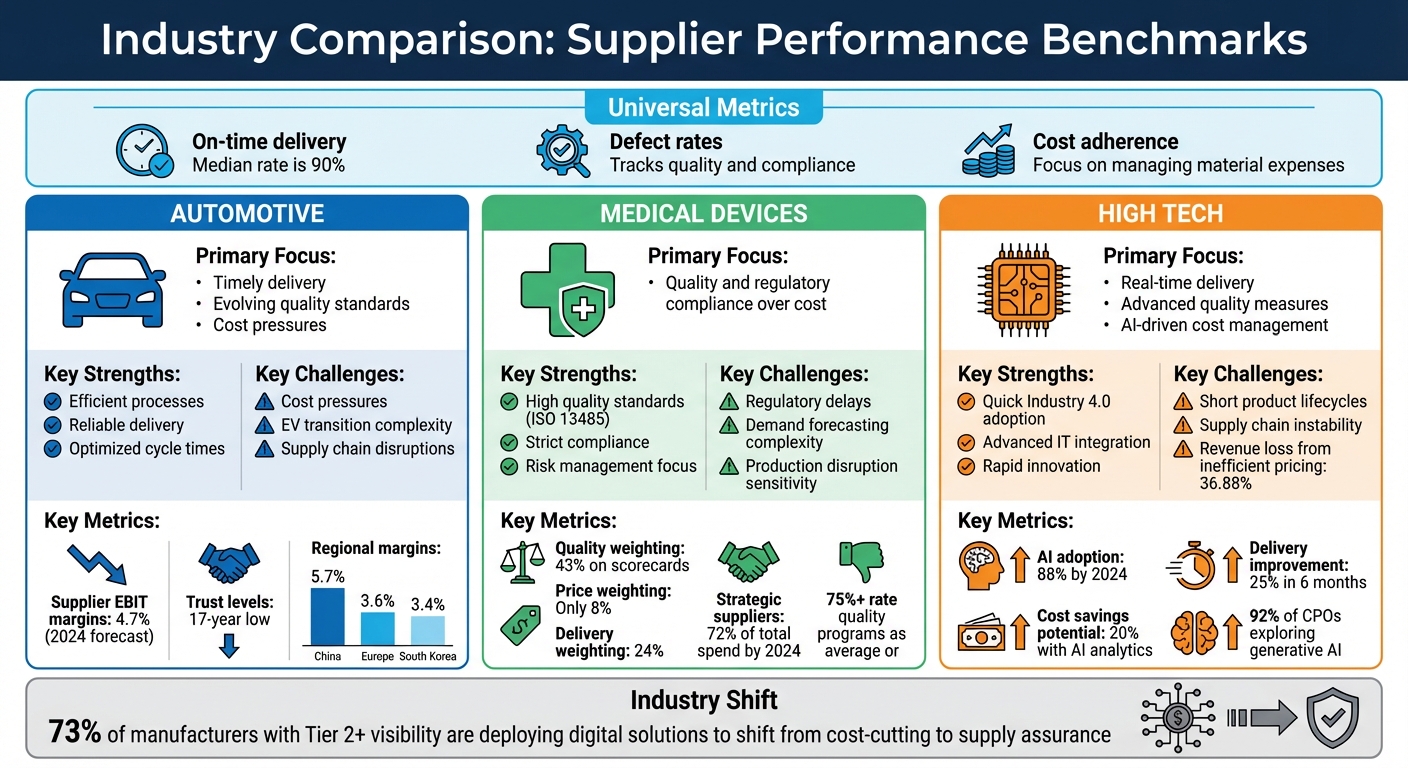
Supplier Performance Benchmarks Across Automotive, Medical Devices, and High Tech Industries
Supply Chain Benchmarking with Trent Morris
sbb-itb-827f251
1. Automotive Industry
The automotive sector is caught in a tough spot, dealing with stagnant growth while facing steep costs tied to major transformations. This dual pressure directly impacts supplier performance, with profitability in the sector lagging behind other manufacturing industries.
On-Time Delivery
Delivering on time in the automotive world requires flawless logistics and coordination. But when production becomes unpredictable, the challenge grows even bigger. Original Equipment Manufacturers (OEMs) now value operational flexibility as much as price. For suppliers, this means keeping delivery rates steady even as schedules shift, especially during the shift from internal combustion engines to electric vehicles.
Quality Metrics
Quality expectations are changing fast. It’s no longer just about mechanical excellence – software reliability and battery performance are now just as critical as vehicles become more software-driven. According to the 2023 Working Relations Index study, which surveyed over 700 executives from 459 suppliers, trust levels between automakers and suppliers hit a 17-year low. This erosion of trust affects suppliers’ ability to recover costs and handle disruptions effectively.
"Many suppliers need targeted programs to stabilize margins amid uncertainties." – Felix Mogge, Senior Partner, Roland Berger
These evolving quality standards are adding more strain to already stretched supply chains.
Cost Adherence
Cost pressures in the automotive sector are relentless. Supplier EBIT margins have dropped from 5.3% (2021–2023) to a forecasted 4.7% in 2024. This is a stark contrast to industries like MedTech and industrial manufacturing, which have maintained profitability levels of 15–20% since the pandemic. Regional differences are notable: margins stand at 5.7% in China, 3.6% in Europe, and 3.4% in South Korea. With OEMs increasingly unwilling to absorb inflation-driven cost hikes, suppliers are left carrying more financial risk.
Technology Integration
The transition to electric vehicles is further complicating cost structures. While electronics and infotainment suppliers have seen revenue growth, their margins have taken a hit due to heavy investments in R&D and product launches. On the other hand, tire suppliers have fared better, maintaining 7.4% EBIT margins in 2024. Tools like QSTRAT are helping manufacturers manage these complex supplier relationships by combining performance tracking with sourcing and quoting systems. This visibility is crucial for navigating the uncertainties of today’s automotive landscape.
2. Medical Devices Industry
The medical devices sector operates in a league of its own, where unwavering quality standards and strict regulatory compliance take precedence over cost considerations. Unlike the automotive industry, where price pressures often dominate, quality holds a massive 43% weighting on scorecards compared to just 8% for price. This stark difference highlights the critical stakes – even one defective component could compromise patient safety and lead to regulatory scrutiny.
On-Time Delivery
When it comes to delivery, "first time in full" is the gold standard for medical device manufacturers. A single missing part can bring production to a standstill. Delivery performance carries a 24% weighting on scorecards, second only to quality. But it’s not just about efficiency – regulations like FDA 21 CFR Part 820.50 and ISO 13485:2016 make timely delivery a compliance issue. These rules naturally enforce stringent quality checks, ensuring that every piece arrives on time and meets exacting standards.
Quality Metrics
Quality in this industry isn’t just about passing or failing inspections. Manufacturers dig deeper, tracking nonconformance rates and issuing SCARs (Supplier Corrective Action Requests) that require root cause analysis instead of quick fixes. A "traffic light" system is commonly used to classify suppliers:
- Green: No issues – everything’s running smoothly.
- Yellow: Signals a need for immediate discussions or site visits.
- Red: Indicates serious problems, potentially leading to supplier replacement.
Despite these rigorous systems, over 75% of companies still rate their supplier quality management programs as average or below.
"High-performing companies stand out by viewing quality as more than a compliance effort and injecting quality into product development and supplier management processes."
- David DeRam, CEO, Greenlight Guru
Cost Adherence
Cost management in the medical devices sector has evolved significantly. Simple price negotiations are giving way to value engineering and global sourcing strategies. By 2024, reliance on price-focused strategies is expected to drop from 53% to 35%, as companies prioritize sourcing from cost-advantaged regions. Additionally, spending in the U.S. and Europe is projected to shrink from 77% to 68%, reflecting a clear push toward geographic diversification.
Technology Integration
Technology is becoming a cornerstone in supplier relationships for medical device manufacturers. The industry is shifting away from transactional vendors toward strategic, design-integrated partnerships. These partners are expected to lead with advanced technology and maintain rigorous quality standards through structured processes. Notably, 83% of top manufacturers plan to vertically integrate their supply chains within three years to reduce disruptions.
Platforms like QSTRAT are playing a key role in this transformation. They help companies centralize supplier performance tracking, manage approval workflows, and maintain compliance documentation. This is especially critical given that 62% of large companies still struggle with fragmented data systems. By integrating technology into supplier relationships, the medical devices sector is laying the groundwork for tackling challenges in high-tech innovation.
3. High Tech Industry
The high tech industry is setting new standards for supplier performance by adopting agile, real-time strategies. Unlike sectors such as automotive or medical devices, high tech operates at a much faster pace. Companies in this space rely on "sense-and-respond" models that use real-time data to quickly adapt to demand fluctuations. Near-instant delivery has become the norm, pushing businesses to move away from traditional linear supply chains in favor of networked, flexible ecosystems that can pivot on demand.
On-Time Delivery
In high tech, speed isn’t just an advantage – it’s essential for survival. One major electronics manufacturer implemented supplier scorecards to monitor on-time delivery as a key performance indicator (KPI). Within just six months, this initiative improved delivery timelines by 25% by identifying and addressing underperforming vendors. However, manual processes remain a hurdle, with 44% of high tech trading partners facing challenges from geopolitical and regulatory complexities. This relentless focus on speed also drives stricter quality standards.
Quality Metrics
Quality in high tech has advanced far beyond tracking defect rates. Companies now evaluate performance through broader measures like operational efficiency, innovation, and cybersecurity. Metrics such as digital twin usage and scenario testing accuracy have become standard in quality assessments. Cybersecurity is especially critical, with suppliers being judged on how often incidents occur, how quickly they respond, and the robustness of their backup systems. In this evolving landscape, 92% of Chief Procurement Officers are exploring or implementing generative AI to automate quality audits and directly tie defect rates to contract incentives.
Cost Adherence
Cost management in high tech goes beyond cutting expenses – it’s about finding strategic value. For instance, a SaaS provider reduced its annual spend by 12% through quarterly supplier reviews and vendor consolidation. Companies using AI-driven analytics have seen potential cost savings of around 20%, while also accelerating supplier selection by 30%. This shift prioritizes "Total Value" metrics, which include factors like recovery time and revenue growth, over simple cost-cutting measures.
Technology Integration
Technology is playing a transformative role in elevating supplier performance in high tech. By 2024, 88% of manufacturing and supply chain companies had adopted AI, with 84% reporting immediate benefits to operations. The industry is also embracing "Agentic AI" – autonomous systems capable of evaluating suppliers, monitoring risks, and executing contract strategies without human input. Tools like QSTRAT simplify complexity with real-time performance tracking and built-in approval workflows. This aligns with the 94% of procurement teams now using generative AI weekly to power AI-first processes.
Advantages and Disadvantages
Different industries bring their own strengths and challenges to supplier performance management, shaped by their specific operational needs and market demands. Recognizing these differences allows businesses to identify areas of success and pinpoint where improvements can be made.
| Industry | Key Strengths | Challenges/Weaknesses |
|---|---|---|
| Automotive | High process efficiency, optimized cycle times, and cost-conscious operations. Strong focus on reliable delivery to support just-in-time manufacturing. | Heavy cost-reduction pressures and high susceptibility to logistics and supply chain disruptions. |
| Medical Devices | Strong quality management systems (ISO 13485) and strict regulatory adherence. Emphasis on risk management and patient safety. | Complex demand forecasting and regulatory barriers that delay time-to-market. Historically limited focus on direct materials spend, which totals around $100 billion annually. |
| High Tech | Quick adoption of Industry 4.0 technologies and digital innovation. Advanced IT integration for better supply chain visibility. | Short product lifecycles and unstable global supply chains, leading to rapid obsolescence. B2B manufacturers lose up to 36.88% of annual revenue due to inefficient pricing and manual calculations. |
This table highlights the strengths and challenges unique to each industry, laying the groundwork for understanding their supplier management dynamics.
The medical device sector faces unique supply chain hurdles. A historical lack of focus on supply management has left the industry vulnerable, where even small disruptions can bring production to a halt. However, the sector is shifting gears, moving from managing numerous transactional vendors to forming strategic supplier partnerships. By 2024, strategic suppliers are expected to account for 72% of total spend.
In the high tech industry, hidden costs linked to inefficient pricing processes are a major concern. These inefficiencies, combined with manual pricing updates, significantly eat into profit margins. For B2B manufacturers, this can result in revenue losses of over 36% annually.
Meanwhile, the automotive industry continues to shine in operational efficiency but faces mounting challenges from global supply chain disruptions. Despite its strengths, the pressure to cut costs and maintain seamless delivery schedules remains intense.
Each industry’s approach to supplier performance reflects its priorities – whether it’s the automotive sector’s efficiency, medical devices’ focus on risk management, or high tech’s battle with pricing inefficiencies. These differences underscore the importance of tailoring supplier performance benchmarks to fit the specific demands of each sector.
Conclusion
Supplier performance benchmarks uncover both common challenges and unique priorities in industries like automotive, medical devices, and high tech. These sectors are moving beyond the old focus on cost-cutting to prioritize supply assurance. In fact, 73% of manufacturers with visibility beyond Tier 2 suppliers are already deploying digital solutions to support this shift. This transition opens the door for industries to share lessons and strategies.
"The familiar formula of minimizing costs and maximizing efficiency in global supply chains is often no longer enough. Now, redundancy and resilience should be added to the equation." – Deloitte
These benchmarks not only spotlight sector-specific hurdles but also guide strategies to improve resilience and efficiency. For instance, automotive manufacturers have simplified their supply chains – a strategy that could benefit medical device companies facing similar challenges. Additionally, companies with advanced procurement practices consistently outperform their peers, achieving EBITDA margins at least five percentage points higher.
Turning these insights into action calls for practical steps, such as adopting digital twin technology to predict supply disruptions, prequalifying backup suppliers with pre-negotiated agreements, and standardizing components to reduce dependency on specialized suppliers. Despite 90% of manufacturers maintaining multiple supplier relationships, only 44% have achieved regional diversification, presenting a clear opportunity to strengthen supply chains.
Platforms like QSTRAT help manufacturers centralize supplier evaluations, automate KPI tracking, and enhance visibility across their networks. These tools shift supplier performance management from reactive to proactive, enabling data-driven decisions tailored to each industry’s needs. The use of such digital solutions across automotive, medical devices, and high tech underscores the article’s central takeaway: customized benchmarks lead to measurable gains in supplier performance.
FAQs
Which supplier KPIs should I prioritize by industry?
The key supplier KPIs differ depending on the industry you’re in, reflecting the unique priorities and challenges each sector faces:
- Automotive: Focuses on metrics like inventory accuracy, warranty costs, and cash-to-cash cycle time to ensure smooth operations and cost control.
- Manufacturing: Tracks order-to-ship time, perfect order rate, and plant utilization to optimize production efficiency and customer satisfaction.
- Procurement: Prioritizes total cost of ownership, on-time delivery, and quality compliance to balance costs while maintaining reliability.
- Logistics: Emphasizes transportation costs, warehouse costs, and order fulfillment times to streamline the supply chain and improve delivery performance.
By aligning your KPIs with the specific demands of your industry, you can effectively measure and enhance supplier performance.
How can I benchmark delivery and defects across different sectors?
To measure delivery and defect performance across different industries, focus on key indicators like on-time delivery rates and defect rates, and compare these against established industry standards. Metrics such as supplier reliability indices and quality benchmarks are essential for assessing how well a business performs. For instance, in sectors like automotive manufacturing, specific benchmarks can reveal patterns and pinpoint areas needing improvement. These comparisons allow businesses to spot shortcomings and refine their strategies for managing delivery and defects more effectively.
How does QSTRAT help centralize supplier performance tracking?
QSTRAT offers a cloud-based platform designed to simplify supplier performance tracking. By automating data collection and enabling real-time monitoring, it helps users stay on top of key metrics like quality, delivery, and compliance – all in a single system. This approach minimizes manual errors and eliminates delays.
The platform integrates seamlessly with CRM and ERP systems, making workflows smoother and more efficient. This integration fosters transparency, accountability, and ongoing improvement, making it a valuable tool for industries like aerospace, medical devices, and automotive.
Related Blog Posts
You may also like

Top 7 Tools For Supplier Relationship Management
Compare seven SRM platforms by features, integrations, and scalability to find the right supplier management solution.

Supplier Certification: Why It Matters for Compliance
Supplier certification is a strategic safeguard that prevents regulatory breaches, supply disruptions, and reputational damage.