

Supplier onboarding software simplifies how businesses bring new vendors into their systems. Instead of juggling emails and spreadsheets, these tools automate workflows, validate data, and manage compliance. The result? Faster onboarding, fewer errors, and stronger vendor relationships.
Here’s a quick look at seven standout platforms:
- QSTRAT: Ideal for manufacturers, it automates sourcing and onboarding with ERP integration.
- SAP Ariba: A robust option for large enterprises, offering advanced risk and compliance features.
- Coupa: Simplifies onboarding with customizable workflows and strong spend analytics.
- Ivalua: Tailored for complex processes, integrating onboarding with procurement and risk management.
- Graphite Connect: Focuses on security and efficiency, reducing onboarding time by up to 85%.
- HighRadius: AI-powered, designed for finance teams, with fraud detection and compliance checks.
- SupplierGateway: User-friendly, emphasizing supplier diversity and document management.
Key Features to Consider:
- Workflow Automation: Speeds up approvals by routing tasks automatically.
- Compliance Tools: Tracks certifications, performs risk checks, and ensures regulatory adherence.
- Integration: Connects seamlessly with ERP, CRM, and sourcing systems.
- Self-Service Portals: Lets suppliers update info and upload documents directly.
- Scalability & Security: Handles growth while protecting sensitive data.
These platforms cater to different needs, from manufacturing to finance, ensuring efficient and secure supplier onboarding.
Supplier Portals: Best Practice in Supplier Onboarding and Enablement
How to Evaluate Supplier Onboarding Tools
Selecting the right supplier onboarding platform involves analyzing several key features that influence how efficiently and reliably you can onboard new vendors into your procurement system. At the forefront is workflow automation. Look for tools that streamline processes by automatically routing documents based on predefined rules, reducing the need for email exchanges. The most effective platforms allow you to customize workflows to match your approval processes and integrate seamlessly with existing systems, enabling automated actions across your technology stack. Additionally, self-service portals are a must-have, as they eliminate the need for manual data entry and improve overall efficiency. Alongside automation, compliance and risk management should be prioritized.
Compliance and risk management are especially critical in heavily regulated industries like aerospace, medical devices, and automotive manufacturing. A strong platform will automatically track certifications, tax forms, financial documents, and other regulatory requirements. Advanced features like AI-driven risk scoring, sanctions screening, and real-time fraud detection are also valuable. Check if the tool integrates with external databases to provide third-party risk scoring, offering a real-time snapshot of each vendor’s risk profile before onboarding begins.
Integration capabilities are another crucial factor. The tool should work effortlessly with your existing technology stack to avoid creating data silos. Prioritize platforms that offer native connectors and flexible APIs, ensuring seamless integration with ERP, CRM, HR, costing, and supplier performance systems. Additionally, integrations with communication tools like Slack or Teams can enhance internal collaboration by enabling streamlined notifications and updates.
Reporting and analytics are vital for gaining insights into your onboarding process. Look for platforms that offer real-time dashboards displaying supplier status, approval progress, and compliance metrics. These dashboards should help teams quickly identify bottlenecks and optimize workflows. Customizable KPIs, benchmarked performance data, detailed audit logs, and the ability to generate compliance reports for regulatory needs are key features to evaluate. Such tools not only enhance visibility but also support continuous improvement in onboarding processes.
Lastly, don’t overlook scalability and security. Ensure the platform can handle growing supplier data and complexity without compromising performance. Pricing should align with your organization’s growth, and the platform must meet industry-standard certifications like SOC 2 Type 2. Robust security measures, including two-factor authentication (2FA), single sign-on (SSO), encryption, and role-based access controls, are non-negotiable for safeguarding sensitive data.
1. QSTRAT
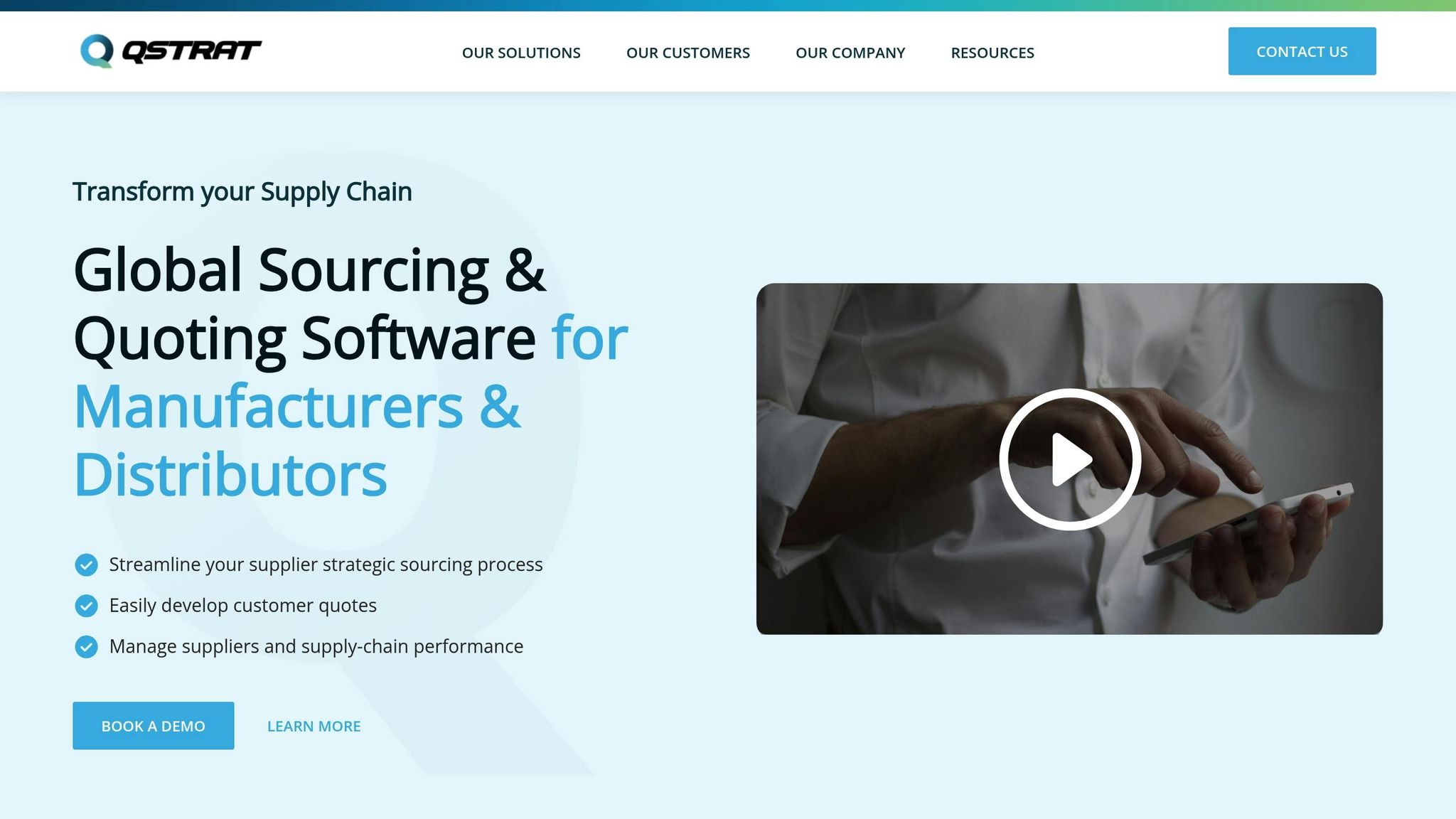
QSTRAT is a cloud-based platform designed to streamline sourcing and quoting for manufacturers and distributors in industries like aerospace, medical devices, industrial, automotive, and high-tech. It simplifies supplier onboarding by addressing common pain points, such as technical reviews and commercial evaluations. Let’s break down how QSTRAT delivers practical solutions.
Workflow Automation and Approval Routing
QSTRAT automates supplier onboarding through customizable workflows. It handles everything – from the initial supplier request to qualification, commercial review, technical evaluation, and final approval. This ensures that buyers and category managers are only involved when necessary. You can set routing rules based on factors like spend thresholds, categories, or risk levels. Plus, parallel workflows let teams like quality, engineering, and sourcing review supplier data at the same time, speeding up processes while keeping approval histories traceable for SOX compliance and audits.
The platform also automates routine tasks, including:
- Supplier request forms
- Data validation against required fields
- Document checklists (e.g., W-9s, insurance certificates, quality certifications)
- Expiration and renewal reminders
- Multi-step approvals
By replacing manual methods like email and spreadsheets with automated workflows, companies often cut onboarding time by 50–70% and reduce errors. For example, a mid-sized U.S. manufacturer onboarding dozens of suppliers each quarter can see faster quoting, fewer back-and-forth emails, and cleaner data for ERP and sourcing analytics.
Supplier Self-Service Portals and Document Management
QSTRAT empowers suppliers with self-service portals, allowing them to access RFQs, upload compliance documents, and update their profiles. A centralized document management system keeps track of critical files like tax forms, insurance certificates, and quality certifications. The platform even sends reminders about upcoming expirations, helping U.S. companies stay compliant.
This setup replaces email attachments with simple, structured workflows for uploading documents. Suppliers maintain control over their data, while buyers ensure accuracy through validation and approvals. The result? A fully auditable record of onboarding documents.
Risk and Compliance Management
QSTRAT includes built-in tools for assessing risks related to quality, delivery, cybersecurity, and social responsibility. It uses standardized questionnaires, scoring models, and approval rules to evaluate suppliers. If a supplier falls into a high-risk category – such as providing critical aerospace parts or medical device components – the platform triggers deeper reviews. These might include detailed capability questionnaires, export compliance checks, and certifications like AS9100 or ISO 13485, all tied directly to RFQs.
Integration with ERP, CRM, and Sourcing Systems
QSTRAT integrates seamlessly with systems like SAP, Oracle, Microsoft Dynamics, and other ERP, CRM, costing, and sourcing tools. Approved supplier records, complete with bank and contact details, flow directly into these systems, ensuring accurate cost tracking and performance evaluation. For U.S. businesses, QSTRAT acts as a bridge between engineering and quoting teams and back-office finance. This ensures that supplier records are validated and complete before being used in downstream systems. Additionally, it links projected costs with actual costs, a critical metric for measuring supplier performance after onboarding.
2. SAP Ariba Supplier Lifecycle and Performance
SAP Ariba Supplier Lifecycle and Performance simplifies supplier management for large U.S. enterprises by centralizing supplier data and standardizing onboarding processes. With access to the SAP Business Network – connecting over 7 million suppliers worldwide – it reduces manual effort through workflows and approval rules tailored to specific supplier risk profiles. By combining automated workflows with advanced risk management tools, SAP Ariba ensures a smoother onboarding experience.
Workflow Automation and Approval Routing
SAP Ariba uses automated, role-based workflows to manage supplier requests, qualification questionnaires, and risk assessments. These workflows route tasks to the right approvers based on factors like spend levels, regions, categories, and risk scores. For example, high-risk suppliers automatically trigger reviews by relevant departments, while low-risk vendors require fewer approvals. U.S. organizations often configure thresholds based on spend amounts, such as requiring VP-level approval for supplier contracts exceeding $250,000. These workflows can run sequentially (e.g., compliance → finance → executive) or in parallel, with built-in escalations and reminders to avoid delays in onboarding.
Supplier Self-Service Portals and Document Management
The platform includes a self-service supplier portal on the SAP Business Network, enabling suppliers to register, update their profiles, and upload necessary documents like W-9 forms, insurance certificates, diversity certifications, and banking details. Buyers can create templates and document checklists tailored to different supplier types, such as professional services or direct materials. The system ensures all required files are uploaded, flags missing documents, and maintains version control. This reduces the need for email exchanges and allows suppliers to keep their information up to date, which is especially useful for U.S. companies managing thousands of active suppliers.
Risk and Compliance Management
SAP Ariba integrates risk assessments and questionnaires with external risk content providers to evaluate factors like financial stability, ESG practices, cybersecurity measures, and sanctions compliance during onboarding and beyond. It tracks compliance attributes, including diversity certifications, safety credentials, and data protection policies, while maintaining a complete audit trail of reviews and approvals. These features help U.S. enterprises meet SOX requirements, monitor OFAC sanctions, and document due diligence for industry-specific regulations. Additionally, the platform’s risk scores and alerts can trigger additional approvals or periodic requalification for higher-risk suppliers.
Integration with ERP, CRM, and Sourcing Systems
SAP Ariba provides standard connectors and APIs to integrate seamlessly with SAP ERP, SAP S/4HANA, and other ERP systems. This synchronization ensures consistency in core vendor master data, such as supplier IDs, tax IDs, payment terms, and bank details. Approved supplier records flow automatically into ERP systems for purchasing and payment processes, while performance data enhances supplier evaluations. Integration with sourcing tools allows onboarding tasks, like security questionnaires, to be initiated when a supplier responds to an RFP. For U.S. companies, aligning tax identifiers (e.g., EINs), payment terms (e.g., Net 30), and currency handling (primarily USD with multi-currency support) across systems helps prevent duplicate vendor records and payment errors.
3. Coupa Supplier Management
Coupa Supplier Management streamlines supplier onboarding by using digital workflows, centralized records, and self-service data collection to cut down on manual tasks. U.S. businesses rely on this platform to standardize supplier invitation, vetting, and approval processes within a single system. Tasks are routed to the appropriate teams – whether procurement, finance, legal, or risk – ensuring efficiency and reducing repetitive admin work. This approach also minimizes errors caused by re-entering supplier data into ERP systems and provides clear visibility into onboarding progress. This is especially useful for teams working across different time zones and departments. By replacing outdated email- and spreadsheet-based systems, Coupa’s customizable workflows and integrations make the process much more efficient.
Workflow Automation and Approval Routing
Coupa allows teams to set up multi-step approval workflows tailored to supplier type, spending limits, categories, or risk profiles. For example, suppliers with higher risk or value may trigger additional reviews from InfoSec, Legal, or Compliance teams, while low-risk suppliers can move through a simpler process. A mid-sized U.S. manufacturer, for instance, might use a streamlined workflow for indirect suppliers, covering procurement, AP review, tax validation, and compliance checks, enabling onboarding in just a few days. In contrast, direct material suppliers or strategic partners could require more extensive reviews, such as category manager approval, site audits, or financial and security checks before they are added to the ERP system.
Each approval is timestamped, creating an auditable trail that supports SOX compliance. U.S. companies can configure workflows to align with internal approval policies – like requiring VP-level sign-offs for contracts over $250,000. Automated reminders and escalation rules prevent delays, keeping the process on track. Alongside these workflows, Coupa enhances supplier engagement through self-service portals.
Supplier Self-Service Portals and Document Management
Suppliers can use Coupa’s self-service portals to register, update their profiles, and upload critical documents such as W-9 forms, insurance certificates, diversity certifications, banking details, and compliance attestations. Document management tools let buyers specify required documents based on supplier type, track expiration dates (e.g., for insurance or ISO certifications), and receive alerts before documents expire. This helps U.S. teams stay compliant without relying on error-prone spreadsheet tracking. By digitizing document management, organizations can better monitor compliance and reduce manual oversight.
Risk and Compliance Management
Coupa supports real-time risk and performance tracking, giving teams the ability to collect risk data, monitor supplier performance metrics, and centralize compliance-related information. For example, organizations can document attributes such as minority-owned or women-owned status to support supplier diversity initiatives in the U.S. Suppliers can also be required to confirm adherence to policies like anti-bribery, data privacy, or codes of conduct during onboarding. These attestations are stored with a complete audit history, ensuring accountability and transparency.
Integration with ERP, CRM, and Sourcing Systems
Coupa’s integration capabilities ensure smooth data flow across systems. It works seamlessly with major ERPs like SAP, Oracle, and NetSuite, so once a supplier is approved, key data is automatically synced to the ERP vendor master, eliminating duplicate data entry and reducing inconsistencies. Supplier profiles in Coupa can also be reused for sourcing events and contracts, ensuring that only approved suppliers participate and that negotiated terms are carried through to purchasing and invoicing. When integrated with CRM or other business systems, teams can easily see which suppliers are active, approved, or under review. This eliminates the need for separate lists or manual updates, improving coordination on large projects.
4. Ivalua
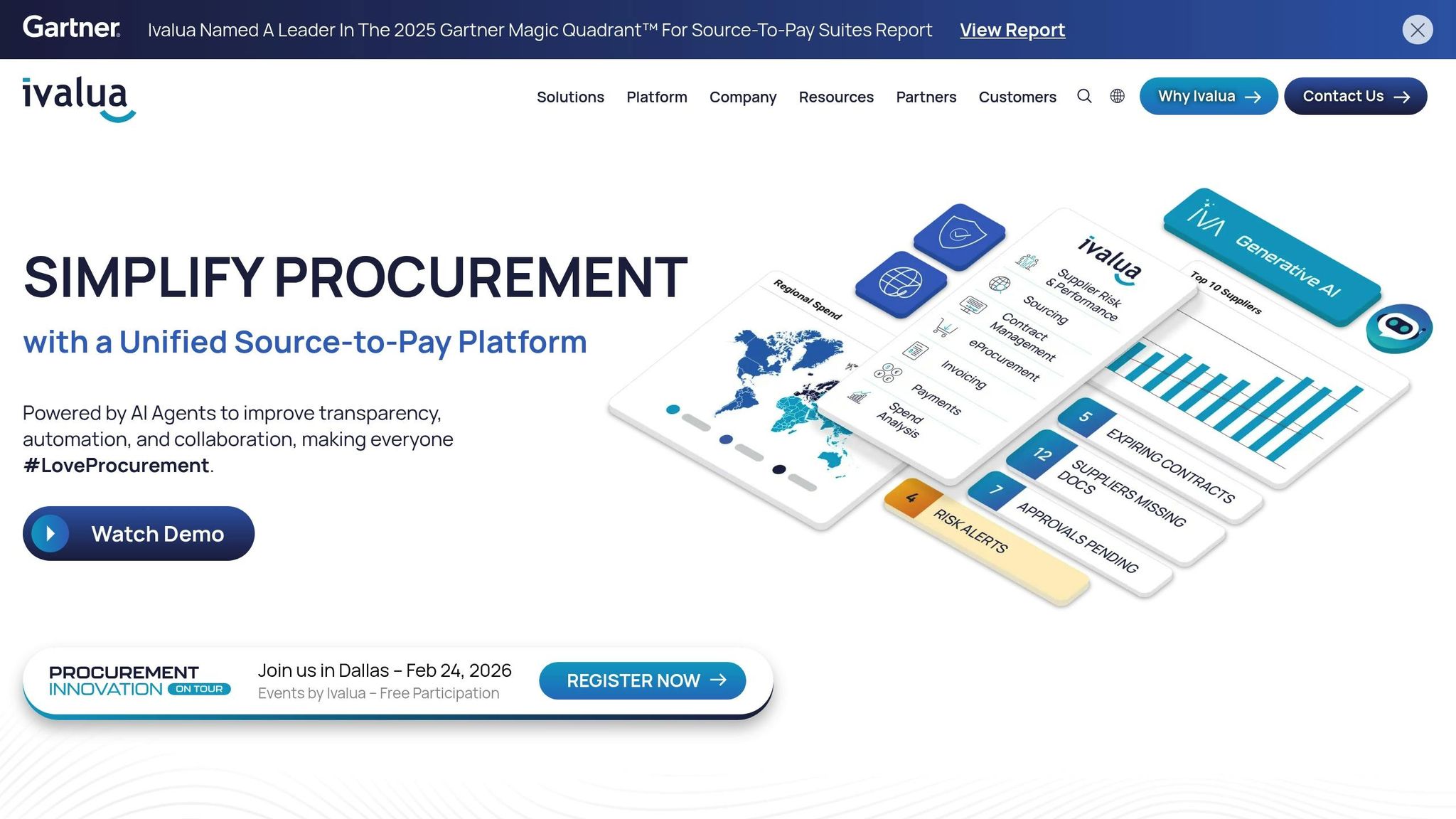
Ivalua provides a source-to-pay platform that combines supplier onboarding, risk management, and procurement into one system. Many U.S. companies, especially those in manufacturing, financial services, and the public sector, turn to Ivalua when they need a solution that can handle complex approval processes and governance structures. Unlike tools that rely on rigid templates, Ivalua allows teams to create workflows tailored to their specific needs, ensuring they align with real-world policies like SOX controls or segregation of duties. This makes it particularly useful for organizations with multiple business units and several ERP systems, as it ensures consistent supplier data across all platforms. Its focus on efficiency through customized workflows and seamless integration sets it apart from many competitors.
Workflow Automation and Approval Routing
Ivalua enables teams to design approval workflows that adapt to different supplier types, spending levels, or risk categories. For example, low-risk suppliers can follow a simplified approval process, while high-stakes suppliers undergo more thorough reviews. Consider a U.S. manufacturer onboarding a high-spend electronics supplier: the request might pass through departments like Legal, InfoSec, and Finance, with each step governed by service level agreements, reminders, and escalation rules to avoid delays. Conditional steps can include tasks like tax validation (e.g., W-9 or W-8BEN reviews), OFAC sanctions checks, and diversity status verification. These workflows ensure all regulatory and internal controls are met before the supplier is activated in the ERP system, creating a smoother vendor onboarding process.
Supplier Self-Service Portals and Document Management
Ivalua’s supplier portal streamlines registration and profile updates, reducing the need for internal data entry. U.S. buyers can customize forms based on supplier categories, collecting different information from small domestic vendors versus global strategic partners. The portal simplifies document management by collecting and storing key documents while using features like metadata tagging, version control, and expiration tracking. For instance, when insurance or ISO certifications approach expiration, the system automatically alerts suppliers to upload updated documents, eliminating the need for manual follow-ups. This self-service approach reduces email exchanges, minimizes errors, and ensures supplier records remain accurate and accessible across sourcing, contracting, and accounts payable processes.
Risk and Compliance Management
Ivalua integrates internal and external data to create in-depth supplier risk profiles. U.S. businesses can define specific risk areas – such as financial stability, cybersecurity, ESG, supply chain reliability, and compliance with U.S. regulations like export controls or data privacy laws – and apply weighted scoring systems to guide risk-based workflows. The platform supports ongoing monitoring with features like periodic reassessments, automated reminders for updating risk questionnaires, and task assignments for addressing risks when scores exceed acceptable thresholds. Interactive dashboards provide insights into high-risk suppliers, geographic dependencies, and category vulnerabilities, ensuring compliance with internal frameworks and meeting expectations from auditors and regulators.
Integration with ERP, CRM, and Sourcing Systems
Ivalua’s integration capabilities connect supplier onboarding with broader enterprise systems, creating a unified source-to-pay experience. The platform integrates with leading ERP systems like SAP and Oracle using APIs or flat-file interfaces. Once a supplier clears all approvals, Ivalua automatically transfers validated supplier data – such as tax IDs, payment terms, and banking details – into the ERP, reducing manual data entry. For companies using separate CRM or sales systems, Ivalua ensures synchronized updates so that changes in contact information, certifications, or risk profiles are reflected across all systems in near real time. Since Ivalua also supports sourcing, contracts, and performance management, suppliers can seamlessly transition into RFPs, contract negotiations, and performance evaluations without redundant data collection. This integration not only speeds up the first transaction but also improves data accuracy across the organization.
sbb-itb-827f251
4. Ivalua
Ivalua offers a comprehensive source-to-pay platform that brings together supplier onboarding, risk management, and procurement in one system. Many U.S. companies, particularly those in industries like manufacturing, financial services, and the public sector, rely on Ivalua to manage complex approval processes and governance requirements. Unlike platforms that rely on rigid templates, Ivalua allows teams to create workflows tailored to their specific needs, aligning seamlessly with policies such as SOX controls or segregation of duties. This flexibility makes it especially useful for organizations with multiple business units and ERP systems, ensuring consistent supplier data across all platforms. Its ability to streamline processes through custom workflows and integration capabilities gives it a distinct edge.
Workflow Automation and Approval Routing
Ivalua empowers teams to design approval workflows that adapt to various supplier types, spending limits, or risk categories. For instance, low-risk suppliers can follow a streamlined approval process, while high-risk suppliers undergo more detailed reviews. Picture a U.S. manufacturer onboarding a high-value electronics supplier: the request might pass through departments such as Legal, InfoSec, and Finance, with each stage governed by service level agreements, reminders, and escalation protocols to prevent bottlenecks. Conditional steps might include tasks like validating tax forms (e.g., W-9 or W-8BEN), conducting OFAC sanctions checks, or verifying diversity status. These workflows ensure compliance with both regulatory and internal controls before the supplier is activated in the ERP system, making the onboarding process smoother and more efficient.
Supplier Self-Service Portals and Document Management
Ivalua’s supplier portal simplifies the registration and profile update process, significantly reducing the need for manual data entry. U.S. buyers can customize forms according to supplier categories, gathering different details from small domestic vendors versus large international partners. The portal also streamlines document management by collecting and storing critical files, using features like metadata tagging, version control, and expiration tracking. For example, when an insurance policy or ISO certification nears expiration, the system automatically notifies suppliers to upload updated documents, eliminating the need for manual follow-ups. This self-service approach minimizes email exchanges, reduces errors, and ensures supplier records remain accurate and accessible across sourcing, contracting, and accounts payable processes.
Risk and Compliance Management
Ivalua combines internal and external data to build detailed supplier risk profiles. U.S. businesses can focus on specific risk areas – like financial stability, cybersecurity, ESG factors, supply chain reliability, or compliance with U.S. regulations such as export controls or data privacy laws – and use weighted scoring systems to guide risk-based workflows. The platform supports ongoing monitoring through periodic reassessments, automated reminders for updating risk questionnaires, and task assignments for addressing risks when scores exceed acceptable thresholds. Interactive dashboards provide insights into high-risk suppliers, geographic dependencies, and category vulnerabilities, helping businesses stay compliant with internal policies and meet the expectations of auditors and regulators.
Integration with ERP, CRM, and Sourcing Systems
Ivalua excels in integration, connecting supplier onboarding with broader enterprise systems to create a seamless source-to-pay experience. The platform integrates with major ERP systems like SAP and Oracle via APIs or flat-file interfaces. Once a supplier clears all approvals, Ivalua automatically transfers validated data – such as tax IDs, payment terms, and banking information – into the ERP, reducing manual data entry. For companies using separate CRM or sales systems, Ivalua ensures synchronized updates so that changes in contact details, certifications, or risk profiles are reflected across all systems in near real time. Since Ivalua also supports sourcing, contracts, and performance management, suppliers can easily transition into RFPs, contract negotiations, and performance evaluations without repetitive data collection. This integration not only speeds up the initial transaction but also ensures data accuracy throughout the organization.
As we look at other supplier onboarding platforms, you’ll find additional tools that can further refine your procurement processes.
6. HighRadius Vendor Onboarding
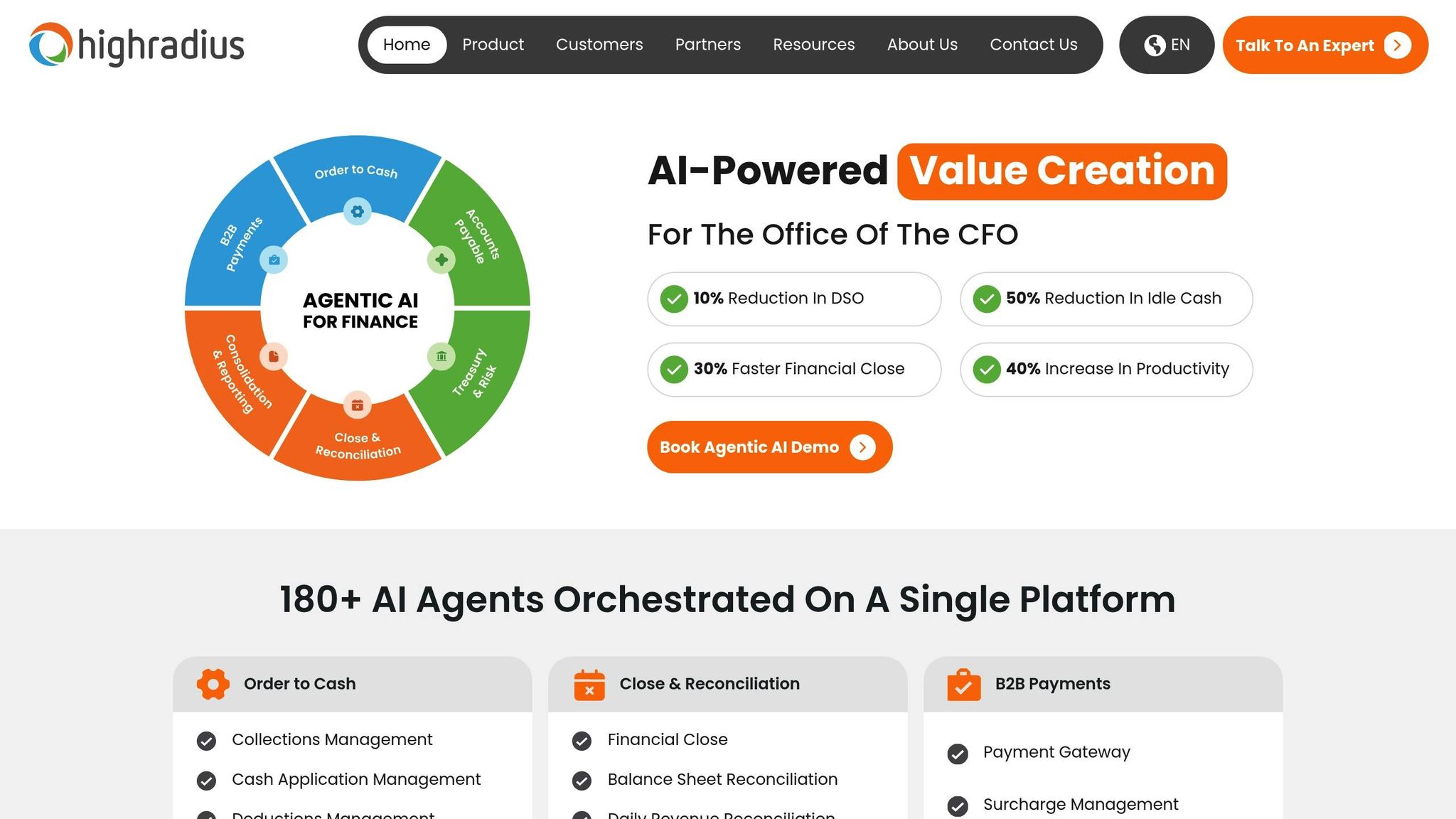
HighRadius Vendor Onboarding simplifies the vendor setup process by replacing tedious spreadsheets and endless email threads with an AI-driven workflow, reducing onboarding time by up to 70%. Built for finance and accounts payable teams, this platform is part of the HighRadius Autonomous Treasury and Finance suite. It automates tasks like data collection, validation, and approval routing while integrating fraud prevention and compliance checks to ensure secure and efficient operations.
Many U.S. enterprises, particularly large corporations and shared services centers in North America, rely on this platform to optimize their financial workflows. Forrester has highlighted HighRadius as a leader in vendor risk and compliance for large enterprises in both North America and EMEA.
Workflow Automation and Approval Routing
HighRadius uses customizable workflows to route vendor requests directly to the right internal teams, including procurement, finance, legal, and compliance. When a vendor submits information through the portal, the system automatically initiates risk and compliance checks and assigns routing based on factors like vendor type, spending levels, or risk category. For instance, a U.S. manufacturer onboarding a high-spend supplier might see the request move from accounts payable for initial data review, to legal for contract assessment, and finally to treasury for bank account verification. These automated workflows enhance visibility into each vendor’s progress and help teams quickly identify and address any delays.
Supplier Self-Service Portals and Document Management
The vendor portal allows suppliers to securely register and upload essential documents, such as tax forms, insurance certificates, and bank details. HighRadius’s AI technology validates this data in real time using external databases, cutting down on manual review and eliminating the need for email-based processes. The system also tracks document expiration dates and sends automated renewal reminders, reducing back-and-forth communication and speeding up the onboarding timeline.
Risk and Compliance Management
To ensure only low-risk vendors are activated, HighRadius integrates real-time fraud detection and bank account verification with automated compliance checks, including OFAC and PEP screenings. Vendors must pass all risk assessments before activation, which helps maintain accurate vendor master data and mitigates regulatory and financial risks.
Integration with ERP, CRM, and Sourcing Systems
HighRadius connects effortlessly with leading ERP systems like SAP, Oracle, and NetSuite through APIs, enabling seamless data transfer. Vendor information, such as names, addresses, tax IDs, and bank details, flows directly into these systems to create a unified source of truth. Once approved, vendor master data is automatically updated in core financial and procurement systems, eliminating manual data entry and streamlining procure-to-pay processes for U.S. enterprises. This seamless integration lays the groundwork for smoother financial operations.
7. SupplierGateway
SupplierGateway stands out as a robust tool for streamlining supplier onboarding and management. Designed for mid-sized to large U.S. enterprises, this cloud-based platform brings vendor data into one centralized hub, simplifying the entire onboarding process. In Blaze.tech’s 2025 roundup, it was recognized as "the best for simplified vendor onboarding", thanks to its ability to handle every phase of supplier management efficiently. The platform’s flexibility allows companies to customize questionnaires, approval workflows, and compliance checks to meet their specific needs.
Workflow Automation and Approval Routing
With SupplierGateway, onboarding becomes much smoother through automated workflows. Supplier information is routed via predefined approval pathways, removing the need for manual handovers and speeding up the process. This automation ensures that tasks like document handling and compliance checks are handled efficiently and without unnecessary delays.
Supplier Self-Service Portals and Document Management
SupplierGateway also includes a self-service portal where vendors can take charge of their onboarding. Suppliers can submit necessary information, complete questionnaires, and upload documents directly through the portal. They can even track their progress in real time. On the backend, the platform manages documents with automated validation and tracking, ensuring that all required paperwork is submitted and verified before a supplier is activated.
Risk and Compliance Management
To ensure smooth operations and mitigate risks, SupplierGateway incorporates strong risk and compliance features. It assesses supplier risk profiles before activation and automates compliance checks to confirm that vendors meet both regulatory and internal standards. For U.S. companies, this is especially valuable, as the platform includes tools to monitor supplier diversity and meet environmental, social, and governance (ESG) reporting requirements.
Integration with ERP, CRM, and Sourcing Systems
SupplierGateway easily connects with major ERP systems like SAP, Oracle, NetSuite, and Microsoft Dynamics. After vendors complete onboarding and pass approval workflows, their data is automatically synced with the ERP system, eliminating the need for duplicate entries. This integration creates a single, reliable source of supplier data, improving decision-making and operational efficiency. By uniting onboarding with broader operational workflows, SupplierGateway strengthens its role as a key tool for modern supplier management.
Feature Comparison Table
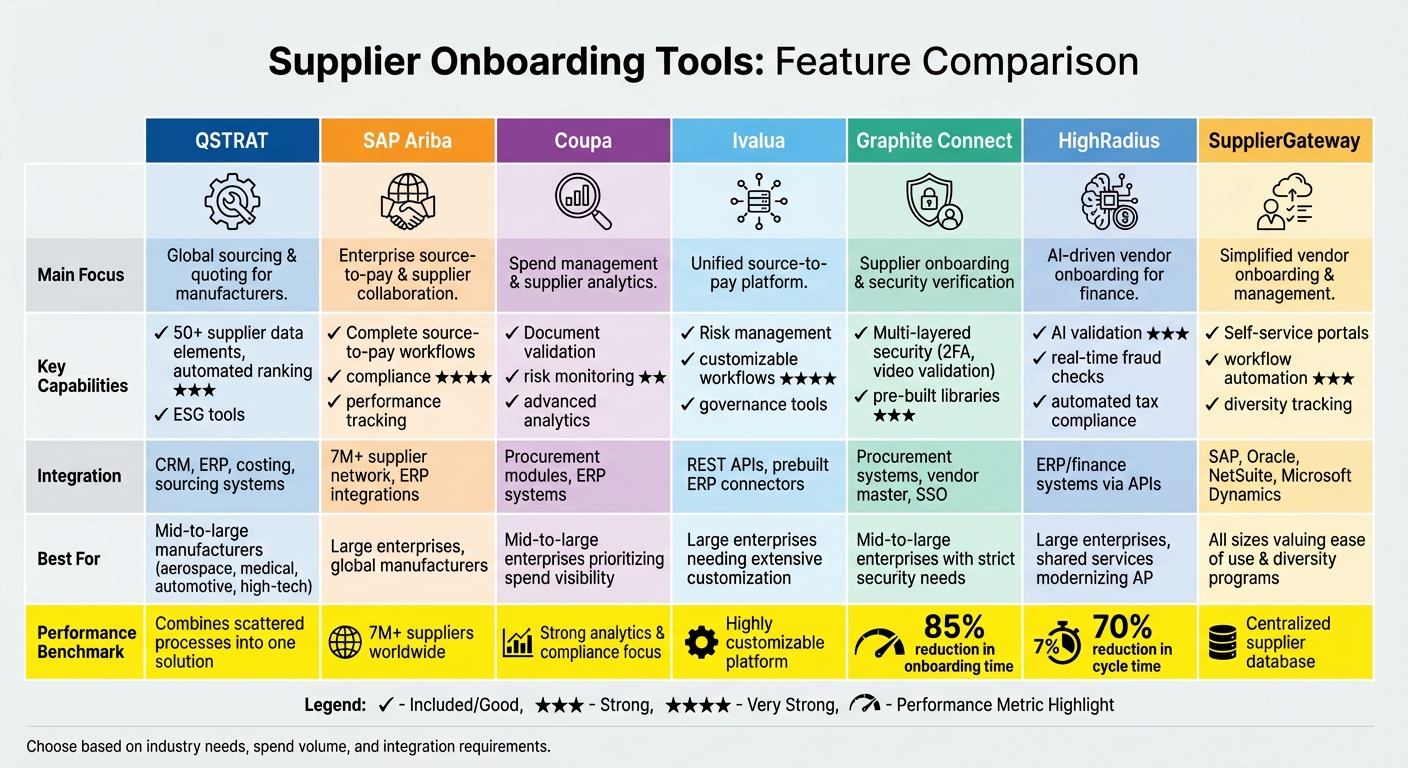
Supplier Onboarding Software Comparison: Features, Integration & Performance Benchmarks
Choosing the right supplier onboarding tool depends on your company’s size, industry requirements, and how well the tool integrates into your existing systems. Below is a comparison of seven tools, focusing on workflow automation, compliance management, and integration capabilities – key factors for U.S. manufacturers and distributors.
| Tool | Main Focus | Key Onboarding Capabilities | Integration Options | Best For | Notable Benchmark |
|---|---|---|---|---|---|
| QSTRAT | Global sourcing and quoting for manufacturers | Gathers over 50 supplier data elements during sourcing, enables streamlined submissions and two-way communication, offers automated ranking and ESG tools | Integrates with CRM, ERP, costing, and sourcing systems | Mid-to-large manufacturers and distributors in aerospace, medical devices, industrial, automotive, and high tech | Combines scattered processes into one cohesive solution |
| SAP Ariba | Enterprise source-to-pay and supplier collaboration | Offers complete source-to-pay workflows, compliance management, performance tracking, and advanced analytics | Connects to SAP Business Network with access to over 7 million suppliers, plus ERP integrations | Large enterprises and global manufacturers needing robust governance | Access to a network of 7+ million suppliers worldwide |
| Coupa | Spend management and supplier analytics | Simplifies onboarding, validates documents, monitors risks, checks compliance, and provides advanced analytics | Works with procurement modules and ERP systems | Mid-to-large enterprises prioritizing spend visibility and data-based decision-making | Strong focus on analytics and compliance |
| Ivalua | Unified source-to-pay platform | Covers risk management, performance tracking, highly customizable workflows, and governance tools | Supports REST APIs and prebuilt ERP connectors | Large enterprises needing extensive customization and unified procurement | Highly customizable and adaptable platform |
| Graphite Connect | Supplier onboarding and security verification | Features automated workflows, multi-layered security (2FA, video validation), pre-built question libraries, and Active Directory integration | Integrates with procurement systems, vendor master systems, and single sign-on | Mid-to-large enterprises with strict security and compliance demands | Reduces onboarding time by up to 85% |
| HighRadius | AI-driven vendor onboarding for finance | Provides AI-powered data validation, real-time fraud checks, automated tax compliance (W-9/W-8), and sanctions screening | Links to ERP and finance systems via APIs | Large enterprises and shared services modernizing accounts payable and finance onboarding | Cuts onboarding cycle time by up to 70% |
| SupplierGateway | Simplified vendor onboarding and management | Offers self-service portals, workflow automation, risk and compliance checks, supplier diversity tracking, and document management | Integrates with SAP, Oracle, NetSuite, and Microsoft Dynamics ERP | Suitable for organizations of all sizes that value ease of use and supplier diversity programs | Maintains a centralized supplier database |
Each tool brings unique strengths to the table. For example, QSTRAT integrates onboarding directly into sourcing and quoting, making it a powerful option for manufacturers dealing with complex supply chains. Companies like BAE leverage QSTRAT to not only compare supplier costs but also to improve quality standards.
"For BAE, QSTRAT Sourcing is much more than a great tool to compare price, labor, raw material, packaging, and transportation among our suppliers. It’s helping BAE become a better manufacturer by using QSTRAT Sourcing as a learning tool for suppliers. Through this process we are driving our quality initiatives forward."
When deciding, think about your specific needs. Do you require a manufacturing-focused solution like QSTRAT, a comprehensive enterprise platform like SAP Ariba or Ivalua, or a streamlined onboarding tool like Graphite Connect or SupplierGateway? Each option caters to different priorities, from compliance and analytics to ease of use and supplier diversity.
Conclusion
Choosing the right supplier onboarding tool requires a clear alignment between the tool’s features and your specific business needs. It’s not just about picking a well-known brand or a tool with the longest feature list. Instead, focus on factors like your industry requirements, spend volume, vendor risk levels, and internal workflows. For instance, if you’re in manufacturing, a solution like QSTRAT might be ideal for integrating sourcing, quoting, and onboarding. On the other hand, platforms like SAP Ariba or Ivalua cater to broader enterprise needs, while tools such as Graphite Connect or SupplierGateway offer more streamlined approaches.
Start by mapping your current onboarding process – from the initial supplier request to issuing the first purchase order. Identify pain points like long cycle times, manual steps, or frequent errors. Then, define your must-have requirements. These might include support for U.S. tax forms (like W-9 or W-8), TIN validation, sanctions checks, USD payment handling, and seamless integration with your existing ERP and CRM systems. Segment your suppliers by risk level to decide whether you need advanced compliance features or a simpler solution.
Modern tools can significantly reduce onboarding times. For example, HighRadius can cut cycle times by up to 70%, while Graphite Connect boasts reductions of up to 85%. These efficiencies come from automated workflows, AI-powered validation, and self-service portals, but they rely heavily on robust integration with your ERP, finance, and procurement systems.
To ensure success, document your goals – such as reducing onboarding time from 20 days to 5 or cutting manual data entry by 60%. Assemble a cross-functional team with representatives from procurement, accounts payable, IT, legal, and other key departments to validate your requirements. Use a feature comparison table to narrow down options, test tools with U.S.-specific scenarios, and conduct a pilot program with 10–20 suppliers. This trial phase helps confirm the tool’s integration and compliance capabilities, ensuring it meets your criteria.
Ultimately, think of onboarding tools as a piece of your broader supplier lifecycle strategy. The best platforms go beyond onboarding, linking data to long-term metrics like on-time delivery, quality, and total cost of ownership. By selecting a tool that evolves with your needs, you’ll build a foundation for lasting efficiency and a stronger supplier management program.
FAQs
What are the main advantages of using supplier onboarding software?
Supplier onboarding software brings a range of benefits that can change the way businesses handle their supply chains. For starters, it helps simplify supplier sourcing by automating time-consuming tasks and bringing multiple workflows into one place. This not only saves time but also conserves valuable resources.
Another advantage is its ability to improve supplier performance management. By providing actionable insights, these tools help businesses make smarter decisions and build stronger, more reliable partnerships.
With features that enhance communication among stakeholders and integrate smoothly with existing systems like ERP and CRM, the software reduces the need for manual work and helps lower operational costs. In the end, it allows businesses to work more effectively, prioritize strategic initiatives, and explore new opportunities for growth.
How do supplier onboarding tools help with compliance and managing risks?
Supplier onboarding tools are essential for maintaining compliance and reducing risks by automating critical processes and keeping records up to date. They simplify tasks like verifying supplier credentials, tracking certifications, and ensuring suppliers meet regulatory standards – minimizing the risk of non-compliance.
These tools also help businesses evaluate supplier performance and keep an eye on potential risk factors, such as financial health or adherence to ethical practices. By making these workflows more efficient, companies can establish stronger, more dependable supplier relationships while staying aligned with industry and legal requirements.
What should I look for in a supplier onboarding platform?
When choosing a supplier onboarding platform, look for tools that can simplify your sourcing process, make it easier to create accurate quotes, and enable you to monitor supplier performance efficiently. It’s essential to pick a platform that works well with your existing systems – like CRM, ERP, or costing tools – to keep everything running smoothly.
You’ll also want to ensure the platform meets your industry’s specific requirements, whether that’s compliance standards or performance tracking features. The right platform can help you save time, minimize mistakes, and strengthen your relationships with suppliers.
Related Blog Posts
You may also like

Top 7 Tools For Supplier Relationship Management
Compare seven SRM platforms by features, integrations, and scalability to find the right supplier management solution.

Supplier Certification: Why It Matters for Compliance
Supplier certification is a strategic safeguard that prevents regulatory breaches, supply disruptions, and reputational damage.