


Manual vs. Automated Quote Generation: Which is Better?
Generating quotes is a critical part of manufacturing that affects profitability and customer relationships. But here’s the problem: manual processes are slow, prone to errors, and cost businesses time and money. On the other hand, automated systems offer faster, more accurate results by integrating tools like CRM and ERP software.
Key Takeaways:
- Manual quoting: Relies on spreadsheets and emails. Slower, with 15% error rates and lost revenue.
- Automated quoting: Uses software to cut turnaround times by up to 90%, reduce errors by 49%, and streamline workflows.
Quick Comparison:
| Factor | Manual | Automated |
|---|---|---|
| Time to Quote | 24+ hours for most | Minutes to seconds |
| Error Rate | 15% pricing errors | 49% fewer order errors |
| Scalability | Limited by staff capacity | Handles growth seamlessly |
| Revenue Impact | 5% annual revenue loss | Improved margins |
Manual quoting struggles to keep up in today’s fast-paced market. Automation addresses inefficiencies, helping manufacturers save time, reduce errors, and stay competitive.
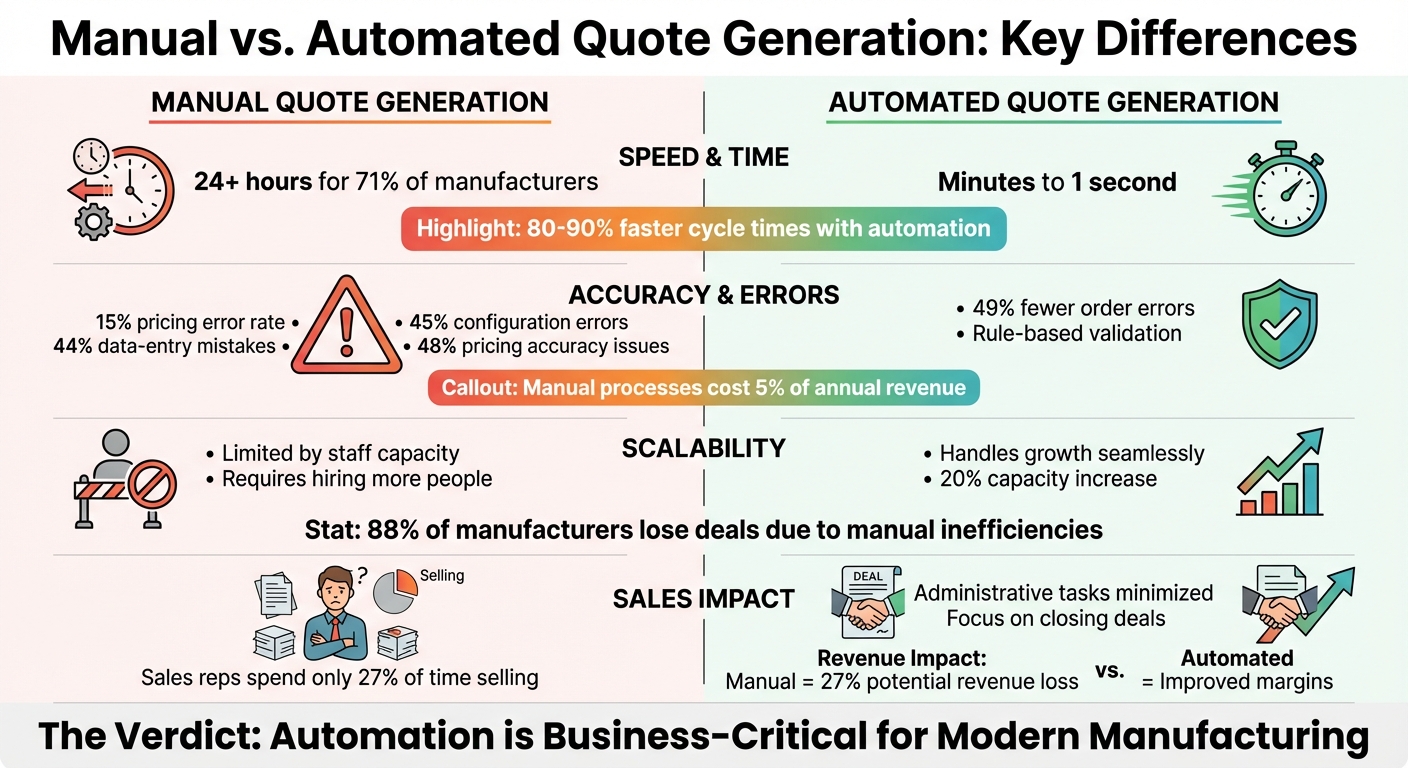
Manual vs Automated Quote Generation: Speed, Accuracy, and Cost Comparison
How 80/20 Automation Can Help Your Machine Shop Quote Faster
What is Manual Quote Generation?
Manual quote generation refers to the traditional method of creating price proposals using manual processes and basic tools like spreadsheets, emails, and disconnected CRM or ERP systems. While it gets the job done, this approach is often slow, error-prone, and inefficient.
Here’s how it typically works: Teams start by gathering customer profiles, product details, and inventory data from various systems. For complex products, they manually select components or modules, checking for technical compatibility along the way. Then, they calculate costs, apply discounts, and determine tiered pricing for each quote. Once all the data is compiled, sales reps prepare and send the final documents for approval. This step-by-step process may seem straightforward, but it’s riddled with inefficiencies.
The numbers tell the story. Around 15% of manual quotes contain pricing errors, and companies risk losing up to 27% of potential revenue due to slow turnaround times and inconsistent pricing. Paul Stone, Product Evangelist at FlowForma, puts it bluntly:
"Manual quote generation transforms what should be swift revenue opportunities into frustrating bottlenecks – sales reps spend hours crafting quotes instead of closing deals".
The challenges only grow as businesses scale or deal with complex supplier data. Expanding product catalogs often overwhelm spreadsheets, creating data silos where critical information is stored in individual employees’ memories rather than accessible systems. Robert Baran, President of PositiveVision, highlights the risk:
"When key information exists only in memory, a single absence can spell disaster".
Scaling manual processes usually means hiring more staff, which limits capacity and increases costs. For manufacturers managing intricate configurations or frequent price updates, this approach often results in pricing inconsistencies and missed opportunities for cross-selling. The problem is especially pronounced in regulated industries like aerospace and medical devices. In fact, 53% of manufacturers in these fields report that manual quoting struggles to align with complex approval processes, while 44% cite data-entry errors as a significant business challenge.
This outdated, cumbersome process underscores the growing need for automation. By streamlining workflows, automated systems can deliver faster, more accurate, and scalable solutions. Up next, we’ll dive into how automation tackles these issues head-on.
What is Automated Quote Generation?
Automated quote generation flips the script on the inefficiencies of manual quoting. Instead of relying on time-consuming processes, it uses software to capture customer requirements, apply business rules, and produce detailed quotes in just minutes. By pulling data from CRM, ERP, and sourcing systems, it centralizes everything you need in one place. The process typically involves three main steps: configuration (selecting product options based on engineering standards and inventory), pricing (calculating costs, discounts, and margins using real-time data), and quoting (creating a professional, branded document with technical details like Bills of Materials or CAD drawings).
One of the standout benefits is how seamlessly it integrates with other systems. By connecting CRM, ERP, and sourcing tools, it eliminates data silos. For example, when a sales rep creates a quote, the system instantly validates configurations against engineering standards, applies pricing rules, and sends the quote through automated approval workflows. These workflows can factor in things like discount thresholds or margin requirements, ensuring quotes are processed faster and more accurately.
The difference is staggering. While 71% of manufacturers still take at least a full day to generate a manual quote, automation powered by AI can slash quote and reorder cycle times by as much as 80% to 90%. Brenda Nobleza, Vice President of Channel Solutions at Epicor, highlights the urgency of adopting this technology:
"AI-enabled quoting and buying experiences aren’t nice-to-have features – they’re business-critical. The data clearly shows that manufacturers clinging to manual processes are losing real revenue".
But it’s not just about speed. Automation also tackles accuracy, a common pain point in manual quoting. Automated systems drastically reduce errors in pricing calculations and data entry. In fact, companies using quote automation report 49% fewer order errors. That’s a big deal when you consider that 44% of manufacturers cite data-entry mistakes as a major reason why manual quotes fail to close deals. Additionally, these systems can automatically generate production-ready Bills of Materials, ensuring the products being sold can actually be built. For manufacturers dealing with complex configurations, guided selling tools – like interactive questionnaires or decision trees – help capture every critical detail.
Ultimately, automated quote generation delivers a faster, more reliable process that scales effortlessly. It solves the bottlenecks of manual quoting, making it a game-changer for businesses looking to grow without increasing overhead.
sbb-itb-827f251
Key Differences Between Manual and Automated Quote Generation
Speed and Time Savings
Manual quoting is a slow and often cumbersome process. In fact, 71% of manufacturers using manual methods need at least a full day to generate a single quote. In contrast, automated systems can produce quotes in mere minutes – or even seconds. Some advanced autonomous commerce solutions boast response times as quick as 1 second for price and availability inquiries. With AI-driven tools, quote and reorder cycle times can be reduced by an impressive 80% to 90%.
This kind of efficiency allows sales teams to focus more on closing deals rather than getting bogged down in administrative tasks.
| Metric | Manual Quote Generation | Automated Quote Generation |
|---|---|---|
| Turnaround Time | 24+ hours for 71% of manufacturers | Minutes to 1 second |
| Sales Rep Focus | Only 27% of time spent selling | High; administrative tasks minimized |
| Cycle Reduction | Baseline | 80–90% faster cycle times |
Next, let’s explore how automation improves accuracy and reduces costly errors.
Accuracy and Error Reduction
Speed is just one part of the equation – accuracy is equally important. Manual quoting often leads to errors that can derail deals. For instance, 44% of manufacturers blame data-entry mistakes for failed quotes. Configuration errors are also common, with 45% reporting mismatches with customer requirements, and 48% struggling with pricing flexibility and accuracy. As Robert Baran, President of PositiveVision, explains:
"One small error during quoting can snowball into thousands of dollars of dead inventory".
Automated systems address these issues by using rule-based validation and real-time data integration. Instead of relying on outdated spreadsheets or human memory, automated tools ensure technical compatibility and pull up-to-date pricing directly from ERP systems. The results? Companies using automation report 49% fewer order errors. For manufacturers, manual quoting processes can cost an average of 5% of their annual revenue due to errors and inefficiencies.
| Error Type | Manual Process Impact | Automated Solution |
|---|---|---|
| Data Entry | Cited as deal-killer by 44% of firms | Eliminated via system integration |
| Configuration | 45% report misalignment with requirements | Rule-based validation prevents errors |
| Pricing | 48% lack pricing flexibility/accuracy | AI-driven dynamic pricing optimization |
| Approvals | 53% struggle with complex approval loops | Automated multi-level routing |
Scalability and Cost Impact
Manual quoting processes inherently limit scalability because they rely on staff availability. Handling an increased volume of quotes manually means hiring more people – a solution that’s both slow and expensive. Automated systems eliminate this bottleneck, enabling companies to scale effortlessly, even during demand surges. Without automation, manual processes often create backlogs, leading to errors and missed opportunities.
The stakes are high: 88% of manufacturing decision-makers report losing deals due to inefficiencies in manual processes. Beyond lost sales, manual quoting contributes to revenue loss through margin erosion, excess inventory, and poor demand forecasting. Brenda Nobleza, Vice President of Channel Solutions at Epicor, sums it up:
"AI-enabled quoting and buying experiences aren’t nice-to-have features – they’re business-critical. The data clearly shows that manufacturers clinging to manual processes are losing real revenue".
Why Automated Quote Generation Works Better for Manufacturers: QSTRAT Features
As manufacturers move away from error-prone manual processes, automation tools like QSTRAT are stepping in to deliver greater efficiency and accuracy. Here’s how QSTRAT’s features make a difference.
Supplier Sourcing and Quoting Automation
QSTRAT’s cloud-based platform revolutionizes the way manufacturers manage supplier relationships and generate quotes. By connecting directly with your existing CRM and ERP systems, it pulls real-time data on material costs, inventory levels, and customer-specific pricing – eliminating the need for manual data collection.
For industries like aerospace, medical devices, automotive, and high tech – where precision and compliance are non-negotiable – QSTRAT integrates engineering rules and manufacturing constraints directly into the quoting process. This ensures that every quote aligns with regulatory and production standards, reducing the risk of costly errors from technically infeasible bids. The platform also tracks supplier performance, providing insights into quality, pricing consistency, and lead times.
With two-way communication tools, QSTRAT keeps vendors and stakeholders on the same page through real-time updates, cutting out the back-and-forth of emails and phone calls. This streamlined approach not only saves time but also sets the foundation for robust error prevention.
Centralized Workflows and Error Prevention
QSTRAT acts as a single source of truth for your entire quoting operation, capturing institutional knowledge in one centralized platform. This makes it easier for any team member to generate accurate, consistent quotes.
Using rule-based configuration engines, the system prevents mismatched configurations while dynamically creating Bills of Materials (BoMs) based on selected options. This ensures that sales quotes are perfectly in sync with production capabilities.
Approval workflows are automated within the platform, routing pricing and discount requests to ensure they meet company policies and margin guidelines. A study shows that 43% of tasks related to quote configuration, pricing, and approvals can be automated with today’s technology – a challenge QSTRAT effectively addresses. By centralizing these processes, the platform not only ensures consistency but also enables businesses to scale their operations while gaining actionable insights.
Scalability and Data-Driven Decision Making
Thanks to its cloud-based design, QSTRAT easily scales to handle fluctuating demand and seasonal spikes without requiring additional staff. This eliminates the bottlenecks that often occur during busy periods. Research indicates that automation can increase capacity by 20%, while early adopters often see efficiency improvements of 10% to 15% and a potential sales boost of up to 10%.
QSTRAT also equips manufacturers with decision-support tools that provide real-time analytics on quoting performance, win rates, and margin trends. Instead of relying on outdated data or guesswork, you can use live insights to refine pricing strategies and identify profitable product configurations or customer segments. The platform’s cost-driver tools shed light on margin impacts, making negotiations more strategic.
For manufacturers managing complex supply chains, QSTRAT’s centralized data ensures that finance, sales, and engineering teams are always working with the same up-to-date information. This eliminates silos and reduces the risk of version control issues, creating a more cohesive and efficient operation.
Conclusion: Moving to Automated Quote Generation
Relying on manual quoting isn’t just time-consuming – it actively drains revenue in a market where speed is everything. When customers expect near-instant responses and manufacturers face delays, sticking to outdated methods puts businesses at a clear disadvantage.
Automated quote generation changes the game. It cuts turnaround times from days to seconds, ensures accurate pricing through rule-based logic, scales effortlessly without increasing staff, and provides centralized data for smarter decision-making. As buyers demand faster service, the gap between manual inefficiency and automated precision becomes impossible to ignore.
"AI-enabled quoting and buying experiences aren’t nice-to-have features – they’re business-critical. The data clearly shows that manufacturers clinging to manual processes are losing real revenue." – Brenda Nobleza, Vice President of Channel Solutions, Epicor
This is where solutions like QSTRAT come in.
QSTRAT’s cloud-based platform tackles these challenges by combining supplier sourcing, quoting automation, and performance management into one streamlined system. For manufacturers in industries like aerospace, medical devices, automotive, and high tech – where precision and compliance are essential – QSTRAT ensures every quote incorporates real-time data, engineering constraints, and regulatory requirements.
Best of all, adopting QSTRAT doesn’t mean overhauling your existing systems. It integrates seamlessly with your current CRM and ERP tools, letting you modernize your quoting process without disrupting daily operations. Discover QSTRAT at https://qstrat.com to see how automation can help you recover lost revenue, speed up response times, and drive long-term growth.
FAQs
What are the key benefits of using automated quote generation instead of manual methods?
Automated quote generation brings a level of speed, precision, and scalability that manual processes just can’t compete with. With this technology, manufacturers can produce accurate and consistent quotes in a matter of minutes, cutting down on human errors and avoiding the delays often caused by manual data entry.
It’s also perfect for handling large volumes of quotes without compromising on quality, making it a game-changer for businesses on the rise. By automating these repetitive tasks, sales teams have more time to focus on what really matters – nurturing customer relationships and sealing deals – leading to improved efficiency and stronger profitability.
How does automated quote generation work with CRM and ERP systems?
Automated quote generation works hand-in-hand with CRM and ERP systems, making workflows smoother and cutting down on manual tasks. By linking directly to these platforms, it pulls in key details like customer profiles, pricing rules, discount structures, and inventory levels. This ensures every quote is not only accurate but also reflects the most current business data.
Once a quote is created, it’s automatically updated in the CRM as a new opportunity or a completed deal. Meanwhile, the ERP system can reserve inventory or initiate production orders. This integration eliminates the hassle of duplicate data entry, reduces errors, and significantly speeds up the quoting process.
QSTRAT’s cloud-based quoting software takes this a step further by syncing product catalogs, supplier performance data, and pricing rules. It ensures quotes are precise, formatted to U.S. standards (like $12,345.67 or Oct 15, 2025), and ready for imperial measurements when necessary. With QSTRAT, manufacturers can shift from handling a handful of manual quotes to generating thousands of automated, accurate proposals every day.
Which industries benefit the most from automated quote generation?
Industries such as industrial equipment, medical devices, specialty vehicles, HVAC systems, electrical and electronics, power generation, and pumps and valves manufacturing benefit greatly from automated quote generation.
By automating the quoting process, these industries can boost efficiency, accuracy, and scalability – all crucial for managing intricate products, high volumes, and strict deadlines. This streamlined approach allows manufacturers to meet customer expectations more effectively while staying competitive in rapidly evolving markets.
Related Blog Posts
You may also like

Automotive Quoting Software: Features to Look For
Key features for faster, accurate automotive quoting: ERP/CRM integration, RFQ automation, supplier performance, configurable rules, and cloud collaboration.

Supplier Escalations: Managing Critical Issues
Practical framework to detect, escalate, and resolve supplier quality, delivery, and contract issues with thresholds, escalation matrix, KPIs and docs.