

Best Practices for Supplier Qualification in Aerospace
- December 15, 2025
- 13 Mins Read
- 8762 Views

Supplier qualification is non-negotiable in aerospace. A single faulty part can lead to grounded fleets, safety risks, and compliance issues. Here’s what you need to know:
- Why It Matters: Supplier-related defects account for 30–50% of quality issues in aerospace. Adhering to standards like AS9100 Rev D ensures safety, quality, and regulatory compliance.
- Key Challenges: Managing ITAR/EAR compliance, avoiding counterfeit parts, and overseeing multi-tier supplier networks are critical concerns.
- Standards to Follow: AS9100 Rev D, AS9120B, and AS9133A guide supplier evaluation, monitoring, and requalification.
- Risk-Based Approach: Classify suppliers by risk (e.g., critical vs. non-critical components) and apply tailored qualification methods.
- Performance Monitoring: Use scorecards to track quality, delivery, and compliance. High-risk suppliers require frequent audits and reviews.
- Digital Tools: Platforms like QSTRAT centralize data, automate workflows, and improve supplier management.
Bottom Line: Aerospace supply chains demand rigorous processes to ensure safety and reliability. Combining structured qualification methods with digital tools helps reduce risks and maintain high standards.
Aerospace Standards and Regulatory Requirements
Core Aerospace Standards Overview
Aerospace supplier qualification revolves around three key standards: AS9100 Rev D, AS9120B, and AS9133A. Each one addresses a specific part of the aerospace supply chain.
AS9100 Rev D serves as the cornerstone quality management system for aerospace manufacturers. It sets strict guidelines for evaluating suppliers based on quality certifications, past performance, and risk assessments. These evaluations are validated through audits and ongoing performance monitoring, such as tracking defect rates and on-time delivery. Additionally, this standard requires that quality, safety, and regulatory requirements are passed down the supply chain, creating a risk-based approach for both initial supplier selection and continuous oversight.
AS9120B focuses on distributors of aerospace commodity items. It mandates a documented quality management system that emphasizes proper handling, storage, traceability, and measures to prevent counterfeit parts. Distributors must ensure traceability to the original manufacturer and verify that their suppliers for special processes meet standards like ISO 9001, AS9100, or AC7004 (PRI-Nadcap).
AS9133A outlines a standardized process for qualifying aerospace standard products used in aviation, space, and defense. By establishing clear qualification principles, this standard ensures that products meet stringent performance and safety benchmarks before they are incorporated into larger assemblies. These standards serve as a foundation for OEMs and Tier 1 suppliers, who often build upon them with additional, customized requirements.
OEM and Tier 1 Supplier Requirements
OEMs and Tier 1 suppliers expand on these standards through detailed quality manuals, such as RTX/Pratt & Whitney’s ASQR-01. These manuals enforce compliance with ISO 9001 and AS9100, require Nadcap accreditation for special processes, and demand close monitoring of key metrics like on-time delivery and defect rates. Suppliers already approved by an OEM’s customer can often be added to that customer’s approved supplier list, provided they maintain compliance and meet performance expectations.
To streamline processes, delegated inspection programs – such as DPRV (Delegated Product Release Verification), also known under names like DSQR, SARA, SRP, DQR, or DQCR – allow qualified suppliers to ship products without additional inspections. These programs require standardized training, typically through a three-day course covering documentation review, visual and dimensional inspection, part marking, and release requirements. Suppliers are also subject to periodic audits and must recertify every three years. Probitas Authentication oversees these programs, ensuring consistency and reducing inspection demands while maintaining flight safety.
OEMs and Tier 1 suppliers use these extended requirements to focus on certified, high-performing suppliers. Continuous monitoring is conducted through performance scorecards, and non-compliance can lead to corrective actions like Supplier Corrective Action Requests (SCARs), probation, or even removal from approved supplier lists. For instance, Carl Zeiss’s Strategic Sourcing team uses QSTRAT Sourcing to collect more than 50 data points from qualified suppliers during the bidding process. This data supports thorough evaluations, particularly during New Product Development and Engineering Change processes.
Common Pitfalls in Aerospace Certification
Risk-Based Supplier Qualification Methods
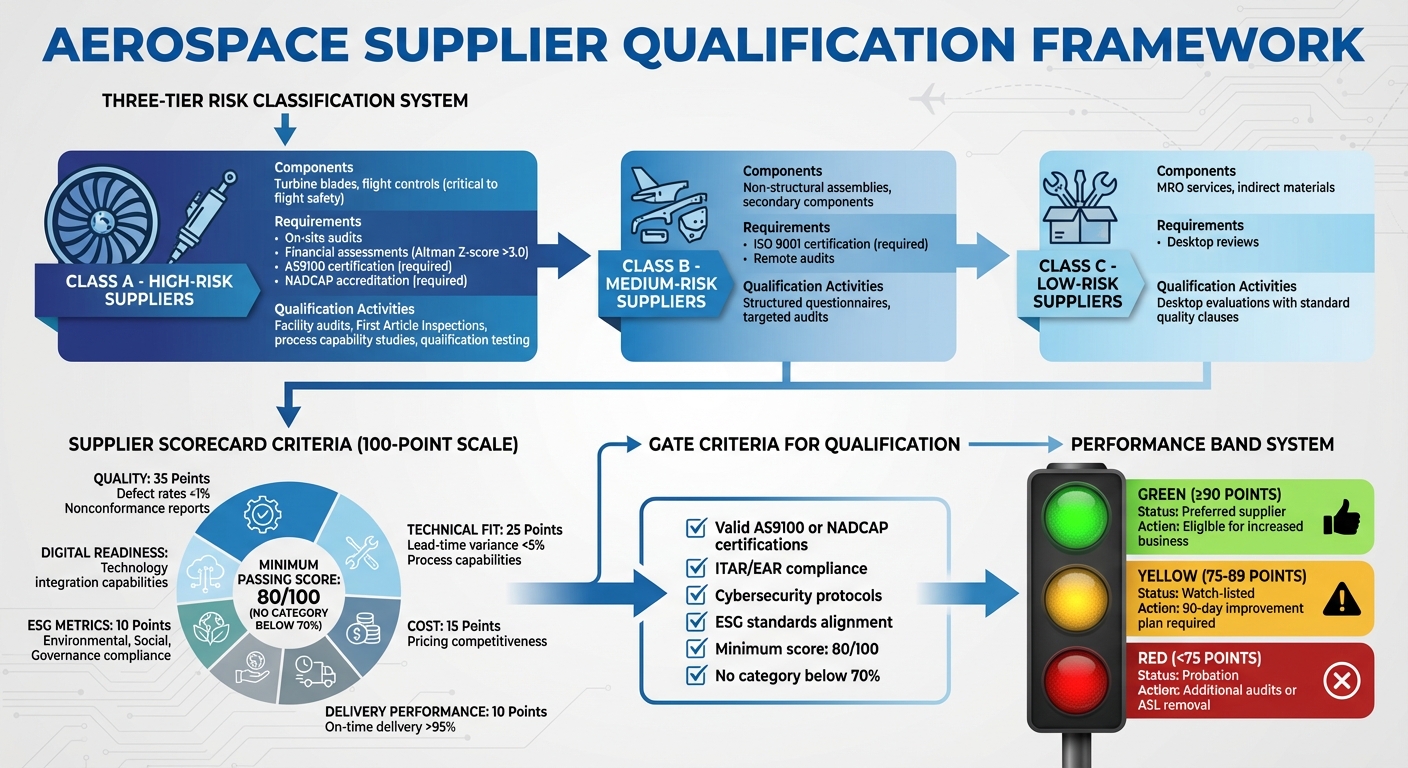
Aerospace Supplier Qualification Framework: Risk Tiers and Evaluation Criteria
Setting Up Risk Tiers and Gate Criteria
Organizing suppliers into risk tiers based on the criticality of parts or processes is a key practice in supplier qualification. This method, required by AS9100 Rev D, ensures that the most stringent controls are applied to suppliers whose components are vital to flight safety, product quality, and uninterrupted delivery.
A typical three-tier system includes:
- Class A: High-risk items, such as turbine blades or flight controls, demand the most rigorous scrutiny. These suppliers undergo on-site audits, financial assessments (e.g., Altman Z-scores above 3.0 for financial stability), and must hold certifications like AS9100 and NADCAP.
- Class B: Suppliers of non-structural assemblies, like secondary components, need ISO 9001 certification and are subjected to remote audits.
- Class C: Providers of MRO (Maintenance, Repair, and Overhaul) services and indirect materials are evaluated through desktop reviews.
Gate criteria for supplier qualification include valid AS9100 or NADCAP certifications, compliance with ITAR/EAR regulations, adherence to cybersecurity protocols, and alignment with ESG standards. Suppliers must achieve a minimum score of 80 out of 100, with no individual category falling below 70%.
The level of qualification activities varies by risk tier:
- High-risk suppliers face extensive evaluations, including facility audits, First Article Inspections, process capability studies, and qualification testing.
- Medium-risk suppliers complete structured questionnaires and undergo targeted audits.
- Low-risk suppliers are assessed through desktop evaluations paired with standard quality clauses in contracts.
This structured, tier-based approach ensures supplier selection is both objective and data-driven.
Using Data for Supplier Selection
Once suppliers are categorized by risk tiers, data-driven scorecards help refine the selection process. These scorecards provide measurable and objective evaluations. For example, an aerospace supplier scorecard might allocate points across several weighted criteria:
- Quality: 35 points (e.g., defect rates under 1%)
- Technical fit: 25 points (e.g., lead-time variance below 5%)
- Cost: 15 points
- Delivery performance: 10 points (e.g., on-time delivery above 95%)
- ESG metrics: 10 points
- Digital readiness: 5 points
Digital tools can further streamline this process. For example, QSTRAT Sourcing enables organizations to gather over 50 data points during the bidding phase, supporting evaluations from pilot runs to full-scale production.
"For BAE, QSTRAT Sourcing is much more than a great tool to compare price, labor, raw material, packaging, and transportation among our suppliers. It’s helping BAE become a better manufacturer by using QSTRAT Sourcing as a learning tool for suppliers. Through this process we are driving our quality initiatives forward." – QSTRAT Client
Supplier evaluations often rely on key performance indicators (KPIs) such as defect rates, on-time delivery, corrective action cycle times, financial health, and ESG compliance. Weighting methods like AHP (Analytic Hierarchy Process) or DEA (Data Envelopment Analysis) ensure a repeatable and auditable selection process. This combination of quantitative data and structured methodologies leads to consistent and informed supplier decisions.
sbb-itb-827f251
Supplier Performance Management Practices
Supplier Scorecards and Performance Metrics
Once a supplier is qualified, ongoing monitoring becomes a priority. A well-designed scorecard – often based on a 100-point scale – helps track critical metrics required by AS9100 standards.
Here’s a typical breakdown of the scoring system:
- 35–40 points: Quality metrics like defect rates and nonconformance reports.
- 25–30 points: On-time delivery performance.
- 10–15 points: Responsiveness to issues or inquiries.
- 10–15 points: Cost performance.
- 5–10 points: Compliance and ESG (Environmental, Social, and Governance) factors.
Suppliers must maintain a passing score, and any underperformance triggers a 90-day improvement plan.
The frequency of performance reviews depends on the supplier’s risk level:
- High-risk suppliers: Monthly or quarterly reviews.
- Medium-risk suppliers: Quarterly or semi-annual reviews.
- Low-risk or indirect suppliers: Annual reviews or as needed.
This tiered review system ensures resources are focused where they matter most, particularly in areas affecting product safety and regulatory compliance.
Many aerospace companies use performance bands to guide actions:
- Green (≥90 points): Preferred suppliers eligible for more business.
- Yellow (75–89 points): Watch-listed suppliers requiring improvement plans.
- Red (<75 points): Suppliers placed on probation, subject to additional audits, or removed from the Approved Supplier List (ASL).
Digital tools like QSTRAT simplify this process by centralizing ERP and quality data, automating scorecard calculations, and providing real-time updates.
When scorecards reveal clear performance gaps, suppliers may face requalification reviews or corrective measures, as outlined below.
Requalification and Corrective Actions
Aerospace suppliers are typically requalified every one to three years to ensure they continue meeting required standards. However, requalification becomes mandatory under specific circumstances:
- Certification lapses (e.g., AS9100, NADCAP).
- Major process or facility changes.
- Extended inactivity (12–24 months without orders).
- Significant quality issues or repeated corrective action requests.
The requalification process involves updated risk assessments, quality system evaluations, on-site or remote audits, and validation of special processes. Based on the results, suppliers may receive full approval, conditional approval with an improvement plan, or removal from the ASL.
For addressing nonconformances, the SCAR (Supplier Corrective Action Request) process is key. This structured approach includes:
- Immediate containment and risk assessment for affected products.
- Root cause analysis using tools like 5-Why or fishbone diagrams.
- Development of corrective and preventive actions with clear responsibilities and deadlines.
- Implementation and verification to ensure the issue doesn’t recur.
For example, The Hope Group‘s Aerospace Supplier Quality Requirements Manual outlines that suppliers failing to meet performance standards may receive a SCAR, undergo an on-site audit, be placed on probation, or even be removed from the ASL. Tracking SCAR closure times and recurrence rates helps ensure accountability and supports ongoing improvement efforts.
Digital Tools for Supplier Qualification
Benefits of Cloud-Based Supplier Management
Relying on manual processes for supplier qualification in the aerospace industry comes with a hefty risk. Cloud-based platforms step in to solve this, acting as a centralized hub where all team members access the same, up-to-date information. This eliminates the confusion of conflicting data versions and ensures everyone works from a consistent, approved supplier list. Such digital tools align seamlessly with the stringent supplier evaluation practices already in place.
Another big advantage? These platforms make audit preparation much easier. Teams can quickly generate reports on approved suppliers, risk levels, performance scorecards, and ongoing evaluations whenever needed. Plus, version-controlled records provide clear traceability for approvals and requalification decisions, which is a critical requirement under AS9100 standards.
Automation plays a key role as well. These systems send reminders before deadlines approach, ensuring compliance doesn’t fall through the cracks. Features like mandatory fields and validation rules help maintain uniform records across multiple locations, cutting down on data entry errors that auditors might flag. For aerospace manufacturers operating across different states, cloud platforms also allow consistent access to standardized workflows, enabling seamless supplier qualification – even when multiple facilities share suppliers.
How QSTRAT Supports Supplier Qualification
QSTRAT takes supplier qualification a step further by combining established best practices with integrated operational data. Its cloud-based platform streamlines supplier qualification by incorporating sourcing and quoting tools. This centralized system organizes RFQs, pricing details, and supplier responses, making it easier for aerospace teams to identify suppliers who meet the required criteria for new parts. Factors like capabilities and historical performance are all considered. The platform’s automated workflows handle everything from issuing RFQs to comparing quotes and awarding contracts, helping buyers assess suppliers based on price, lead time, capacity, and quality.
One standout feature of QSTRAT is its ability to integrate with ERP, CRM, and costing systems. This means awarded quotes can be converted directly into purchase orders without manual data entry, reducing errors and speeding up the process. The platform also links to costing tools, allowing teams from engineering, finance, and supply chain departments to evaluate total landed costs – including unit price, logistics, and risk – before making final decisions. This “digital thread” connects supplier selection and quoting decisions to program profitability and on-time delivery, empowering teams with data-driven insights.
QSTRAT doesn’t stop there. It tracks key supplier performance metrics such as quote turnaround times, price consistency, and adherence to commercial terms. These metrics complement quality and delivery data from ERP or QMS systems. By combining this performance data, QSTRAT enables structured supplier reviews, helping teams make informed decisions about increasing, maintaining, or reducing supplier allocations based on solid evidence.
Conclusion
Supplier qualification in the aerospace industry plays a crucial role in ensuring flight safety, maintaining product integrity, and keeping the supply chain dependable. The strategies discussed here – like risk-based evaluations, performance scorecards, regular requalification, and corrective actions – are designed to tackle some of the industry’s toughest challenges. When suppliers fail to meet standards, it can jeopardize safety and lead to regulatory consequences.
To strengthen these practices, the industry is increasingly adopting digital tools to enable seamless, data-driven supplier management. By implementing tiered risk classifications for critical components, weighted scoring systems that emphasize quality (often at 35% or higher), and real-time monitoring of key metrics like defect rates and on-time delivery, aerospace manufacturers are creating a proactive system that catches potential problems before they escalate to production.
Digital tools are a game-changer for these structured, risk-based frameworks. Cloud-based platforms eliminate manual errors and version control issues common in spreadsheets, while automated workflows ensure that critical tasks aren’t overlooked. For instance, QSTRAT’s platform integrates sourcing, quoting, and performance management into one system, addressing the daily challenges aerospace teams face. By connecting qualification data with ERP, CRM, and costing systems, manufacturers can make informed decisions about supplier allocation and risk management.
Aerospace is an inherently complex field, and good intentions alone aren’t enough. It requires disciplined processes, clear criteria, and constant oversight. This unified approach equips aerospace teams with the tools they need to uphold rigorous standards and build resilient supply chains.
FAQs
What are the biggest challenges in qualifying suppliers for aerospace projects?
Qualifying suppliers in the aerospace industry comes with its fair share of challenges. First and foremost, there’s the need to meet strict industry regulations, which demand unwavering attention to detail. On top of that, maintaining exceptional quality and performance standards is non-negotiable, given the high stakes involved in aerospace operations.
Another hurdle is assessing a supplier’s capabilities. This often means diving into extensive data collection and conducting thorough evaluations to ensure they meet the necessary benchmarks. Then there’s the task of integrating supplier management processes into existing systems – a process that can be tricky but is absolutely essential for smoother operations and long-term reliability.
How can digital tools improve supplier qualification in the aerospace industry?
Digital tools have transformed supplier qualification processes in aerospace by automating essential tasks, improving communication, and simplifying performance management. These tools enable efficient data collection, real-time analysis, and benchmarking, helping organizations make smarter decisions while staying compliant with industry standards.
By pulling data from various systems like CRM, ERP, and sourcing platforms, these tools offer a unified view of supplier performance. This centralized approach speeds up evaluations, optimizes cost management, and enhances quality control – key priorities in the aerospace industry.
How do risk tiers help in evaluating suppliers?
Risk tiers are a way to categorize suppliers based on how much risk they pose and how they might impact your operations. This system allows businesses to streamline their evaluation processes, keep a closer eye on supplier performance, and implement specific measures to minimize the risk of supply chain disruptions.
Focusing on high-risk suppliers ensures that companies can uphold compliance, maintain quality standards, and protect themselves from unexpected challenges that might derail production schedules or increase costs.
Related Blog Posts
You may also like

Top 7 Tools For Supplier Relationship Management
Compare seven SRM platforms by features, integrations, and scalability to find the right supplier management solution.

Supplier Certification: Why It Matters for Compliance
Supplier certification is a strategic safeguard that prevents regulatory breaches, supply disruptions, and reputational damage.